case studies
Calculating and Creating a Marketing Budget: A Beginner's Guide
The phrase “marketing budget” makes even the most experienced marketers groan.
Putting together a marketing budget is traditionally a very painful affair because it’s just not something that marketers are trained for.
We are taught how to choose the perfect action verb, the right Call To Action (CTA) color, or the ideal meme, but for some reason, no one ever trains us on budgeting.
And as a result, 50% of SMBs don’t even bother to make a marketing budget according to OutboundEngine’s research.
But we have good news for you: marketing budgets don’t have to be that hard. 💵💵💵
With the right practices, you can come up with a solid budget for your marketing initiatives. Read on to discover how to do just that.
What is a marketing budget?
A marketing budget outlines your planned marketing spend during a chosen time frame, typically a year or quarter. The budget will include things like the cost of your marketing employees’ salaries, software used specifically for marketing purposes, advertising, and other activities.
The budget provides visibility for leadership into the marketing team’s spend and helps the marketing team stay on track financially throughout the given time frame.
Step 1. Determine Your Total Budget Spend
Before you can start to allocate funds, you need to know how much total funds there are to allocate. There are a few ways to determine how much cash you need to spend over the year or quarter.
How to figure out your goal-based spend
You can use a simple formula to determine your goal-based spend:
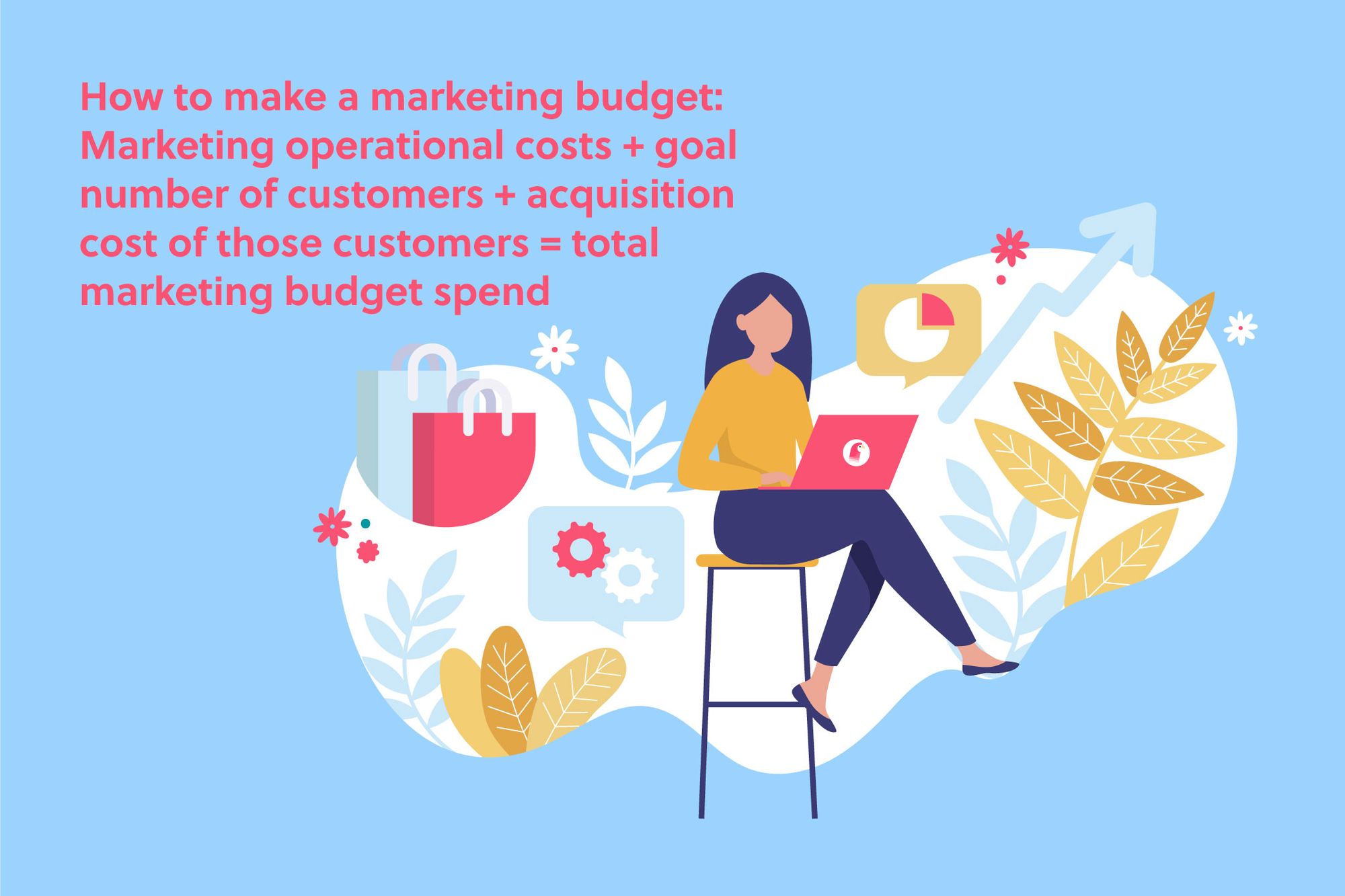
Marketing Operational Costs + (Goal Number * Goal Acquisition Costs) = Total Budget Spend
Marketing operational costs are the costs required to run your marketing initiatives. Things like marketing staff’s salary, software, and certification costs get accounted for here.
After that, you need to take your goal(s) into account. For instance, you have a goal of converting 100 new customers in the next year. That’s your goal number. To determine how much that costs, you multiply it by your customer acquisition cost, either ideal or historic average. So if your average CAC is $10, your planned spend for your conversion goal is $100.
For a team with a $10,000/year operational expense, their marketing budget would therefore be $11,000. ($10,000 + (100 * $1000) = $11,000.)
Step 2. Allocate the Budget
Once you’ve determined your total spend, it’s time to allocate the funds to specific things.
The first thing to allocate is your operational expenses. This is especially true if your total spend was chosen by a method other than goal-based. The other methods leave you needing to figure out how much money is available for your goals.
In general, your other planned costs will breakdown into:
Choose Your Channels
In order to determine how much you’ll be spending on the above, you’ll need to do some high-level strategizing on what channels you’ll use to drive your goals.
For instance:
With just this simple plan, you can allocate the budget like so:
Of those above expenses, quite a few may fall into operational expenses, like the salaries or software costs.
Whatever doesn’t fall into operational costs should be estimated out of the remaining total based both on existing knowledge of such expenses coupled with an idea of how much you’re willing to spend.
For instance, to create a budget for a month of social media advertisements, we’d have to consider a few things:
With this information, we know our ideal number of leads will cost us $500. If there’s room for that, we can throw that number into our budget as is.
However, if we were to only have $300 left to spend on the project, we’d need to lower our planned number of leads to 30 and figure out a way to drive the other 20 leads organically from our operational costs.
Alternately, you could cut $200 elsewhere and move it to this budget if you consider social media ads to be more important than something else to your plan.
Step 3. Manage Your Spending to not go Over Budget
Once your budget is in place and approved, it’s time to set up tracking so that you can monitor your total actual spend. This is all about tracking your Key Performance Indictators (KPIs). While your goals will determine which KPIs monitor your spend, here are the two most teams will track:
In addition to tracking your actual spend, you should also track the revenue driven by your measures. This revenue will help determine the success or failures of your efforts, determining what projects you should double down on. Revenue driven can also provide justification for your spend if you do end up over budget. Some revenue KPIs include:
If you’re running a business that also involves automation systems—like a smart home relay setup or a marine automation switch for specialized operations—you might find that tracking costs across different channels becomes more intuitive when you treat each project like a separate budget line. For example, if you’re managing a gate wireless controller installation alongside a broader marketing campaign, the same principles of goal-based spend apply: calculate your operational costs, then estimate the acquisition cost per lead for each effort. Similarly, if you’re experimenting with a dc 6v wireless relay for an aquaponics water circulation project, you can allocate funds based on expected outcomes and adjust as you go.
Wrapping Up
To create a good marketing budget, you need to be tracking your KPIs closely throughout the year. This reporting will give you data to reference during your budgeting season and make drawing up a new budget much easier.
If you’ve never made a marketing budget and you haven’t been reporting on your efforts, start by doing as much reporting on the past year’s efforts as you can.
Good luck, and get in touch with us at info@axwp.com if you have any burning marketing questions!