A chocolate box has three jobs, and they are usually three components. Something food-contact holds the piece. A paper carton or rigid box presents it. A corrugated shipper takes the parcel. One decorative box is not a food-contact system and not a mailer.
For a handed-over gift, a two-piece box or a folding carton with food-grade cups and a fitted insert is the usual build. For a shop running hundreds of seasonal boxes, the same build also has to pack fast, stay in spec, and carry paperwork for whatever touches the chocolate.
Fit is the presentation
The lid, the row, and the gap are what people see before they taste anything. Two nine-piece selections can use the same recipe. One sits in a loose box with tissue doing the work of an insert. The other sits in cups, in a cavity, with a card that names the filling. The second one looks finished because each piece has a place.
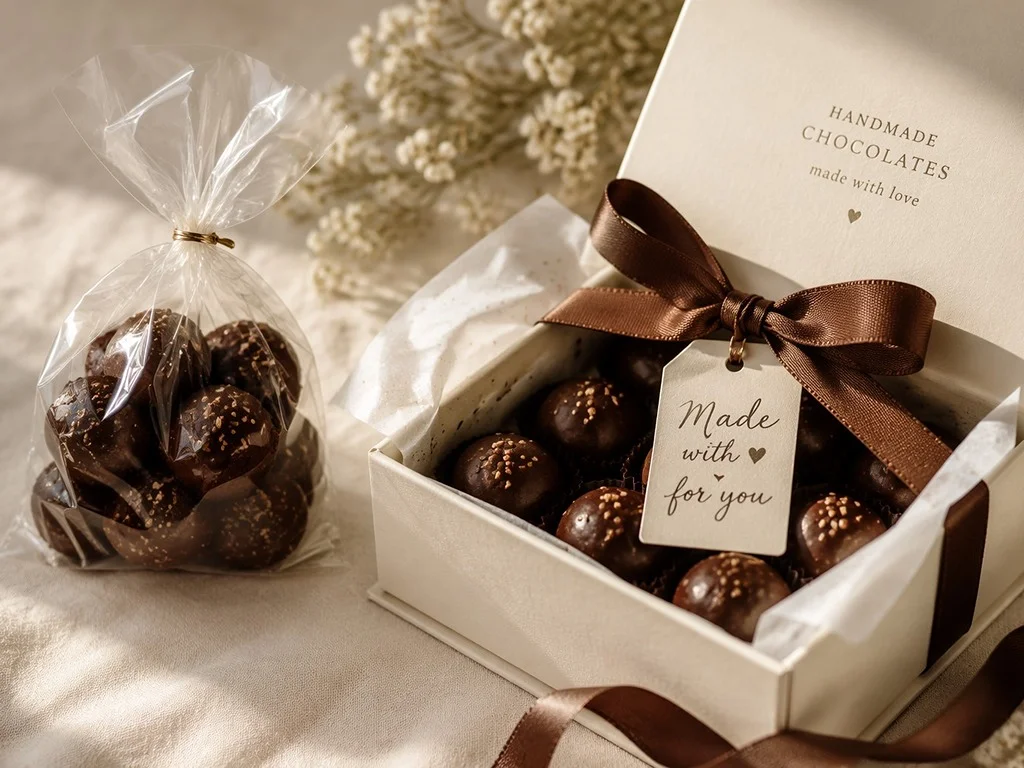
What reads as careful is mostly geometry:
- The same gap around each piece
- A box that looks full, not packed until the lid bows
- One printed focal point, not five finishes
- An opening sequence that does not dump the tray
- A food-contact layer that is not an afterthought printed on the cavity wall
Foil on a sloppy cavity still looks sloppy. Spend the first sample on fit.
Box styles and what they are for
| Style | What it is good at | Where it fails |
|---|---|---|
| Folding carton | Bars, favors, small counts. Ships flat. | Needs an insert. Treat print as secondary packaging unless the whole material stack is cleared for direct contact. |
| Two-piece lid and base | Truffles and assortments. Natural open, room for a tray. | Lid depth and fit have to be sampled. A shallow lid and a deep base are different tools. |
| Drawer | Tasting sets, short editions. Slower open. | Too much clearance and the tray rattles. Too little and humidity swells the sleeve shut. |
| Magnetic rigid | Corporate sets and anything with a second layer of product. | More board, more labor, more inbound cube. A poor reason to pack four casual pieces. |
| Sleeve and tray | Wrapped bars, a quiet range. | Weak when the assortment is heavy or tall. |
| Corrugated mailer | The outer shipper. | Not a food-contact box. Do not set unwrapped chocolate on the flute. |
Folding styles that earn their keep on chocolate: straight tuck, reverse tuck, crash-lock, sleeve and tray, a window only if you accept the film, and a carton with an integrated divider. Proportion and the paper do more than a second foil.
On a two-piece, the insert matters more than the lid silhouette. Without cups or a cavity, the pieces still walk to one corner.
A drawer needs a pull that matches the build. A ribbon is another component and another adhesive. A thumb notch is a cut in the tray. Either is fine. The sliding fit is the part to measure. Paper grows in damp air. A fit that is perfect in a dry sample room can stick in a summer kitchen.
Magnetic rigid boxes arrive set up unless you order a collapsible build. Use them when the box is part of the gift: a paired product, a holiday layer, a pack someone keeps. For a four-piece favor, they are a lot of greyboard.
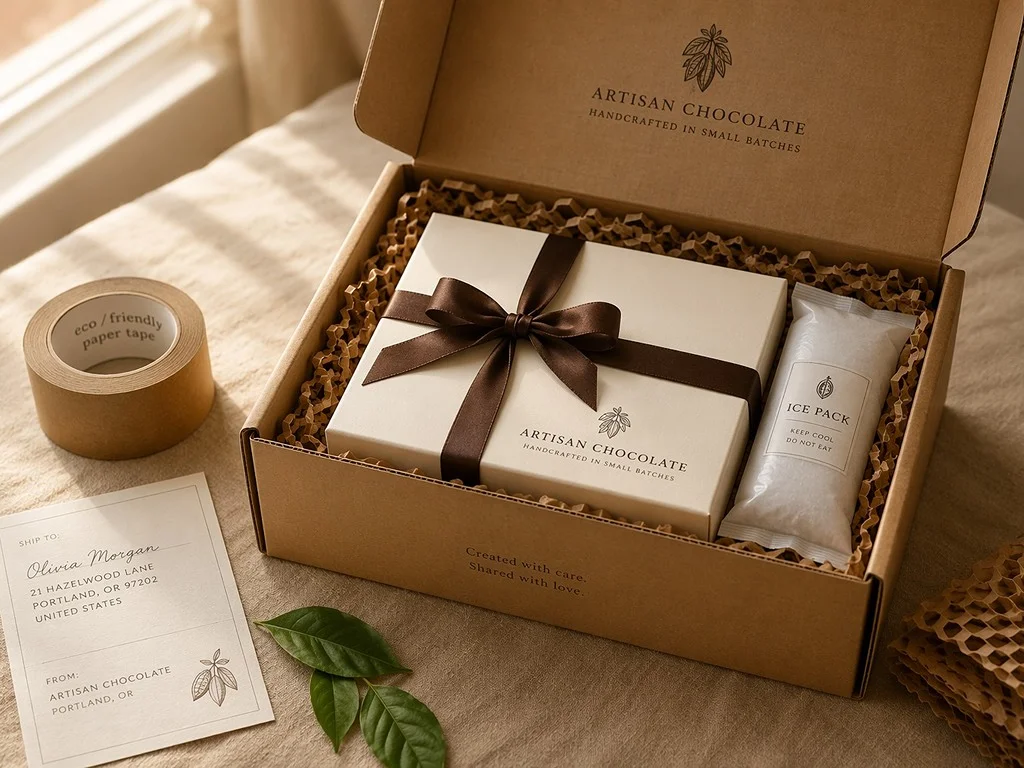
The shipper is a third layer:
- Cup, wrapper, liner, or a sealed tray that is documented for the food
- The presentation box
- A corrugated carton that fits the presentation box, with pads so it cannot slide
Flute on that outer carton is a crush and drop problem. It does not manage heat. Insulation and transit time are a separate spec.
Size the box from the finished piece
Start with chocolates that have already been cupped or wrapped. A mould dimension ignores coating, a tall garnish, and the cup wall.
Lay out the real count before you draw:
- 2 × 2 for four
- 2 × 3 for six
- 3 × 3 for nine
- 3 × 4 for twelve
- One row for bars
- Mixed cavities only when the shapes are actually different
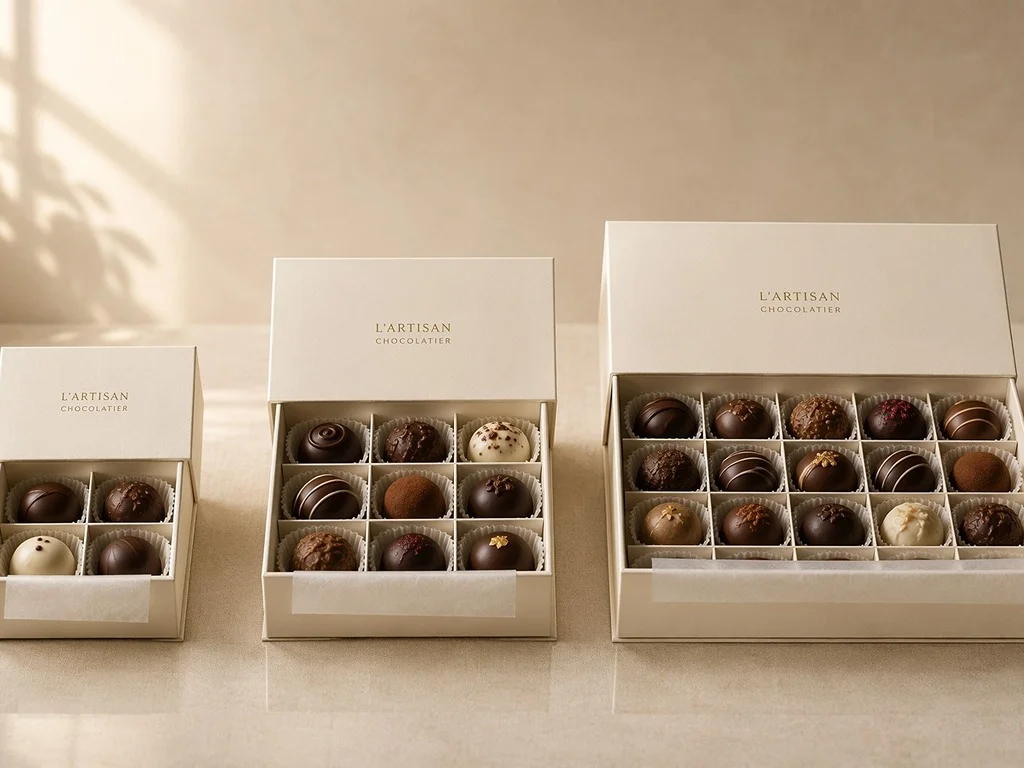
The outer blank is not "piece width times count." Add:
- Cup or wrapper
- Gap between pieces
- Insert walls
- Tray walls
- Lid clearance
- A top pad, if you use one
- A flavor card
One tall bonbon in a nine-piece is a local problem. Change the cavity or the pad cutout around that piece before you raise the whole lid.
An oversized cavity lets the piece turn, makes a small chocolate look lost, and makes each packed box look different. Shredded paper hides the gap on a table and does not hold the piece in a bag.
Clearance has a job. Leave it for a domed top, a garnish, a finger lift, a top pad, wrapper swell, or a drawer that has to slide. Too little marks the decoration. Too much is movement.
Approve a sample with the real product:
- Load the chocolates.
- Close the box.
- Tilt it.
- Open it and look for contact marks and shifted rows.
- Time the pack. That number matters when you move from a few dozen gifts to a production day.
The drawing that cuts and creases the blank is the dieline. Lock the cavity before you lock the art. Artwork drawn on the wrong pitch gets thrown away with the die.
Food contact is a layer, not a paper color
Chocolate is fat. Fillings add moisture, oil, fruit, or dairy. Those are the conditions of use. Kraft, white, and black are print decisions. They do not answer whether the sheet may touch the food.
Split the pack:
| Layer | Examples | Job |
|---|---|---|
| Primary | Food-grade cup, glassine, grease-resistant paper, approved parchment, a verified tray or film | Touches the chocolate |
| Secondary | Folding carton, drawer, rigid box | Holds and presents |
| Transport | Corrugated, pads, insulation | Takes the parcel |
Printed cartons and wrapped greyboard are secondary unless the full stack — paper, ink, coating, adhesive — is cleared for that contact. A certificate on the base paper does not cover the ink or the glue you added.
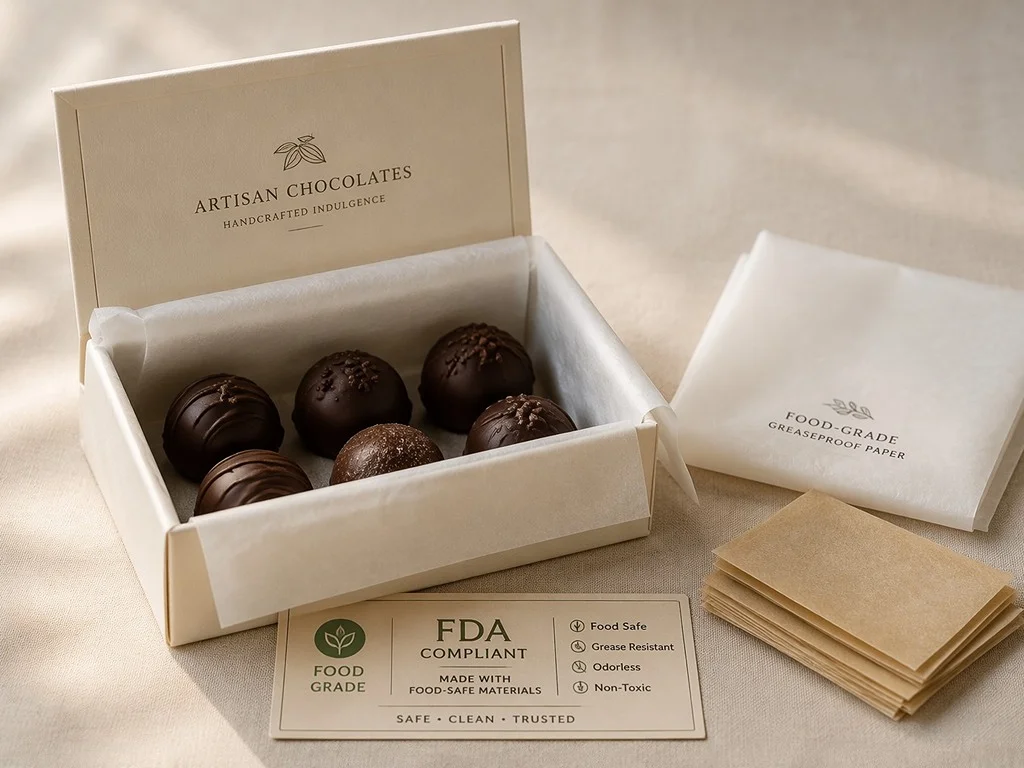
Components that can be primary when the declaration matches the use: food-grade paper cups, glassine, grease-resistant paper, parchment, food-contact tissue, a suitable cellulose film, foil with a paper sleeve, formed trays, a paperboard insert with a verified barrier. Decorative tissue, printed metalized film, and ordinary glue are not on that list just because they look plain.
In the United States, adhesives, colorants, coatings, and similar substances are food-contact substances when they touch food. Suitability depends on the food and the conditions, including temperature and time. Read the FDA's packaging and food-contact pages and ask for documents on the combination you are buying, not the marketing name of the sheet. Grease-proofing chemistry has changed; PFAS-based grease-proofing agents for paper food packaging were no longer being sold into the U.S. market after the FDA's 2024 announcement. Use a current declaration.
In Canada, the seller is responsible for packaging that does not transfer a harmful substance. Health Canada will assess a material voluntarily. A letter of no objection, if you have one, is about that submission.
In Australia, packaging has to be fit for purpose and unlikely to contaminate the food. FSANZ notes that migration depends on food type, temperature, humidity, time, and whether contact is direct.
| Component | Touches food? | Confirm |
|---|---|---|
| Food-grade paper cup | Yes, when documented | Grease resistance and the intended use |
| Glassine liner | Yes, when documented | The supplier declaration for this food |
| Printed folding carton | Usually no | Chocolate stays behind a barrier |
| Rigid greyboard box | Usually no | Internal food-contact layer |
| Corrugated mailer | No | Food stays sealed inside |
| Decorative tissue | Not automatically | A food-contact declaration, or do not use it against the chocolate |
| Paperboard insert | Depends | Paper, coating, ink, and adhesive |
| Foam | No for this job | Keep it off the food. Prefer a paper cavity |
Inserts
The insert holds each piece without marking it and without adding folds the packer will skip on a busy day.
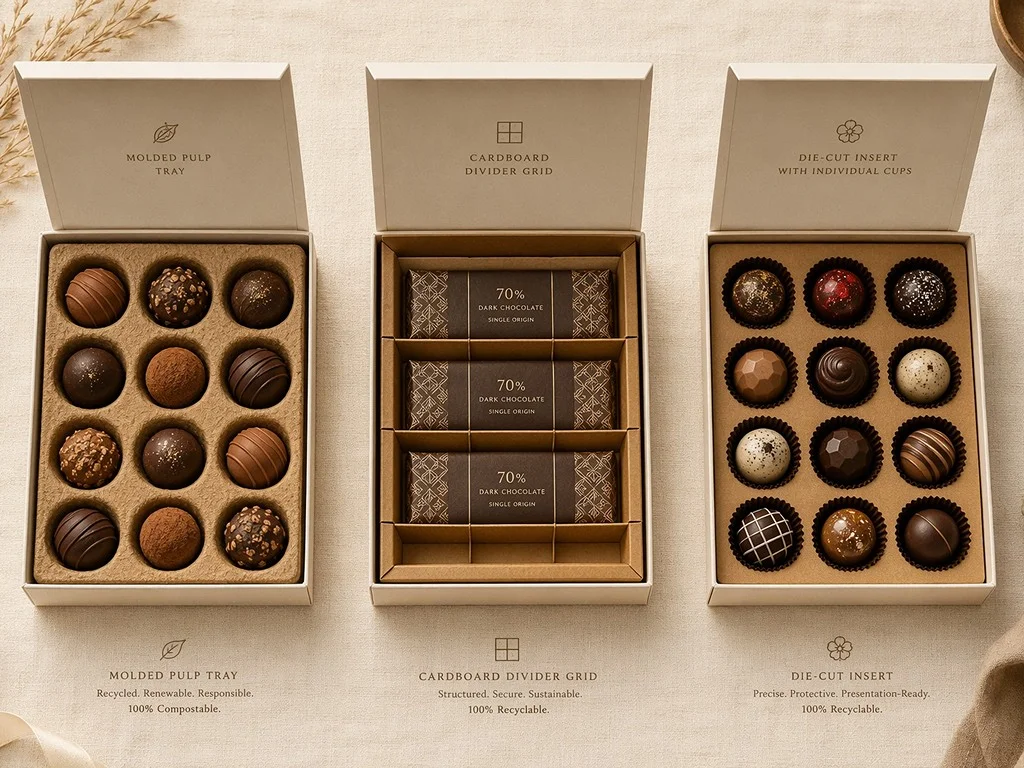
Paperboard cavities suit bonbons of a consistent size. The opening should support the base, not pinch a decorated side. A tight cavity looks neat and then scars the piece on the way out.
Paper cups separate truffles, forgive handmade variation, and set a rhythm. Fit the cup to the chocolate and to the cavity. A cup that is right for the piece and wrong for the hole wrinkles and rocks. Color is a spec: brown and cream read as classic, white as plain, black as contrast, gold as a celebration, pastel as a wedding. Pick one and hold it.
Bar dividers stop corners hitting and keep a flavor label visible. One outer box with two divider tools is cheaper than a new carton per assortment.
Top pads take up empty headspace. They should not press a soft filling or a tall decoration. A pad is not a fix for a lid that is a centimeter too tall.
| Piece | Insert | What you are stopping |
|---|---|---|
| Round truffle | Cup in a cavity tray | Rolling and scuff |
| Moulded bonbon | Cut cavity | Scratch and shift |
| Wrapped bar | Sleeve or divider | Corner crush |
| Chocolate-covered fruit | Deeper supported cavity | Compression and moisture against the wall |
| Mixed shapes | Cavities drawn to each piece | One size of hole for every shape |
| Thin pieces | Tray plus a light top pad | Breakage |
| Two layers | Stacked trays and a separator | Layer on layer |
Turn a packed box on its side, set it upright, and open it. If the row moved, fix the insert. Do not add more filler.
Print and finishing that do not fight the chocolate
Pick one idea and build the art from it: cocoa color, a season, an origin, a wedding, a quiet kraft. Then stop.
Usable palettes are just palettes: cocoa, cream, and a small copper; deep green and a champagne foil at Christmas; blush and burgundy for Valentine; white and sage for a wedding; black with one metal for dark chocolate; kraft with low ink for a plain range. Bright pieces usually need a quieter box.
A sleeve is how you change the season without a new die. One carton, two inserts, and printed sleeves for Christmas, a wedding name, a corporate logo, or a retailer. You stock structure, not a new box per event.
Foil works as a logo, a thin border, a flavor name, or a line inside the lid. A full-panel foil costs more, argues with the chocolate, and complicates separation later.
Emboss and deboss sit in the paper. They need caliper and a clean plate. Fine lines that look sharp on screen close up under pressure. Proof the tool on the actual stock.
Put the flavor, filling, allergen, date, and storage line on the lid or on one card. A blank on the card is where a handwritten name goes. Do not design that space out and then stick a second label over the foil.

Paper, plastic, and claims
"Paper" can still hide a window, a film laminate, magnets, a synthetic ribbon, and several glues. The recovery path is the whole build.
A paper-dominant pack is folding board or corrugated, a paper cavity, a sleeve, a card, and coatings you chose on purpose. FSC chain-of-custody is a sourcing claim. It does not mean recyclable, compostable, plastic-free, food-contact safe, or lower carbon. Those need their own evidence. Put an FSC mark on art only when the mill, the converter, and the claim rules are in place. Tendlyn can supply FSC board when you specify it.
Design the pack so a person can separate it: a lift-out insert, no window or a window that tears off, a ribbon that is not glued across the lid, little adhesive, and the shipper kept separate from the gift box. Local programs differ. Recycle BC, for example, takes paper candy boxes and tells residents to remove plastic windows. Write "recyclable where this material is accepted," not "recyclable everywhere."
Say: FSC-certified paper, paperboard insert, plastic reduced to a named part, remove the ribbon, window separates from the box. Do not say zero impact, harmless, or fully recyclable everywhere.
Shipping
Heat and impact fail independently. A stronger carton does not stop a ganache from softening in a van. An ice pack does not stop two bonbons from hitting if the cavity is loose.
Hold the gift box in the mailer with corrugated pads, honeycomb, moulded pulp, or paper corners. Cushioning limits travel. It should not crush the lid. Keep refrigerant off unwrapped chocolate, and keep condensation off the paper. Cold chocolate taken into humid air sweats. Test the pack you will actually ship, including where the pack sits.
Dispatch and lane matter more than a slogan on the mailer. Warm routes need a shorter transit and a receiver who will pick up. Weekend dwell is a temperature event. Australia Post and Canada Post both put perishable food on the shipper: it has to arrive usable, and the risk sits with the sender. Read the current carrier rules for the lane you use. A table of markets is not a substitute.
Before a commercial run, ship filled boxes and check position, scuff, bloom or soften, broken garnish, insert crush, corner damage, condensation, and whether the open still works. An empty gift box proves nothing.
When a custom box is worth it
Stock boxes are right while the assortment is still changing. Move to a custom die when the same count repeats, stock cartons leave a hole, pieces arrive damaged, packing is slow, a retailer wants the same face every time, or you are building a wholesale shipper out of three stock parts.
Send this, not a mood board:
- Finished piece size, after cup or wrap
- Count and the grid
- The food-contact layer
- Insert material
- Outer structure
- Ship method
- The legal lines you must print
- Quantity and the destination
Art comes after the cavity is stable.
Keep the first system small: one carton, two inserts, seasonal sleeves, swap-in flavor cards, a sticker for a retailer, ribbon only on the premium order. Then watch the bench. If cups tip, the lid snags, cards migrate, or the box needs a lot of glue, the structure is wrong even if the photo is good.
A paper converter should be able to talk dielines, board, inserts, print, a white sample, color on the real stock, and export packing. Food-contact documents come from the suppliers of the layers that touch food. Ask which components the declaration covers.
Short answers
Best everyday build. A two-piece or a folding carton, food-grade cups, a fitted insert. For a parcel, that box goes inside corrugated with cushioning and a temperature plan.
Can chocolate touch the printed box? Only when paper, ink, coating, adhesive, and the use conditions are all covered. Otherwise use a cup, wrapper, liner, or tray.
Twelve pieces. A 3 × 4 grid is common and not a size. Tall decorations change the height. Measure the set.
Is kraft food-safe? Not because it is brown. Ask for the declaration on that paper, coat, ink, and glue.
Recycling. Clean paperboard and corrugated often go in the paper stream. Windows, magnets, ribbon, grease, foam, and some laminations change acceptance.
Refrigeration before shipping. Recipe, filling, and the lane decide. Very cold chocolate plus humid air means condensation. Test the pair.
Guangzhou Tendlyn Trading Co., Ltd. has made paper packaging since 2009 in its Foshan and Zhanjiang factories: folding cartons, rigid boxes, mailers, paper bags, paper tubes, and the paperboard inserts that go with them. Minimum is 100. The quote is written after structure, board, print, and quantity are known. Send the piece sizes to info@axwp.com, +86 158 1238 1273, or WeChat trimgem.
