A folding carton that looks finished on screen can still fail on the folder-gluer. Scores crack. Glue flaps miss the wheel. Grain fights the main folds, and the filling line slows down.
Settle structure, board, print, and finishing before the cutting die is made. Graphic polish will not pull a blank that jams.
What the carton has to do
Four constraints sit on the same blank: protect the product, run on the line, read on the shelf, and stay within the board you are willing to buy. Resolve them before tooling.
Match caliper, stiffness, and grain to product weight and to how fast the carton is erected. An auto-bottom, a reverse tuck, or a snap-lock is a line decision. Manual packing can live with a tuck. A high-speed erecting line needs a style the machine can open and square.
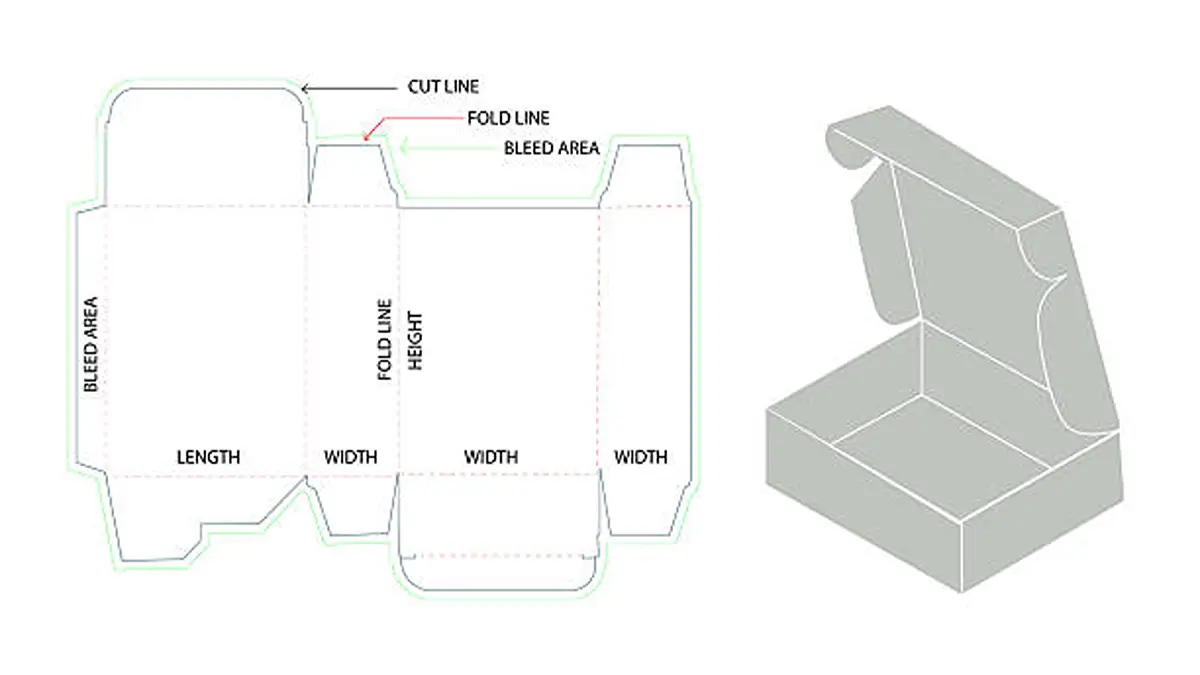
Check the flat geometry, the scores, and the glue-tab margins on an unprinted mockup in the target board. Nest the blank so trim is not the largest cost on the sheet. If the blank will not run, the artwork does not matter yet.
On the graphic side, keep type and barcodes off the creases. Coatings have to survive rub and still allow the fiber to be repulped if that is the end-of-life claim. Pull tabs, thumb notches, and a reclosable tuck are functional, and they belong on the dieline. A plastic window is a second material. Specify it only when the product has to be seen.
Dieline numbers that affect the gluer
The blank becomes a carton only when board thickness, flap clearance, and glue area are drawn on purpose. These are working ranges from converting practice. The approved sample overrides them when the plant's gluer or the board says otherwise.
| Element | Working range | Why it is there |
|---|---|---|
| Glue flap width | 18–22 mm | Enough adhesive coverage at speed |
| Glue flap bevel | 7–10 degrees | Clearance so the flap does not hit the machine |
| SBS caliper | 0.35–0.60 mm | Stiffness against the load you are actually shipping |
| Fold allowance | One board thickness per 90° fold | Holds outer size and limits warp on erection |
| Bleed | 3 mm minimum past the cut | Covers sheet movement in die-cutting |
| Safe zone | 3–4 mm inside creases and cuts | Keeps type and barcodes off the fold |
| Trapping | 0.15–0.25 mm | Covers registration on a multi-color offset run |
Grain. Run grain parallel to the major folds. Folding against the grain on a coated board, especially above about 0.45 mm, is where the coating splits and raw fiber shows.
Crease. Rule height, matrix width, and caliper have to match. A shallow score folds crooked. A deep score cuts the outer fibers.
Prepress. Keep the structural dieline on a locked layer, in a non-printing spot color set to overprint. Build the press file as a PDF/X-1a or PDF/X-4, and send the editable Illustrator file with it, at 100% scale. Trap between 0.15 and 0.25 mm on multi-color work so a small register move does not leave a white gap or a muddy edge.
Compression and vibration on a physical prototype, in the real board, tell you whether the joint and the closure hold. IoPP publishes protocol references that labs actually use. Name the test. Do not treat a bench fold as a transit result.

Board grade
The grade decides stiffness, print surface, and whether the glue flap bonds.
- SBS (solid bleached sulfate). Bleached chemical pulp, white through the sheet. Smoothest face for cosmetics, spirits, and pharma, and the usual substrate for foil and emboss.
- FBB (folding boxboard). Mechanical pulp in the middle, chemical pulp on the faces. High stiffness for the weight. Useful when the panel has to stay flat and the blank has to ship light.
- WLC (white-lined chipboard). Recovered fiber with a clay-coated white top. A cost board for dry goods that do not need direct food contact.
- SUS (solid unbleached sulfate). Unbleached kraft. Tear and compression for carriers and heavier transit cartons.
Five numbers belong on the spec, not a color name:
- Grammage (gsm). Mass per square meter. It moves blank weight and material cost.
- Caliper. Thickness. Stiffness rises fast as caliper increases, which is why a small step up can stop a panel bowing.
- Stiffness. Taber or an equivalent. This is what the erecting line feels.
- Smoothness. Ink laydown and foil register.
- Grain direction. The sheet is stiffer along the grain. Put grain on the panels that carry the load, and parallel to the main creases.
Food contact. The board, the coating, and the adhesive all have to be suitable for that food, that temperature, and that contact time. A dispersion barrier or a polymer layer may be required to stop grease. Name it in the bill of materials. In the U.S., start from FDA food-contact rules for the intended use. In the EU, the framework is Regulation (EC) No 1935/2004, with member-state rules still doing much of the work for paper.
Cold chain. Condensation softens fiber. A moisture-resistant coating has to be in the spec if the carton sees a chiller or a freezer, and it has to be checked against repulping if recyclability is a claim.
Pharma. You need a stable sheet, a barcode that scans, a quiet zone that survives the fold, and braille that the caliper can take without cracking.
Cosmetics. Smooth SBS is what survives hot foil, a deep deboss, and spot UV.
Heavy ink, UV varnish, and film on the glue flap stop the adhesive biting into fiber. Draw a glue keep-out on the dieline and keep that zone free of ink, varnish, and foil. Fold cracking shows up when thick board folds against the grain, or when low humidity makes the coating brittle. Match the crease to the caliper and prove it on a blank from the production lot.
High-bulk FBB can hold stiffness at a lower grammage. Ask for FSC fiber when the brand needs a chain-of-custody claim. It is available on request. It is not the default on every order. Keep polymer laminations and plastic windows small enough that you can still explain the pack to a recycler. Design-for-recycling criteria under the EU PPWR keep tightening toward 2030. A coating choice made now is part of that file.
Print and finishing
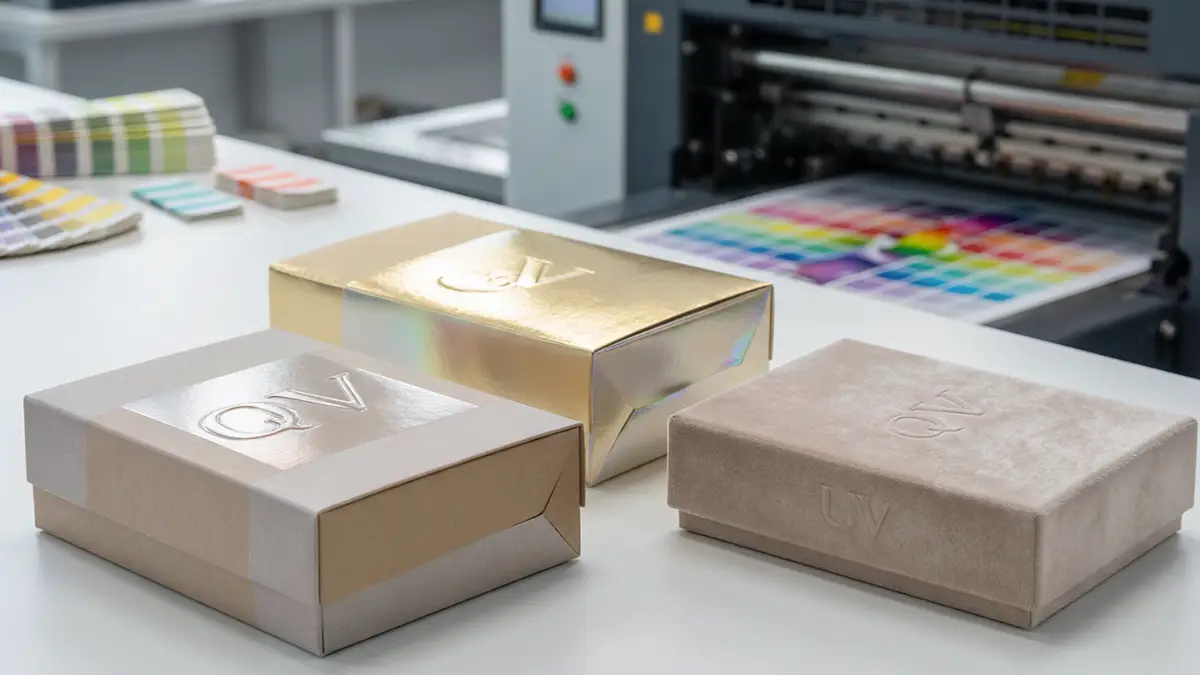
Pick the process from the run length, the surface, and how fine the graphics are.
- Offset. The default for medium and long runs on coated SBS. Plates, tight register, and clean solids.
- Flexo. Long runs on kraft or a less even recycled face. Speed is the point. Fine type will not match offset.
- Digital. Short runs, prototypes, and versioned or serialized art. No plates. Unit cost and color tolerance need a proof on the real board before you treat it as the production reference.
Beyond CMYK:
- Pantone spot inks hold a brand color on a large solid, where process color drifts.
- Metallic ink is a reflective accent. It is not a mirror. Foil is the mirror.
- Low-migration ink belongs on food-contact and pharma cartons. Pair it with the barrier the product actually needs: a dispersion coat, an extrusion, or an inner liner. The ink name alone does not stop grease.
Finishing:
- Aqueous coating. Water-based, inline, gloss or matte. Rub protection with less film.
- UV coating. Higher gloss, cured under UV lamps. Spot UV sits on a matte field when you want the logo to catch light.
- Soft-touch. A velvety coat used heavily on cosmetics. Check glue areas and the recycling note before it covers the whole blank.
- Foil. Heat, pressure, and a metal die. Keep foil off the glue zone.
- Emboss and deboss. Depth has to suit the caliper and the grain, or the fiber tears.
Die-cutting, scoring, and gluing close the job. Major creases parallel to grain. Score depth matched to caliper. Glue flaps free of coating. A bond you can call acceptable is one that tears fiber, not one that peels at the coating.
What changes by category

A retail folding carton and a parcel carton are different loads.
- Food. Food-contact board, a grease or moisture barrier you can name, and inks matched to that contact.
- Pharma. Legible text, serialization quiet zones, size that the cartoner can repeat, tamper evidence or braille when the market requires them.
- Cosmetics. SBS or FBB that will take color, foil, and emboss without the face failing.
- Electronics. An insert, a partition, or an auto-bottom that stops parts moving. The carton wall alone is rarely the cushion.
- E-commerce. Locks that stay shut, corners that take a drop, and compression for sortation. Many of these SKUs belong in a corrugated mailer, with the folding carton as the retail unit inside it.
Premium and food cartons often land between 270 and 350 gsm in SBS or FBB. That is a starting band, not a rule. Weight, span, and humidity move it. Verify compression, drop, vibration, and rub on production board, adhesive, and coating. A generic white sample in the wrong caliper will not show a score crack that the real sheet will.
How to audit a folding-carton plant
Compare plants on whether your file becomes the same carton twice. Unit price comes after that.
| Check | What you want to see |
|---|---|
| Structure | CAD dieline, an unprinted white sample in the target caliper, product fit checked before print |
| Print and conversion | Offset and a short-run process if you need it, color control, die-cutting and folder-gluing under the same responsibility |
| Records | A quality system you can read, food-contact paperwork when the SKU needs it, FSC chain of custody when you will print an FSC claim |
| Board | Lot traceability, board stored so it does not pick up moisture, a named backup mill |
Walk the board store. Humidity swings change caliper and cracking. Ask what happens when a coating or an adhesive is substituted after the golden sample. If the answer is informal, the test report you paid for describes a carton you are no longer buying.
A workable approval chain:
- White sample in the target caliper. Dimensions, folds, glue clearance, product fit.
- Printed proof on production board. Pantone, type, barcodes, finish.
- Short run on production tooling. The gluer actually runs, and the seam tears fiber.
- Bulk against the frozen spec. Dimensions, print, and closure sampled to an AQL you agreed.
Questions that come up before tooling
Which file do you send? A press-ready PDF/X-1a or PDF/X-4, plus the Illustrator file. The manufacturer's dieline stays on its own locked layer. Cut, crease, and perf are spot colors set to overprint, at 100% scale.
How do you estimate blank weight? Pick a grammage from the product and the span, often somewhere in 200–400 gsm for a folding carton. Multiply by the flat blank area. A 0.1092 m² blank at 300 gsm is about 32.8 g before coating and glue. The mill ticket on the approved board replaces the estimate.
Offset or digital? Offset carries plates, spot colors, and long-run consistency. Digital skips plates and fits short runs, many SKUs, and variable data. Approve color on the production board either way.
What quantity is realistic? Make-ready is the constraint: plates, a cutting die, foil tools, and gluer setup. Guangzhou Tendlyn Trading Co., Ltd. accepts custom paper packaging from 100 pieces. The quote is written after structure, board, print, and quantity are known. A heavy foil and emboss job will not price like a one-color tuck carton at the same count.
How long does it take? Lead time depends on board, tooling, and the finishing stack. It is quoted with the job. A repeat that uses an existing die is a different schedule from a first cutting die. Build ocean freight and customs into the date the cartons have to be at the filler. Do not treat a domestic converting estimate as a door-to-door date.
Before you release the die
An open seam or a split score on the filling line costs more than the sample cycle you skipped. Lock caliper, prove the fold allowance on a physical blank, and watch the plant glue the flap.
Tendlyn was founded in Guangzhou in 2009 and converts folding cartons, mailer boxes, rigid boxes, paper bags, and paper tubes in its own Foshan and Zhanjiang plants. FSC board is available on request. Send the dieline, the product weight, and the fill method to info@axwp.com, +86 158 1238 1273, or WeChat trimgem.
