If you place packaged goods on the EU market, PPWR is in force. Regulation (EU) 2025/40 on packaging and packaging waste entered into force on 11 February 2025 and has applied since 12 August 2026. It covers recyclability, substances of concern, minimisation, labelling, conformity assessment, and technical documentation.
A paper face does not make a pack compliant. Coatings, windows, foil, adhesives, inks, and labels travel into the recycling mill with the board. The whole construction is the unit of assessment.
Some duties apply now. Detailed Design for Recycling criteria and later thresholds run toward 2030, 2035, and 2038. The Commission published further guidance in June 2026. Delegated and implementing acts are still arriving. Use the legal text on EUR-Lex, the Commission PPWR page, and the 2026 guidance. This article is a buyer's map of the file, not a legal opinion.
What to settle early on a paper pack
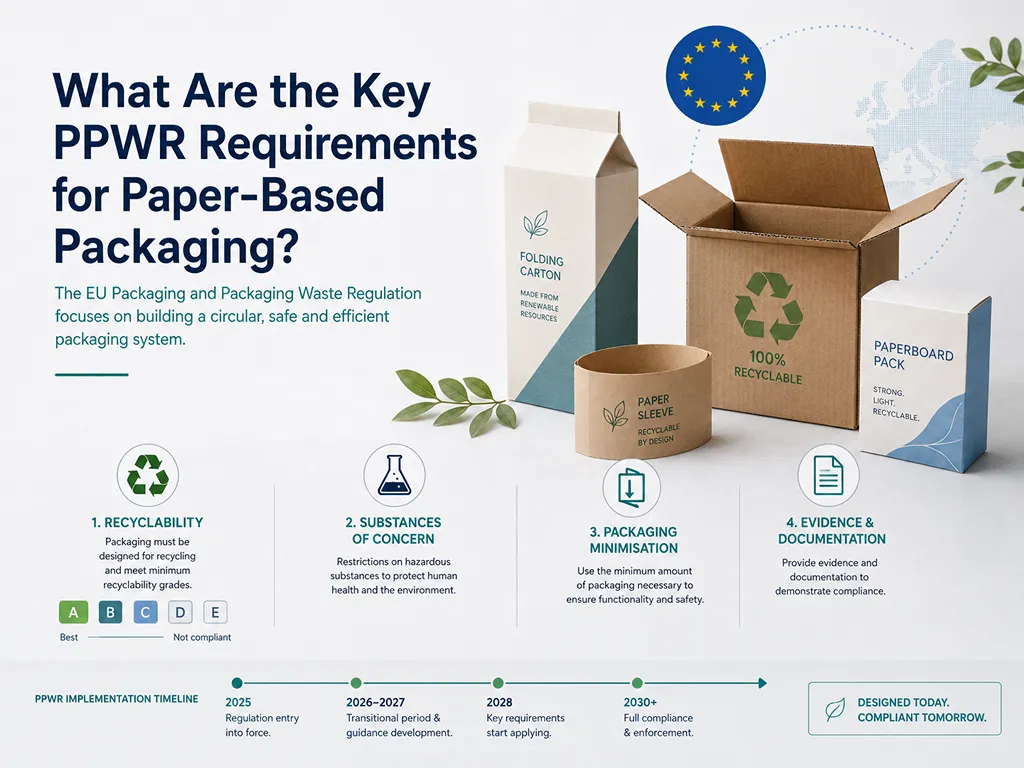
For folding cartons, corrugated boxes, sleeves, and other fiber packs, start with four items: recyclability, substances of concern, minimisation, and the evidence that ties them to a SKU.
Timeline
| Date | Milestone | What it means on a paper pack |
|---|---|---|
| 11 Feb 2025 | Regulation entered into force | The framework became law |
| 12 Aug 2026 | PPWR generally applies | Core duties apply, including PFAS limits for food-contact packaging |
| By 1 Jan 2028 | Detailed Design for Recycling acts due | The Commission is to set recyclability criteria and performance grades in detail |
| 1 Jan 2030 | Design for Recycling and minimisation phase in | Applicable recyclability criteria, and weight and volume cut to what the function needs |
| 2035 | Recycled-at-scale is added | Actual recycling at scale becomes part of the assessment |
| 1 Jan 2038 | Grade C generally no longer enough | Packs generally need Grade A or B to stay on the market |
Read those dates with the delegated and implementing acts for your packaging category. The Commission's Joint Research Centre is supporting the technical Design for Recycling work. A date in a slide is not a substitute for the act that names your format.
1. Design for recycling
PPWR grades recyclability by the share of the packaging unit considered recyclable by weight.
| Grade | Design for Recycling assessment |
|---|---|
| A | ≥ 95% |
| B | ≥ 80% |
| C | ≥ 70% |
| Technically non-recyclable | < 70% |
From 1 January 2038, packs generally need Grade A or B, subject to the exceptions and detailed rules in the Regulation.
For fiber, the assessment is the whole structure:
- paperboard or corrugated substrate
- ink
- varnish or barrier coating
- lamination
- window film
- foil or a metallised decoration
- adhesive
- label
- closure and anything else attached
The useful question is what is still on the pack when it enters the paper stream, and how those components behave in sorting and repulping.
2. Substances of concern
PPWR keeps a 100 mg/kg combined limit for lead, cadmium, mercury, and hexavalent chromium in packaging or packaging components, subject to the Regulation's own provisions.
Food-contact packaging has an additional PFAS restriction from 12 August 2026. The thresholds in the Regulation are:
- 25 ppb for any individual PFAS measured by targeted analysis, excluding polymeric PFAS from that quantification
- 250 ppb for the sum of PFAS measured by targeted analysis, subject to the method provisions
- 50 ppm for PFAS including polymeric PFAS
Grease-resistant papers, takeaway packs, and coated fiber structures are where this shows up. "Water-based coating" is not a compliance statement. You need the chemistry, the function, the food-contact status, and a test or a declaration that matches that coating.
3. Minimisation
From 1 January 2030, the manufacturer or importer must keep packaging weight and volume at the minimum needed for the function. Features that exist to inflate perceived volume — extra layers, false bottoms, double walls — are called out, with defined exceptions.
A lighter carton is a success only if it still survives filling, storage, palletising, transport, and ordinary handling. The 2026 Commission guidance separates marketing preference from function. A heavier board needs a reason you can defend under the criteria, such as compression, a drop, or a closure that has to work.
4. Recycled fiber is not the whole test
Recycled board can be the right sheet and still carry a laminate, a coating, or an adhesive that fails the recycling route. A virgin construction can be the right recycling route if every component is chosen for it. The sequence that holds up in a file is:
function → structure → composition → recyclability assessment → testing → documented evidence
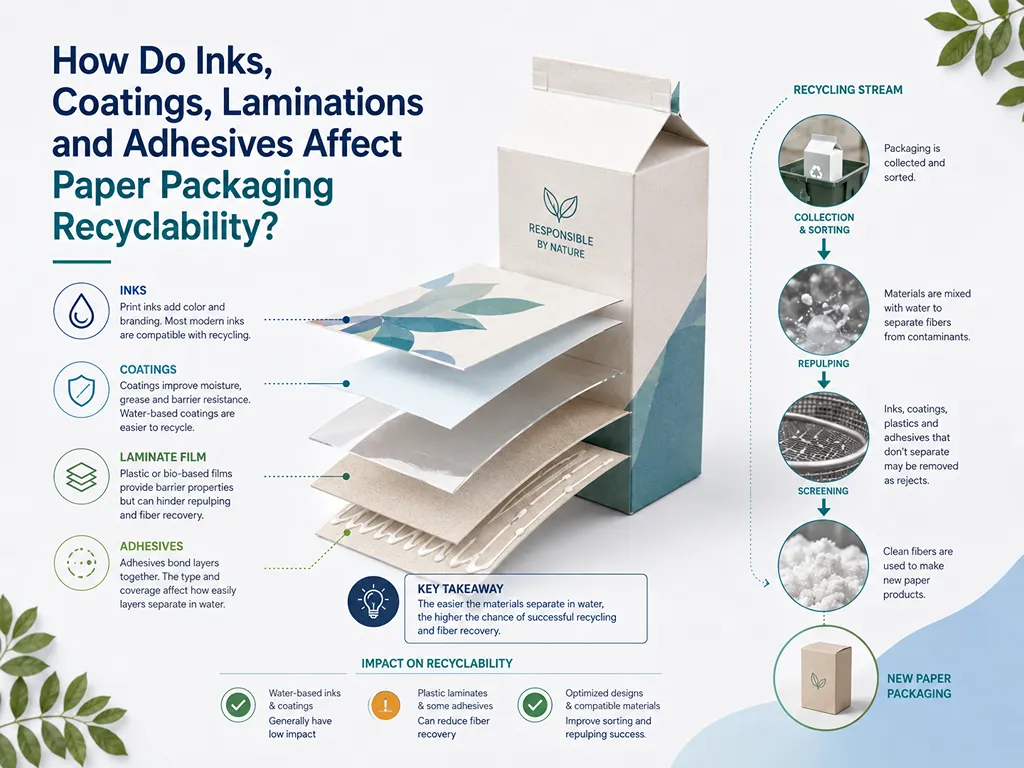
Inks, coatings, films, and glues
Converting adds materials. Those materials change the mill result.
Inks. Print does not automatically block fiber recovery. Coverage, the ink system, and the recycling route do. Heavy coverage, some UV systems, metallics, and special finishes need a closer look than a conventional carton. Print what the brand and the legal text require.
Coatings. A coating can add grease resistance, moisture resistance, a heat seal, scuff resistance, or an oxygen or aroma barrier. "Water-based" does not mean "recyclable." Fiber yield, screening rejects, and how the coating behaves in the target process are the data.
Laminations. A plastic or metallised film can be the barrier or the decoration, and it is a non-fiber layer. Before you specify it, ask whether the product needs it or the artwork does, whether area or thickness can drop, whether a coating can do the same job, and how the full structure performs in the route you will claim.
Adhesives. Residues become stickies in the pulper, especially on large glued areas, pressure-sensitive labels, self-adhesive closures, and window patches. Assess recyclability from the bill of materials.
Cepi's Paper and Board Recyclability Laboratory Test Method, Version 3 covers pulping, screening, and sheet formation. It is also a technical input to the 4evergreen evaluation work. It is a lab method. It is not an EU-issued PPWR certificate.
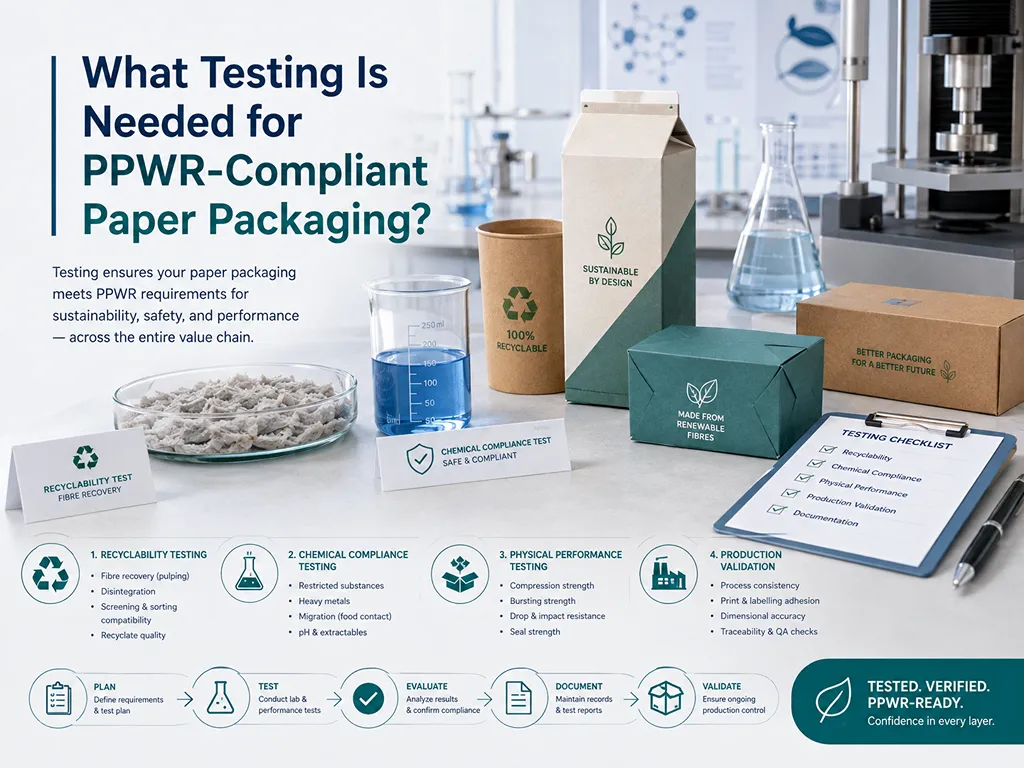
What to test
No single lab report turns every format into a government-issued "PPWR-certified" product. There is no such universal certificate. Test against the construction, the use, and the risk.
Recyclability. For a complex fiber pack, a lab repulping assessment shows fiber recovery, rejects, and sheet quality. The 4evergreen Recyclability Evaluation Protocol adds industry routes for European recycling processes. Cite them as evidence. Do not print them as an official PPWR approval.
Chemistry. The plan may include heavy metals, PFAS where the pack is food-contact, and substances tied to the inks, coatings, or adhesives. Other EU food-contact law can apply on top of PPWR. Start from the bill of materials and the application, not from a fixed menu of tests.
Performance. Minimisation raises an engineering question: does the pack still do its job after the material comes out? Depending on the format, that can mean compression, burst or edge crush on corrugated, drop, vibration, rub, humidity, and seal or adhesive performance. These are not automatically "PPWR tests." They are how you justify the board weight and the protective part you kept.
Production. A lab result describes the sample that was tested. Later lots stay aligned only if you hold a chain: approved specification, incoming material control, in-process checks, batch traceability, and change control. Swap the adhesive after the test and the report describes a different pack.
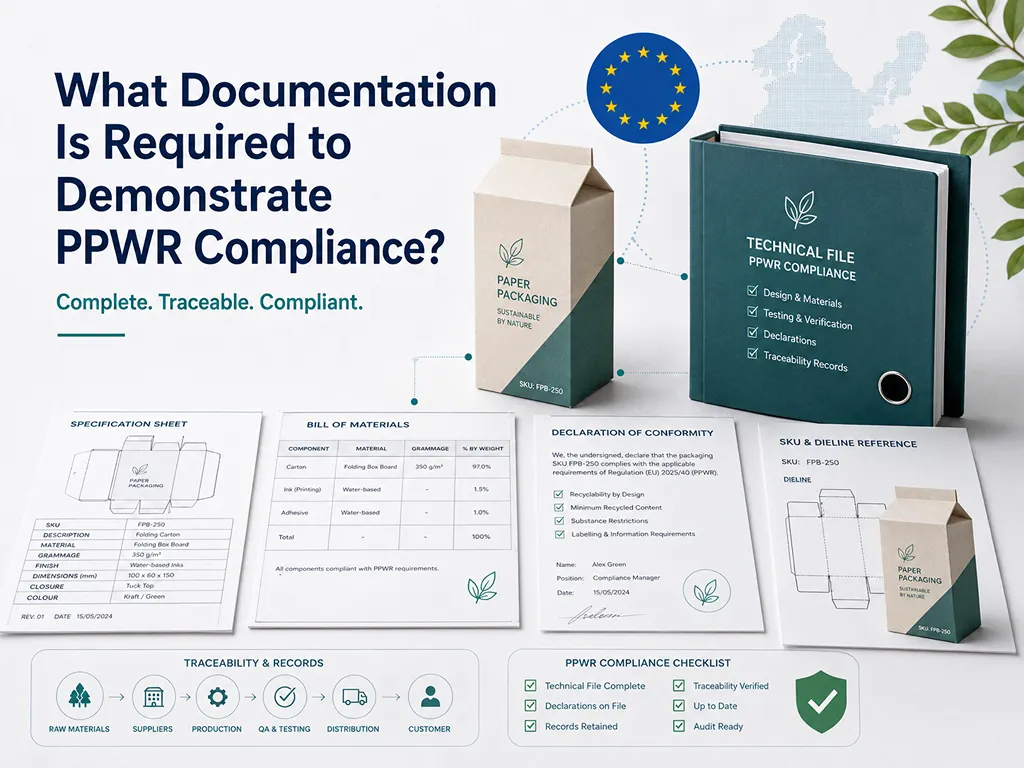
The file
The manufacturer carries out the applicable conformity assessment and prepares technical documentation before the pack is placed on the market. Once conformity is shown, an EU Declaration of Conformity is required. Annex VII describes the internal production-control procedure and the role of the technical file.
For one paper SKU, a reviewer should be able to connect:
| Evidence | Typical records |
|---|---|
| Identity | SKU, pack type, drawings, dieline |
| Construction | Substrate, grammage, coatings, films, inks, adhesives, other components |
| Legal basis | The PPWR requirements, standards, and specifications you are applying |
| Technical evidence | Assessments, calculations, lab reports, recyclability data where they exist |
| Minimisation | Weight and volume assessment, and the function of any feature you kept |
| Production control | Approved spec, inspection records, traceability, change control |
| Conformity | EU Declaration of Conformity and the supporting file |
Retention, from the date the packaging is placed on the market, is generally:
- 5 years for single-use packaging
- 10 years for reusable packaging
Suppliers of packaging and packaging materials have to give the manufacturer the information needed to demonstrate conformity. Supplier data is part of the chain, not a courtesy.
The path through the file should read in one direction: what the pack is, what is in it, how it was assessed, what evidence supports that, and how a production change is controlled.
Germany's Central Agency Packaging Register (ZSVR), with the German Environment Agency, published a 2025 Minimum Standard for recycling-friendly packaging and organised it around the coming PPWR classification. ZSVR's templates are optional guidance, not a binding EU form. They are still a concrete picture of how one member state expects packaging data to be structured: ZSVR minimum standard.
What to ask the plant
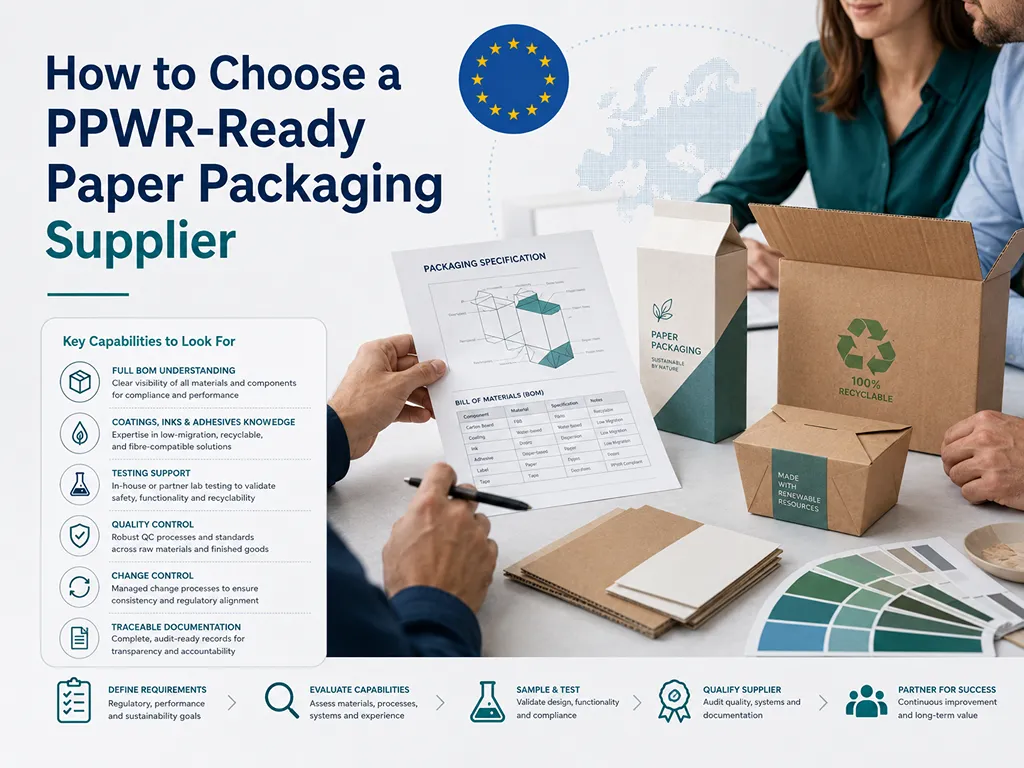
Before you approve an EU paper pack, the converter should be able to:
- name the full bill of materials, not only the paper grade
- specify coatings, inks, adhesives, films, and finishes
- argue against a layer or a multi-material detail that has no function
- prepare samples and material data for the third-party tests you choose
- tie reports and declarations to a SKU or a packaging family
- control substitutions after approval
- repeat production against the approved specification
- hand you traceable documents when the file needs them
Change control is the item that gets missed. A new adhesive, coating, film, or board after the test means the old evidence does not describe the pack now being made. Approved alternates and revision records belong in the order, not in a chat log.
What a converter can put in your file
The economic operator who places the packaging on the EU market remains responsible for the legal requirements and for the conformity process. A paper converter does not take that duty by printing the carton.
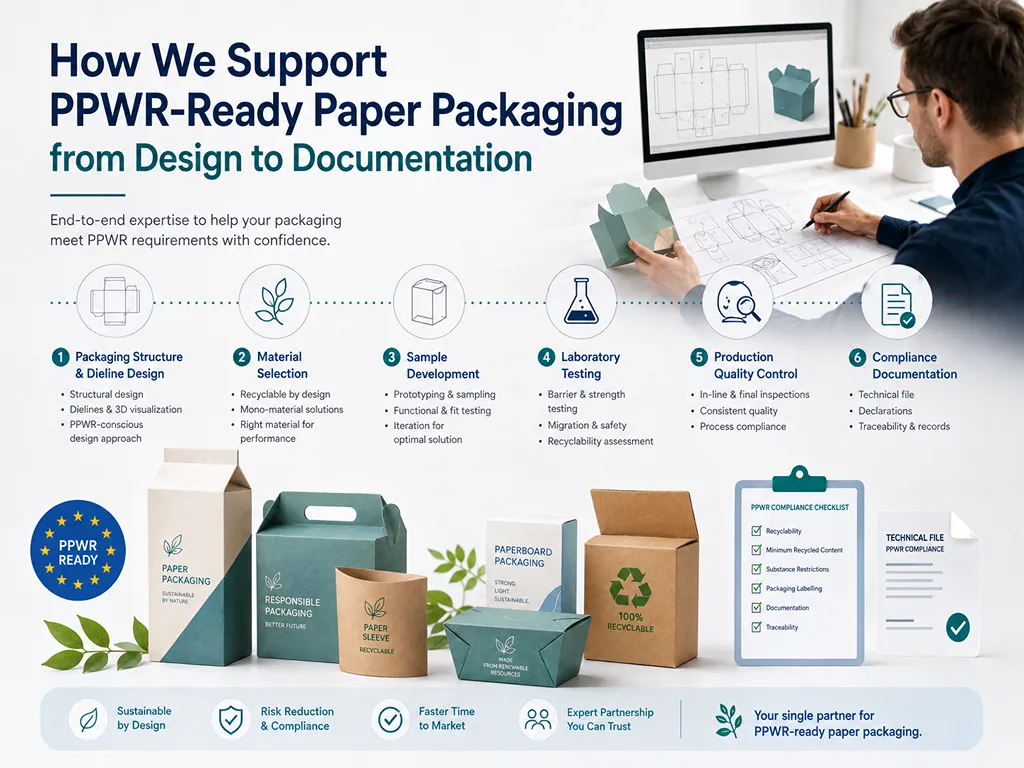
What the plant can do, and what you should ask for on an EU job:
- review the dieline, the paper grade and grammage, and the full component list before tooling
- record coating, lamination, and adhesive
- note whether the application is food-contact
- supply the packaging specification and the material declarations the mill and the ink maker actually issued
- hold production to the approved spec, and flag a change before it ships
FSC-certified board is available on request when you need a chain-of-custody claim. An FSC claim is not a PPWR declaration. Declarations of conformity follow the brand's specification and the operator's assessment.
Guangzhou Tendlyn Trading Co., Ltd. was founded in Guangzhou in 2009 and converts folding cartons, mailer boxes, rigid boxes, paper bags, and paper tubes in its own plants in Foshan and Zhanjiang. Minimum order is 100. For an EU carton or mailer, send the dieline, the component list, the product application, and any lab reports you already hold to info@axwp.com, +86 158 1238 1273, or WeChat trimgem. The quote is written after structure, board, print, and quantity are known.
PPWR is supplemented by Commission guidance, delegated acts, implementing acts, and technical standards. Those measures move. Verify the rules for your packaging category and for the date you place the product on the EU market.
