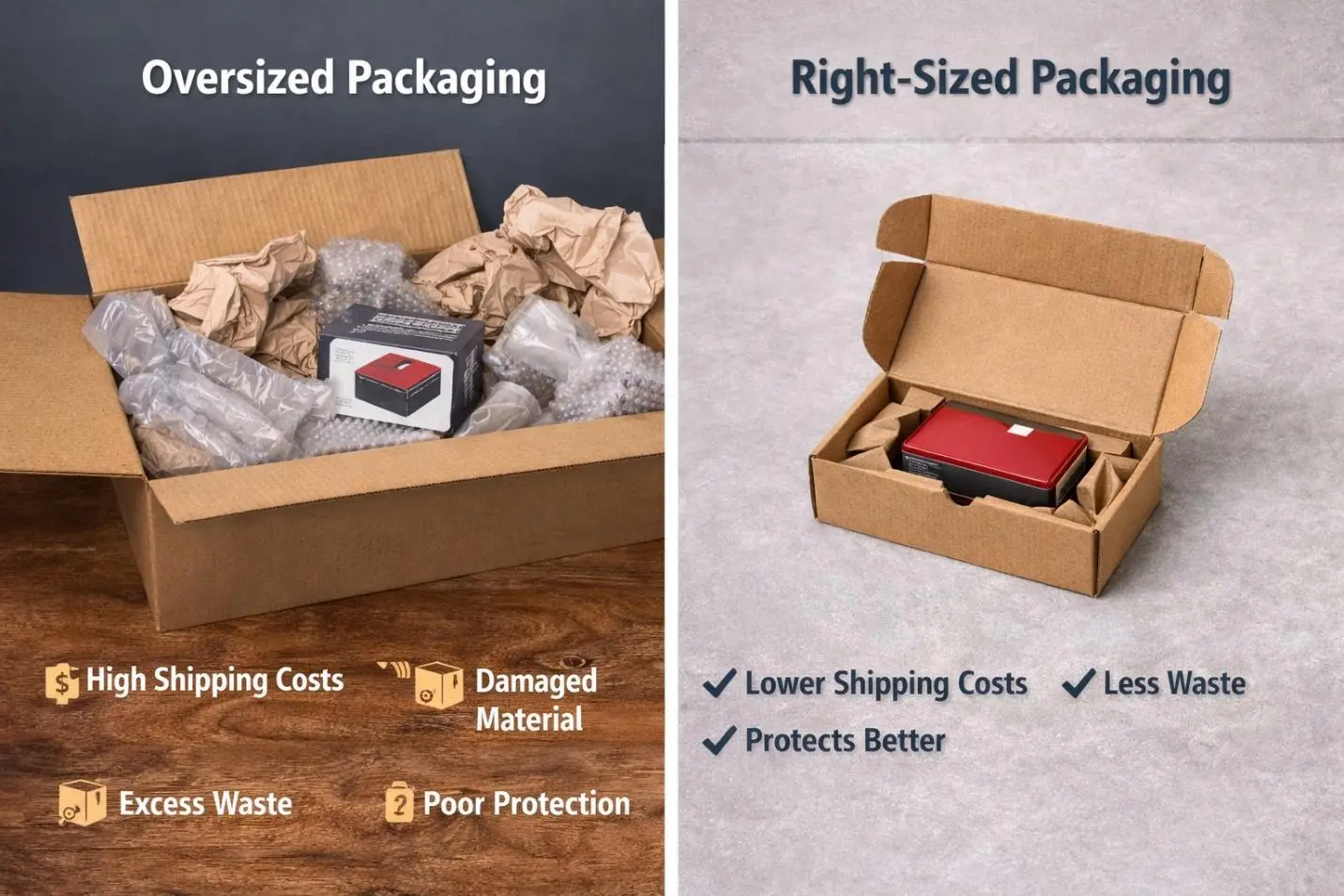
A small jar in a carton the size of a shoebox, packed out with plastic air pillows, is a design failure. It spends board, dimensional weight, and the customer's patience.
The extra material shows up on the freight bill and in the warehouse. A pack that is too light then comes back as a damage claim, and the replacement order spends the material the redesign was meant to save.
Treat the parcel as one system: product, clearance, board, insert, and the route it actually travels.
Where the extra material comes from
Most of the waste sits in a few repeatable places.
- The shipper is larger than the product plus the protection it needs.
- Void fill is doing the job the structure should do.
- The product is bagged, cartoned, and boxed again, and one of those layers has no job.
- A plastic window, a foam tray, or a film laminate puts the pack in two waste streams.
- A weak pack fails in transit, so the order ships twice.
Pull five recent orders and look at them as packed. Check whether the carton is larger than the product requires, whether every layer has a function, whether the product can slide, and whether the customer can separate the materials at the bin.
Size the carton to the product
Right-sizing means enough clearance for the insert, the lid, and normal product variation, with no empty volume beyond that.
Measure the product with caps, pumps, and any part that sticks out. Add the space the insert occupies. Then stop. Extra air becomes kraft paper, bubble, or a dimensional-weight charge.
One carton size wastes board on the small SKUs and can crush the large ones when the range is wide. Group products by footprint and fragility, then hold a short list of shipper sizes. Odd shapes can take a mailer cut to the product. A stock size still makes sense when the warehouse has to pick fast and the products cluster.
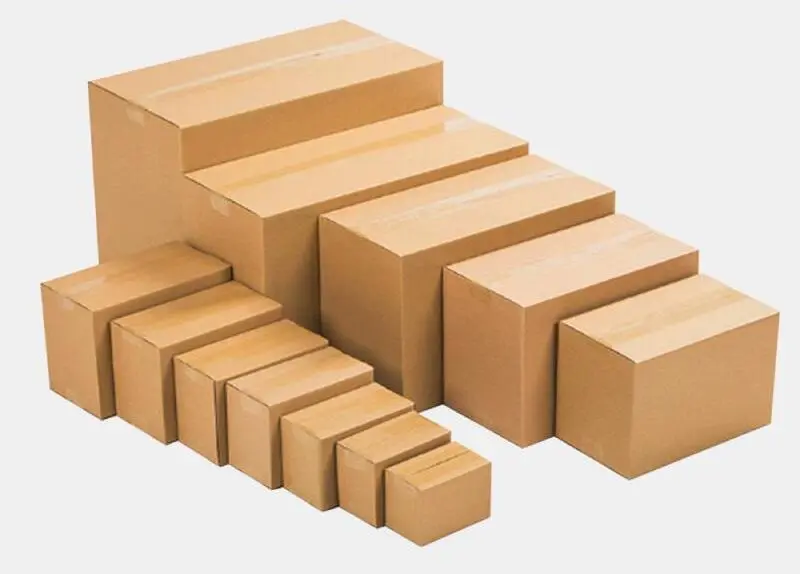
A few millimeters on a high-volume SKU changes board area and cube across the year. Confirm the gain on that SKU's actual orders.
Choose the board for the load
A folded garment and a glass bottle do not belong on the same flute.
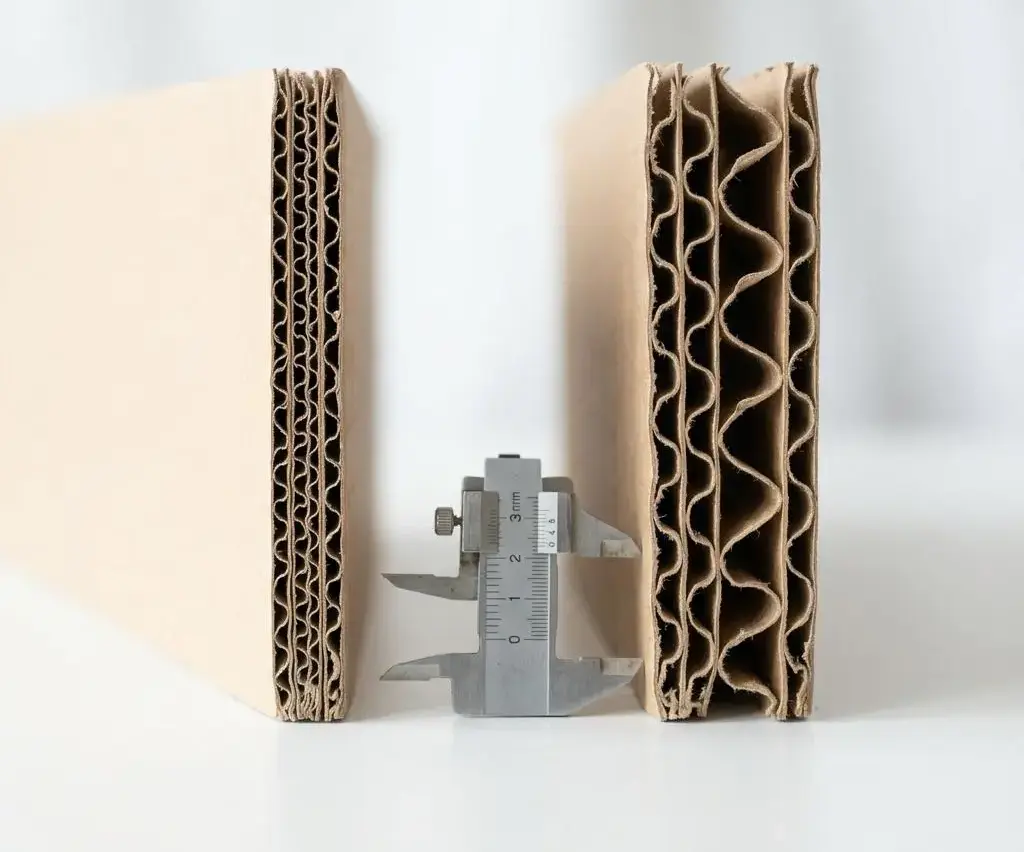
E-flute is thin. It prints cleanly and suits light mailers and retail cartons where the face is the brand surface.
B-flute is the usual e-commerce wall. It resists crush better than E and still die-cuts cleanly for locks and windows.
Double wall, often a B/C combination, is for heavier goods, longer routes, and stacks that sit in a warehouse. You are buying two flutes and three liners. Specify it when the stack or the drop needs it.
Kraft paper still works as wrap, or as a limited void fill when the structure cannot hold the product alone. Recycled liner is a fiber choice. A plastic coating or a foam insert still decides whether the parcel belongs in the paper stream.
Molded pulp fits when the product is irregular and you want a nest. Check moisture. A pulp tray that softens in a humid lane is not protection.
| Material | What it is for | Recycling note |
|---|---|---|
| E-flute | Light mailers, printed faces | Generally recyclable where paper is collected, if coatings stay light |
| B-flute | General parcels | Same condition, subject to the local mill |
| Double wall | Heavy or long-haul packs | Same fiber stream, more board |
| Kraft paper | Wrap and limited void fill | Usually accepted with paper |
| Molded pulp | Shaped nests | Usually accepted if product residue is not soaked in |
Recyclability depends on coatings, adhesives, contamination, and the mill that takes the bale. FSC-certified board is available on request when the brand needs a chain-of-custody claim. It is not assumed on every order, and the claim does not replace a recyclability check.
Let the structure hold the product
Extra cushion is often a patch for a blank that does not locate the product.
A paperboard or pulp insert cut to the footprint stops a bottle walking into its neighbor. A three-bottle cosmetics set needs compartments. One insert can locate, separate, and take a light shock, which removes a loose-fill layer.

A corrugated mailer with a locking lid can be the shipper. A folding carton inside an outer carton is an extra layer unless the inner carton has a retail job. Assembly of a locking mailer is a fold and a lock, which is what the packing table actually times.
If one part can do two jobs, drop the second part. Then test. A compact blank still crushes when the caliper is wrong for the weight.
Test before you scale
A lighter board can look fine on the bench and fail in a sortation hub.
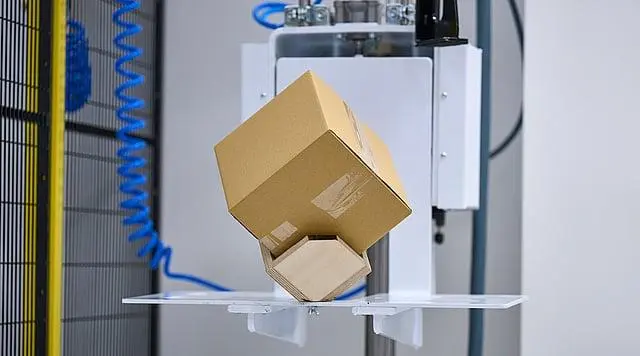
- Drop. Specified heights and orientations, product inside, insert in place.
- Compression. Stack load in storage and on a pallet. Put the safety margin in the spec.
- Vibration. Finds rub, scuff, and caps that walk loose.
- A named transit protocol. ISTA publishes procedures by distribution channel. An informal bench drop is a development check. It is not an ISTA test until the procedure, the weight class, and the lab are named.
After launch, track board per order, freight per parcel, damage and reship rate, packing time, and complaints that mention the box. A change that cuts material and raises returns has not saved anything.
A white sample in the target flute, loaded with the real product, shows those problems before a production die is committed.
Keep the unboxing, drop the extra layers

A mailer can carry the brand without a second gift box. One or two inks, a clear type hierarchy, and a matte aqueous coat are enough for many lines. Emboss or a small foil can sit on the face when glue areas stay clean and the coating is one the brand can defend in a recycling conversation.
Film lamination, plastic windows, and foam are the parts a customer cannot put in the paper bin. Paper tape, water-based ink, and a paper insert keep the parcel in one stream where that grade is collected.
The inside panel can hold a short note or a use instruction. That is board you are already shipping. Tell the customer how to separate the pack. Print a specific claim, such as the recycled content or the coating type, only when you can support it. In the United States, the FTC Green Guides expect that specificity. In the EU, the Packaging and Packaging Waste Regulation (PPWR), Regulation (EU) 2025/40, has applied since 12 August 2026 and pushes minimisation and recyclability. A vague green line is a liability in both markets.
What a tighter pack looks like
This is a layout comparison, not a measured case.
| Loose pack | Tighter pack | |
|---|---|---|
| Carton | Larger than the product | Cut to product plus clearance |
| Protection | Bubble and loose fill | Fitted paper insert |
| Materials | Paper plus plastic | Mostly one fiber grade |
| Movement | Stopped by filler | Stopped by the cavity |
| Face | Plain shipper | Printed mailer, when the parcel is the brand surface |
The result depends on the product, the board, the quantity, and the carrier's dimensional rule. Measure it on the live SKU. The better pack protects the goods with the least material that has no function.
A practical sequence
- Audit current cartons, fill, damage, and freight.
- Group SKUs by weight, fragility, and route.
- Reset dimensions, and replace loose fill with structure where the product needs a fixed position.
- Sample in the production board and test the route.
- Watch damage rate and freight after launch, then adjust.
Guangzhou Tendlyn Trading Co., Ltd. has converted paper packaging since 2009, with its own plants in Foshan and Zhanjiang. The range is mailer boxes, folding cartons, rigid boxes, paper bags, and paper tubes. The minimum order is 100. A quote is written after structure, board, print, and quantity are known.
For a sample on a live SKU, send the product dimensions, the current carton, and the damage notes to info@axwp.com, +86 158 1238 1273, or WeChat trimgem.
Questions buyers ask
Is there one sustainable e-commerce pack? E-flute and B-flute mailers, kraft, and a molded pulp nest each fit different loads. Protection, fiber source, coatings, and the recycling system at the destination decide it.
Can you use less material without more damage? Often, when the cut and the insert change together. Prove it with a drop or compression check before the old carton is retired.
Are corrugated mailers recyclable? A plain fiber mailer usually is, where paper is collected. Film lamination, a plastic window, and heavy adhesive can take it out of that stream. Use the mill guidance for the countries you ship into.
How do you set the carton size? Measure length, width, and height of the product. Add insert thickness and a working clearance. Empty space needs a protective reason.
Does a paper pack cost more? The board or the die can cost more at the start. Less void fill and a smaller cube can reduce freight. Count material, make-ready, packing labor, freight, and reships. No price belongs on a spec until the structure is fixed.
