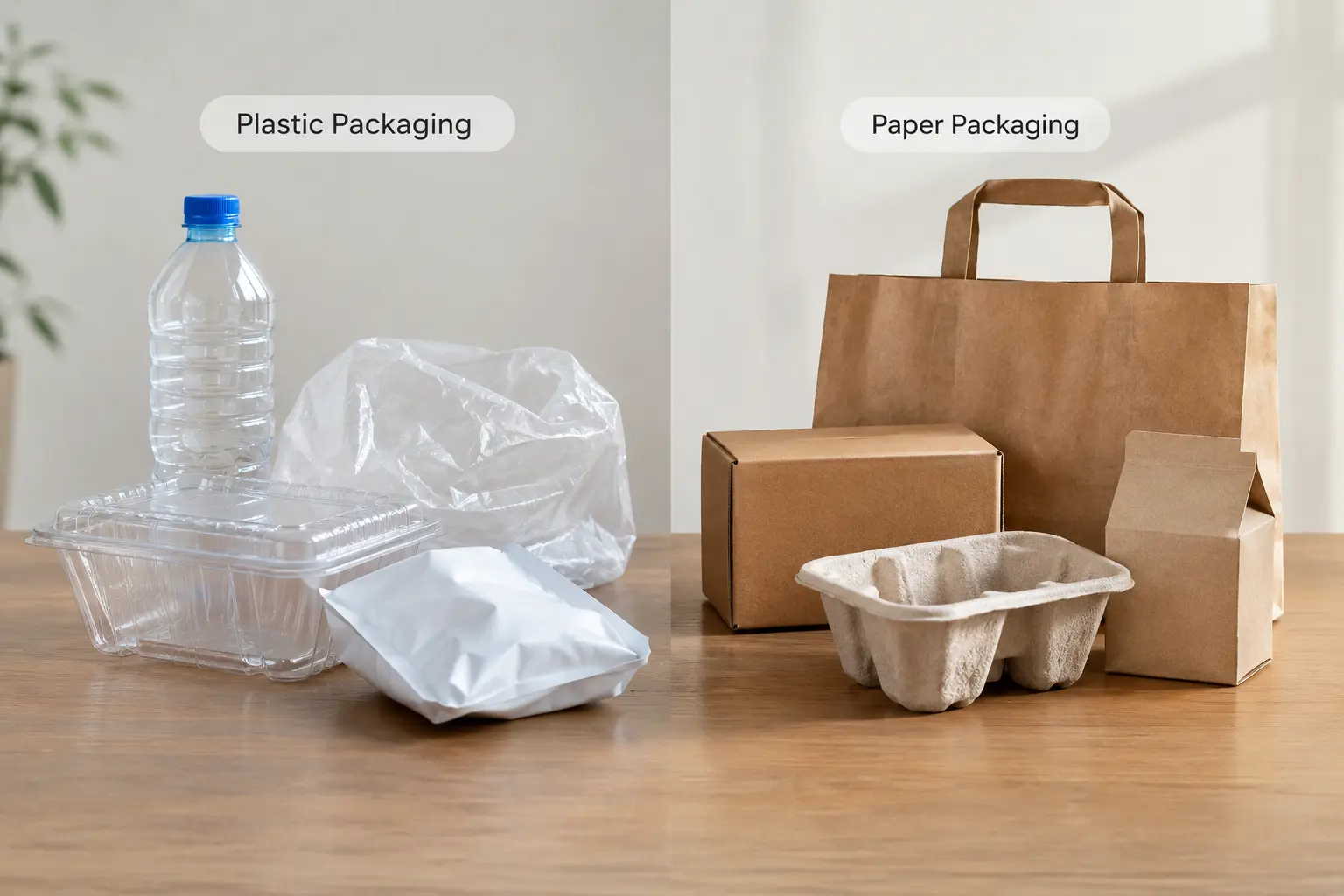
Paperization is the trade term for giving paper a job that plastic used to do. Folding cartons, kraft bags, corrugated mailers, and rigid boxes are the formats buyers ask about first. The word does not come from a regulator. Packaging Europe, Packaging Digest, and Packaging Insights have used it for the same movement: more fiber in place of multi-layer plastic, plus barrier papers and converting that try to keep the product intact.
It is a direction, not a material grade and not a certificate. It fits some categories and fails in others. Moisture, grease, shelf life, and the recycling system at the destination decide whether the swap is real.
Why the question is on the table
What shoppers have said
The research is consistent enough to plan around, and it is not universal.
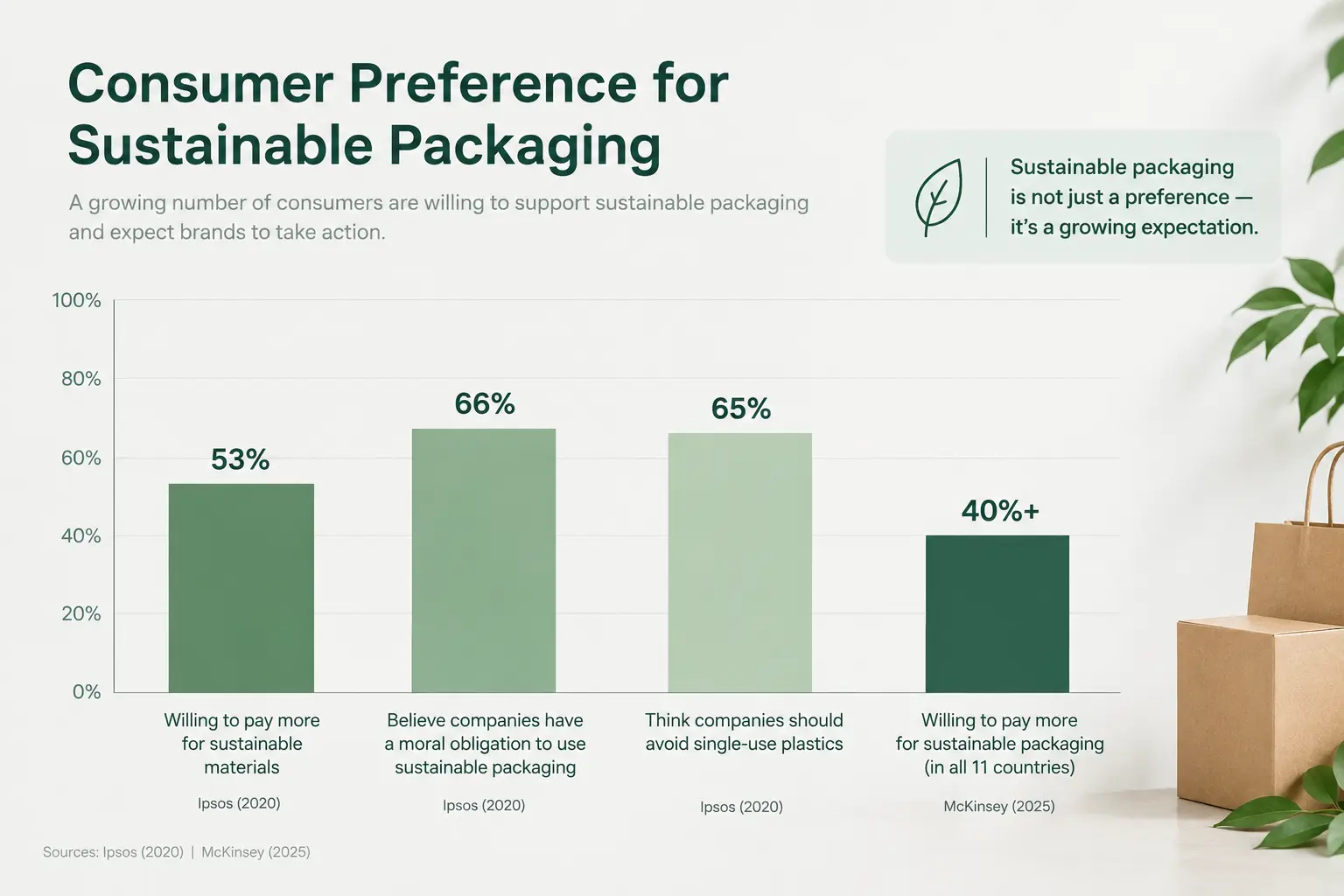
Ipsos in 2019 reported that 53% of consumers were willing to pay more for sustainable packaging (10% "significantly more," 43% "a little more"), while 43% were not. In the same study, 66% said companies have a moral obligation to use sustainable packaging, and 65% said companies should avoid single-use plastics.
McKinsey's 2025 Global Packaging Survey, covering more than 11,000 people in 11 countries, found that in every market at least 40% were willing to pay more. In some markets the figure was above 80%. Japan, often the price-sensitive end of that set, still sat at 40%.
A paper pack can support that preference. It does not create it if the product arrives damaged or the claim is vague.
Regulation
In the EU, Regulation (EU) 2025/40 (PPWR) has applied since 12 August 2026. Packaging placed on that market is expected to be recyclable by 2030, with pressure on unnecessary material and empty volume, and with reuse and refill targets in defined categories.
Separate single-use plastic rules restrict specific formats from 1 January 2030, including plastic film around grouped goods, wrap on some pre-packed fresh produce, condiment sachets, hotel toiletry packs, and very light plastic bags. Read the current list for your category before you treat a date as a ban on every film.
A paper outer is not a free pass. EU guidance on single-use plastics has treated some paper-based composites that still contain plastic — commonly discussed at 5% plastic or more — alongside plastic formats. Coatings, adhesives, and windows count. Check the text that applies to the pack you are placing on the market.
Outside the EU, OECD work on extended producer responsibility describes fees that follow packaging onto the producer. UNEP has noted dozens of countries running EPR schemes, alongside single-use plastic limits. A U.S. brand can meet a state EPR program and still fail an EU recyclability grade with the same SKU. Specify by market.
What the pack communicates
On beauty, food gifts, and anything opened in front of someone else, texture and structure do part of the selling. Emboss, foil, and a rigid lid are available on paper. They are also the details that can complicate recycling. Use them where the brand can explain them.
Paper and plastic on the points that change a spec
Neither material wins every row. Write the requirement first: barrier, life, route, and where the empty pack will be sorted.
| Point | Plastic | Paper |
|---|---|---|
| Recyclability | Depends on resin and whether the local sort can take it. Multi-layer films often cannot. | Uncoated or lightly coated fiber is widely collected. A plastic content that trips composite rules may not be. |
| Sort infrastructure | Flexible films are the weak spot in many regions. | Fiber collection is broader in the U.S. and the EU, and still local. |
| Print and texture | Functional. Fewer tactile tools. | Emboss, foil, soft-touch, and die-cuts are ordinary converting steps. |
| Small-run cost | Existing molds can be cheap per unit once they exist. | Board, coating, and finishing set the cost. Mid and long runs are where a custom blank usually settles. |
Read the full bill of materials. The visible face is not the pack.
Formats that have actually moved
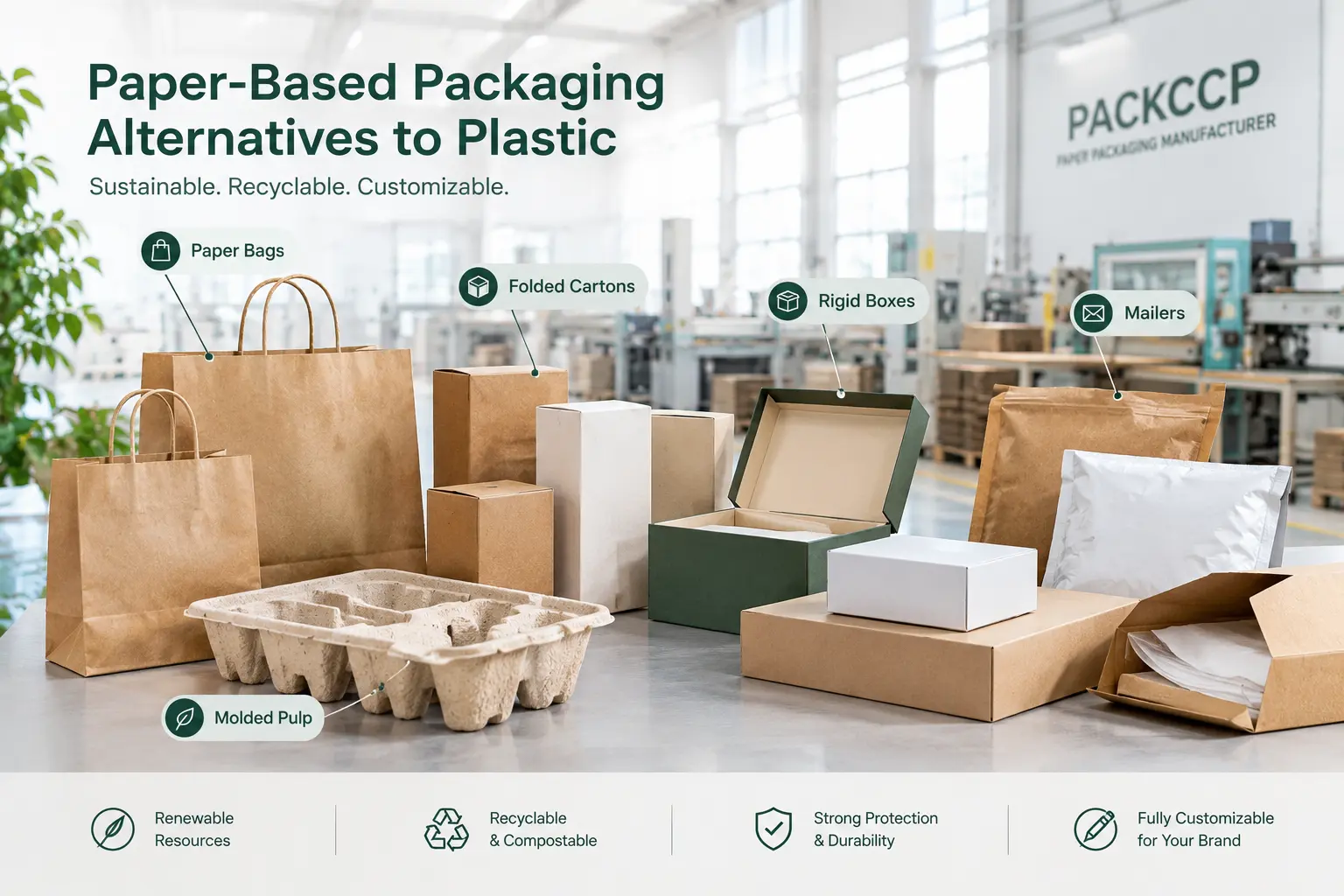
- Kraft bags in place of retail and grocery film bags, in apparel, food service, and gift retail. Handle, basis weight, and a grease barrier if the product needs one.
- Corrugated mailers in place of poly mailers, when the brand wants print and a paper stream. Size them to the product or you have only swapped one oversized pack for another.
- Rigid paper boxes in place of clamshells and blisters for accessories and premium retail, when a shipper outside the rigid box is part of the plan.
- Molded pulp in place of expanded polystyrene for irregular and fragile goods. Test humidity and shock. Pulp is a nest, not a foam equivalent, until the geometry does the cushioning.
| Plastic format | Fiber option | Where it shows up |
|---|---|---|
| Shopping bag | Kraft bag | Retail, apparel, gifts |
| Primary or secondary plastic carton | Folding carton | Cosmetics, dry food, general goods |
| Plastic gift pack | Rigid box | Jewelry, electronics, luxury sets |
| Poly mailer | Corrugated mailer | E-commerce and subscriptions |
| Foam insert | Molded pulp or a paperboard/corrugated insert | Electronics and fragile goods |
High moisture, a long grease barrier, or a seal that has to hold a liquid may still need a coating or a structure paper cannot copy. Name that limit in the brief so the sample is not judged against a job it cannot do.
Specifying by category
- Cosmetics and skin care. Print and stiffness first. Liquids need a primary pack that holds the formula. The carton is secondary unless you have designed it to touch the product.
- Food. Grease, moisture, and oxygen are coating decisions. "Paper" is not a food-contact statement. The board, the ink, and the adhesive need a status for that food and that use.
- Electronics. The insert has to match weight and what can crack or scratch. A corrugated cradle or a pulp nest is a design, not a material swap.
- Jewelry. A rigid box, foil, and emboss carry the perceived value. Magnets and a foam tray are the parts that make disposal harder. A paperboard insert is the simpler fiber choice when it holds the piece.
Three technical choices show up on every one of these: board caliper matched to the load, the coating that does the barrier, and whether an FSC claim is required. FSC-certified board is available on request. It supports a chain-of-custody statement. It does not make the pack recyclable, plastic-free, or compliant with PPWR.
Questions buyers ask
What is paperization? The growing use of paper for packs that plastic or other fossil-based materials used to make, where the product and the recycling system allow it.
Why are brands moving? Shopper preference, brand presentation, and rules such as the EU PPWR and single-use plastic limits. Cost still has to work after board, coating, and freight are counted.
Which paper formats replace which plastics? Kraft bags, folding cartons, mailers, rigid boxes, and molded pulp or paper inserts. The product's protection requirement picks among them.
Is paper always the lower-impact choice? No. Sourcing, coatings, converting, transport, reuse, and local collection all move the result. Judge the SKU.
Can paper survive shipping? A corrugated box, a reinforced paperboard structure, or a molded pulp insert can, when it is designed for that product and tested on that route.
How do you choose? Dimensions, weight, what can break or scuff, print, quantity, and the rules of the market you sell into. Then sample.
Guangzhou Tendlyn Trading Co., Ltd., founded in Guangzhou in 2009, converts folding cartons, mailer boxes, rigid boxes, paper bags, and paper tubes in its own Foshan and Zhanjiang plants. Minimum order is 100. A quote follows once structure, board, print, and quantity are known. Send the current plastic pack and the product to info@axwp.com, +86 158 1238 1273, or WeChat trimgem.
