The style code and the board grade do different jobs. FEFCO tells the plant how the blank folds. Flute and ECT tell you whether that blank survives the stack. Specify both, or you will either buy wall you do not need or watch the bottom tier crush.
"Cardboard" is the loose word. On a spec it has to become corrugated fiberboard, paperboard, or a wrapped rigid box. Those are three different converting routes.
Nine styles buyers actually specify
Codes below follow the FEFCO / fibre-box usage a plant will recognize. A quote that says "mailer" or "HSC" without a code is not finished.
Regular slotted container — FEFCO 0201
One piece of corrugated, a manufacturer's joint, and flaps of equal length. The outer flaps meet at the center. The inner flaps do not, so the bottom has a gap unless you add a pad.
This is the default master carton. It runs on case erectors, stores flat, and wastes little board. Print on an RSC is usually an identifier: kraft, or one color. When every panel has to carry retail art, move to a die-cut mailer or a litho-laminated blank. The RSC stays the outer.
Full overlap — FEFCO 0203
The outer flaps overlap completely, so the top and the bottom are double board. Use it for dense hardware, glass, and parts that need the extra column strength and a more closed seam. You are buying more board than an 0201 of the same cavity. It is rarely the printed retail face.
Half slotted — FEFCO 0200
Flaps on one end only. The other end is open. Canners and beverage lines use it as a tray, often with a shrink or a separate lid. It is not the gap-free, all-flaps-meet box. That construction is the next code.
Center special slotted — FEFCO 0204
Inner and outer flaps are cut so both pairs meet at the center. You get a flush, gap-free top and bottom, which is why jars and cans stop tipping. Length flaps are half the width, width flaps are half the length, and the cut has to be accurate or the flaps miss. Some quotes still mislabel this drawing as an HSC. Ask for 0204, and look at the flap lengths.
Roll-end mailer — FEFCO 0427
A die-cut, one-piece folder. The ends roll over to build a multi-layer wall, the bottom is unbroken, and the lid tucks and locks. No manufacturer's joint, and no tape if the lock is doing its job. The face is one panel, so full-color print, a laminate, or a small foil sits there without a seam through the artwork.
This is the usual e-commerce and subscription mailer for cosmetics, electronics, and apparel. It needs a cutting die. That die is a setup cost, separate from the unit price.
Telescope — FEFCO 0301
A separate base and a lid that slides over it. Where the lid covers most of the depth, the vertical wall is double board and the height can follow a stack of variable product. You handle two blanks, and you store them as two parts.
A 0301 is still corrugated. A luxury rigid box — greyboard wrapped with printed paper — is a different plant, a different joint, and a different freight cube, because those boxes usually ship set up. Do not let a quote treat them as the same SKU with a nicer finish.

Ready-glued cases — FEFCO 07 series
These arrive pre-glued and flat. A push squares the body and the bottom locks. Styles such as 0701 and 0703 differ in the top closure. The gain is on the packing table: no bottom tape, and a flat base that does not sag the way a loose tuck can. The pre-glue is extra converting. Confirm the crash-lock or auto-lock geometry on a sample with the real product weight in it.
Bliss-style trays — FEFCO 06 series
A body panel and two end panels, joined with staples, stitches, or hot melt. Codes such as 0601 and 0606 are built for column strength on beverage and food multipacks and on retail-ready trays. They go out flat and are formed on a bliss machine. Once formed, they do not fold flat again. Fill them on site.
FEFCO's "rigid" here means a non-collapsing corrugated tray. It does not mean a wrapped setup box.
Die-cut blank
Windows, handles, integral dividers, and a cavity that follows an odd product come off a steel-rule die, flatbed or rotary. Void drops, and so can dimensional weight, when the cube matches the product. Tooling is the hurdle on a new size. At low quantity, ask whether the plant can plot a sample from the CAD file before a production die is cut.
Five-panel folder — FEFCO 0410
One scored piece wraps a long, narrow product. The fifth panel overlaps a side wall. The ends fold into several layers so a rod, a profile, or a tube does not punch through. Tape, staples, or glue close the length seam. It is the wrong tool for a cube-shaped product.
FEFCO 0420 is a different drawing: a one-piece folder with dust flaps and a hinged lid. If a supplier writes "0420" on a long-parts quote, ask which file they mean.
| Code | Style | Typical job |
|---|---|---|
| 0201 | RSC | Outer cartons, warehouse stacks |
| 0203 | Full overlap | Dense or fragile loads that need double ends |
| 0200 | Half slotted | Open trays for cans and bottles |
| 0204 | Center special slotted | Gap-free base for jars and multipacks |
| 0427 | Roll-end mailer | Printed e-commerce shippers |
| 0301 | Telescope | Two-piece corrugated, variable height |
| 07xx | Ready-glued | Fast packing, locked base |
| 06xx | Bliss tray | Heavy retail multipacks |
| 0410 | Five-panel folder | Long, narrow goods |
Interior fitments sit in the 09 series: dividers, pads, and inserts. Specify them with the box. A strong 0201 with a loose product inside still fails.
Corrugated, paperboard, and a rigid box
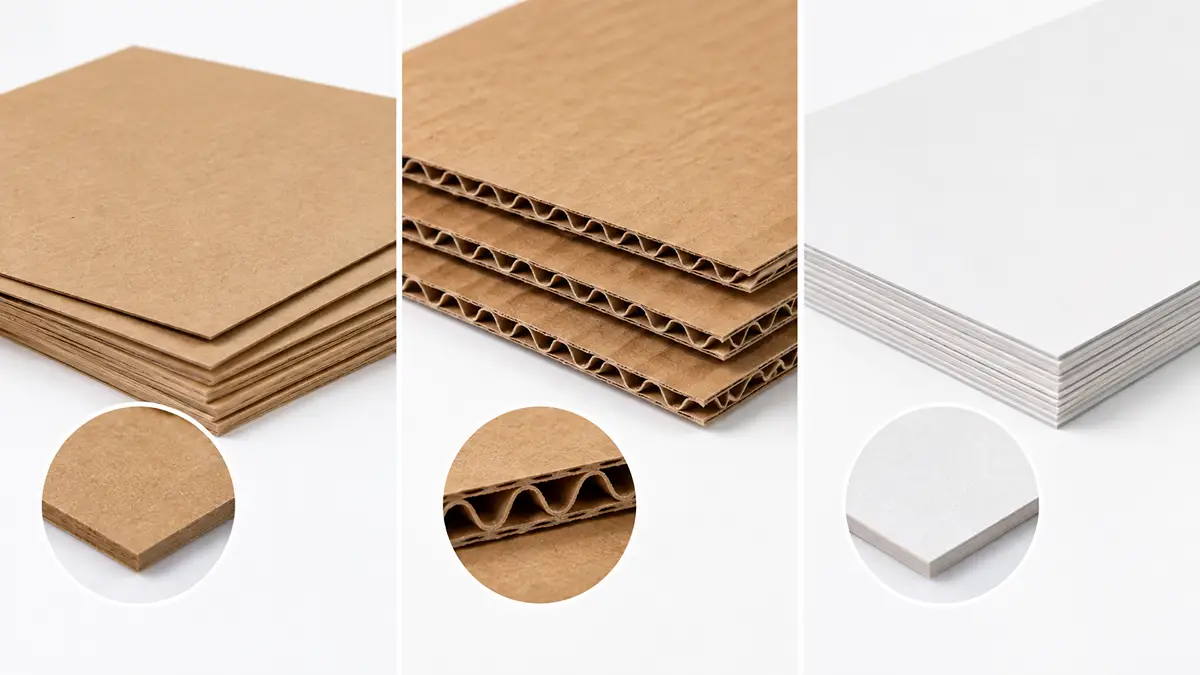
Corrugated fiberboard is liners with a fluted medium between them. The flutes are the cushion and the columns.
Paperboard is a single dense sheet: SBS, FBB, or chipboard. It folds into a carton, prints cleanly, and does not replace a shipper when the load is heavy or the route is rough.
A wrapped rigid box is greyboard cut into a tray, wrapped with paper, often with a separate lid. The strength is the board thickness and the wrap, not a flute. It is presentation packaging. It still needs a corrugated outer if it is going parcel or pallet as the only wall.
Single wall, double wall, and flute
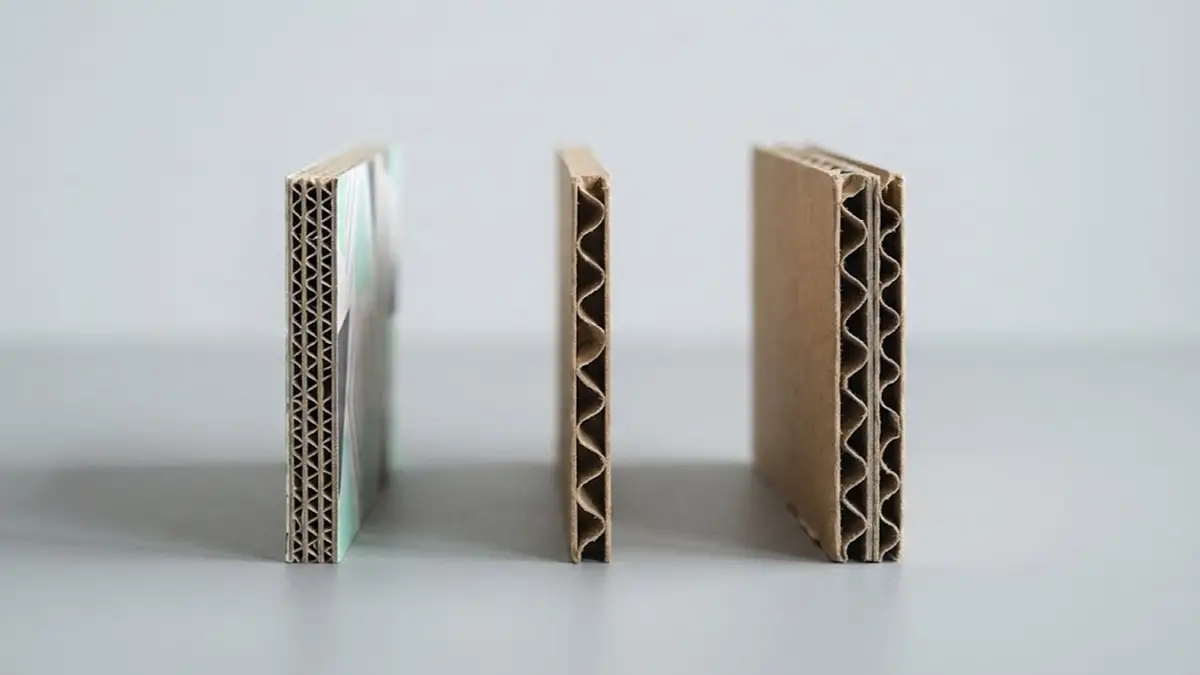
Single wall is three layers: liner, flute, liner. Thickness runs from about 1/16 inch on a microflute to about 1/4 inch on an A or C flute.
Double wall is five layers: three liners and two flutes. Thickness is often about 1/4 to 3/8 inch. You buy it when puncture, stack height, or a long export leg needs the second flute.
Edge crush test (ECT) measures force along the edge of the board before it buckles. Single-wall grades are commonly discussed from about 23 to 55 ECT. Double-wall grades sit higher, often in a 42 to 82 ECT band. The number on a box maker's certificate is not a promise that any size box will hold any weight. Compression of the finished box depends on perimeter, flute, humidity, and how long the load sits. A planning factor used for warehouse stacks is often around four times the expected static load. Time under load and moisture can demand more. Put the required box compression in the spec, then test it.
Flute, in practical terms:
- C flute is the general-purpose shipping wall: cushion and stack in one profile.
- B flute resists crush and die-cuts well. It is the usual mailer wall.
- A flute is the tall cushion. Less common on printed retail faces.
- E flute (about 1.0–1.8 mm) prints and saves cube. Retail cartons and light mailers.
- F flute (about 0.6–1.0 mm) is the smoother cosmetic face.
- B/C double wall (about 6–7 mm) is a common export combination: one flute for crush, one for cushion.
- A structural flute laminated to an E flute outside gives a printable face on a stronger body.
How to choose

Start with the product: weight, dimensions, what breaks or scuffs, and how high the pallet will be stacked. Then pick wall count and flute. Then pick the style.
Use a plain 0201 when the carton is an outer and nobody sees it. Use a 0427, a ready-glued 07, or a die-cut when the box is the thing the customer opens. Use 0203 or double wall when the load is dense or the stack is tall. Use 0410 when the product is long and the ends take the hits.
Moisture, many handlings, and parcel sortation all raise the board you need. A water-resistant coating is a separate spec from ECT. It also changes how the plant glues and how a mill will take the fiber back.
Then prototype. An ISTA procedure or an ASTM D4169 distribution test belongs on high-risk lanes. Name the procedure before you scale. A bench drop is a useful screen. Call it a bench drop.
Stock sizes and a custom cut
U.S. stock bands exist so a warehouse can reorder without a die. Makers measure them internally.
- Under about 4 inches. Small retail units, jewelry, samples.
- Around 6 × 6 × 6 in to 8 × 6 × 4 in. Light apparel and accessories, usually single wall.
- Around 12 × 9 × 6 in to 12 × 12 × 12 in. Mixed e-commerce orders and kits.
- Up toward 24 × 24 × 24 in. Bulk and retail distribution, often double wall once the load and the stack demand it.
Leave the stock size when the void is large enough to need fill, when dimensional weight is billing you for air, when the product is long or flat, or when the outer has to match a pallet pattern. A custom mailer or RSC from 100 pieces is a normal production quantity at Guangzhou Tendlyn Trading Co., Ltd. The cutting die, if the style needs one, is quoted with the job. The unit price follows structure, board, print, and quantity.
What people ask
What is the most common box? FEFCO 0201, the regular slotted container. Outer flaps meet. It stores flat and erects on standard equipment. Keep it plain when it is an outer. Put the print on the mailer the customer sees.
Single wall or double wall? Single wall is one flute between two liners, and it covers most parcels. Double wall adds a flute and a liner for stack and puncture. Match it to pallet height and the route.
What should an e-commerce brand use? A 0427 roll-end mailer or a ready-glued 07 when the box is the unboxing. A single-wall 0201 when the carton stays unseen behind a retail pack.
What does ECT mean? Edge crush test: how much load the board edge takes before it buckles. Use it with box size and stack height. It is not a substitute for a compression test on the finished box.
Can a custom size start small? Yes. Tendlyn's minimum is 100. A new steel-rule die is still a setup. Ask for a plotted sample when you are proving fit and do not yet want that die.
What is a FEFCO code? A four-digit structural code. The first two digits are the family (02 slotted, 03 telescope, 04 folder, 05 slide, 06 bliss-style, 07 ready-glued, 09 fitments). The last two are the variant. The code does not set the size.
Are these boxes recyclable? Corrugated and paperboard are widely recovered as fiber. Coatings, tape, plastic windows, and metal staples change what a mill will accept. A wax or a heavy film is a different conversation from a plain kraft RSC.
Tendlyn was founded in Guangzhou in 2009 and runs its own plants in Foshan and Zhanjiang. Folding cartons, mailer boxes, rigid boxes, paper bags, and paper tubes are the range. FSC board is available on request. Send the product size, the route, and the style code you think you need to info@axwp.com, +86 158 1238 1273, or WeChat trimgem.
