To measure a box, record length × width × height (L × W × H), state whether those numbers are internal or external, and name the unit. For a gift box or a mailer, the numbers are unfinished until the real product, the insert, and the closed lid have been checked together.
A bottle can sit in the open cavity and still touch the lid. A drawer can match the drawing and still jam in the sleeve. Both are cheap to fix on a sample.
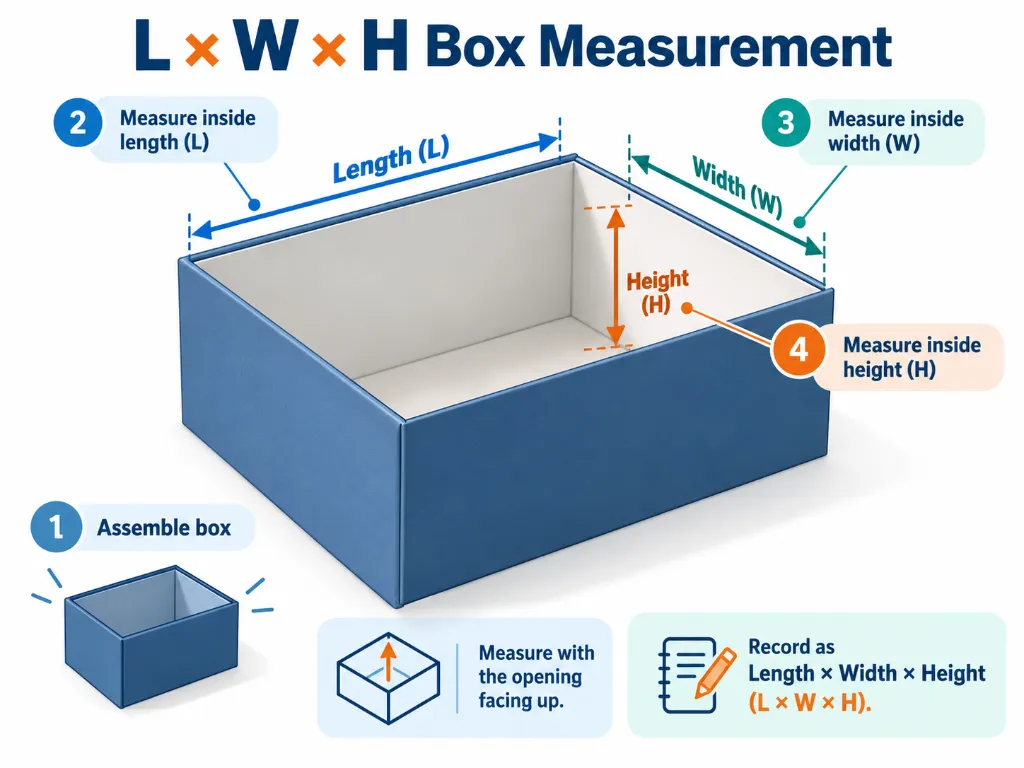
Length, width, and height
Use a rigid ruler or a tape. Put the assembled box on a flat surface. A caliper helps on small cartons and on board thickness.
- Assemble the box. Square the corners and lock the flaps. Take a loose insert out if you are measuring the cavity.
- Internal length (L). Opening up, measure the longer inside edge between the finished walls.
- Internal width (W). Measure the shorter inside edge on the same plane. Keep the ruler square. A diagonal reading is not a width.
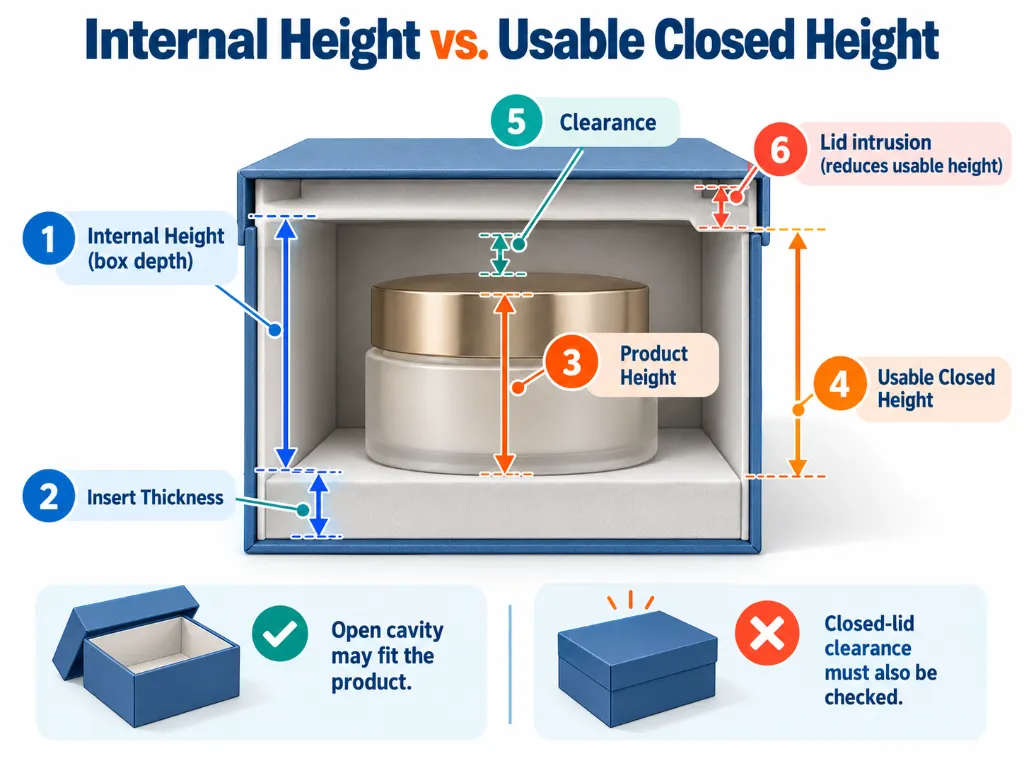
- Both heights. Measure inside depth from the finished base to the opening. Then close the lid and measure usable closed height over the product. A shoulder, a recessed lid, or an internal flap can steal that space.
- Repeat and label. If a wall bows, or the box is wrapped by hand, check more than one position. Write L × W × H, the unit, and whether the figure is internal, external, or usable closed height.
For the external size, close the box and measure the greatest overall length, width, and height, including a lid that overhangs. On an unusual opening direction, the approved dieline labels win. Some plants call the third axis depth. Say which word you are using.
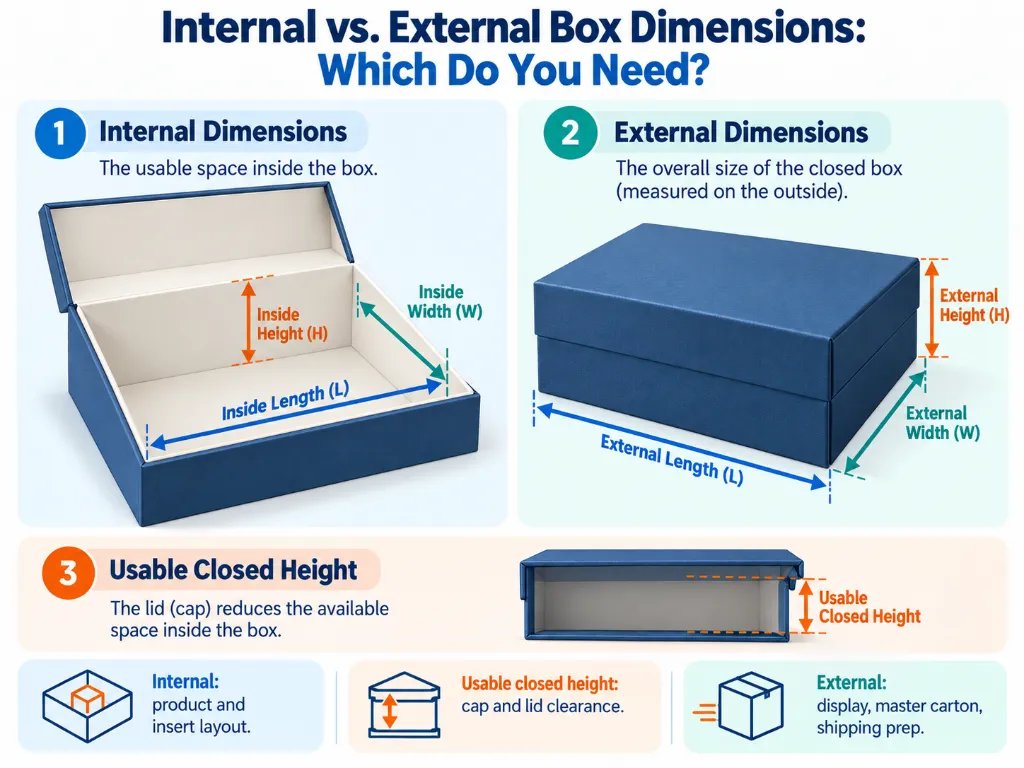
Internal or external
Use the dimension that matches the decision.
| Measurement | What it is | Use it for |
|---|---|---|
| Internal dimensions | Clear space inside the body | First layout of product and insert |
| Usable closed height | Space left with the lid shut | Cap, pump, and lid interference |
| Insert cavity | Finished space around each item | Retention, packing, and removal |
| External dimensions | Largest size of the closed box | Shelf, master carton, and freight |
Greyboard, wrap paper, and lid turn-in change the outside size of a rigid box. Adding one board thickness to every internal face will not give you the external size. Measure the assembled sample.
Factory axes and carrier axes
A tall display box can be specified as 120 × 80 × 200 mm (L × W × H) because the opening is the length–width plane. The same box, packed and closed, may be booked as 200 × 120 × 80 mm because the carrier calls the longest outside edge the length. The box did not change. The axis name did.
For freight, measure the packed outer parcel, including bulge and anything that projects. UPS describes longest-side measurement and rounding for U.S. parcels. EU parcel tariffs use the greatest outside edges as well, and each carrier publishes its own divisor for volumetric weight. Apply rounding only when you are rating a shipment. Keep the unrounded millimeters on the manufacturing drawing.
A published Canada Post example shows the arithmetic cleanly: a 100 × 60 × 20 cm parcel is 120,000 cm³. Divided by 5,000, the volumetric equivalent is 24, against an actual weight of 8 kg in that Xpresspost illustration. It is a worked example of why outside size matters. It is not a recommended box size. See Canada Post's calculation notes.
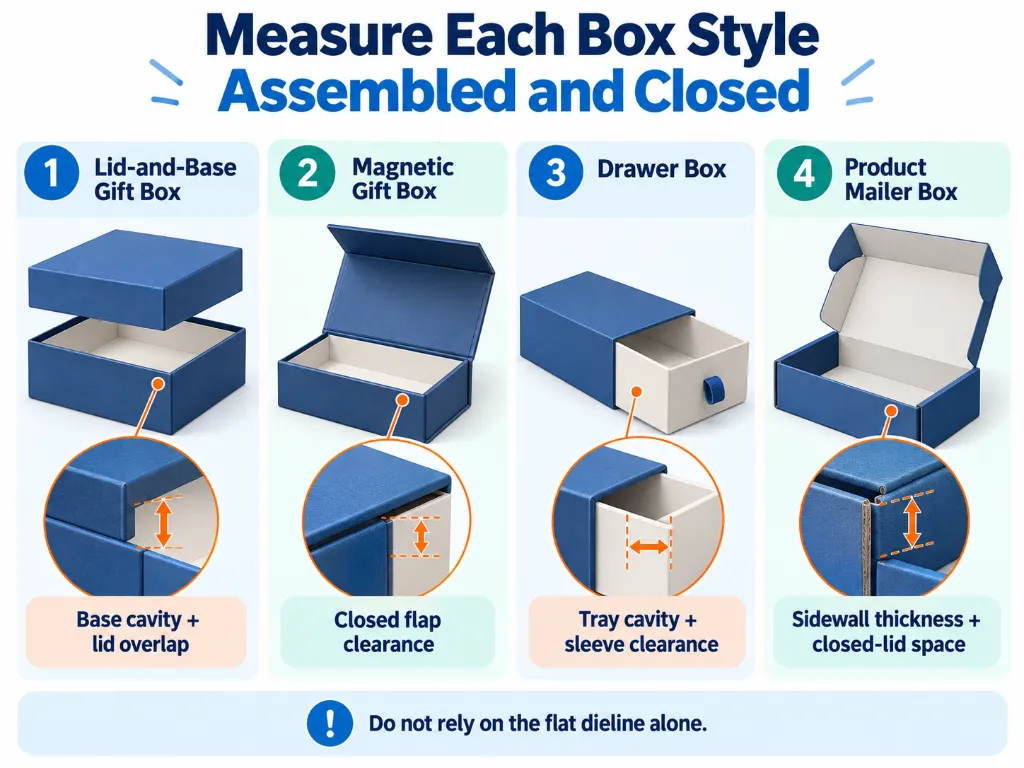
Gift boxes and mailers
Measure each style assembled and closed. A flat dieline does not include wrap, turn-in, or how far a lock actually sits.
| Style | What to check |
|---|---|
| Lid-and-base rigid box | Base cavity, lid overlap, usable height with the lid on |
| Magnetic rigid box | Clearance under the closed flap and around the magnet or shoulder |
| Drawer box | Tray cavity, tray outside size, sliding clearance in the sleeve |
| Corrugated mailer | Sidewall thickness after folding, lock tabs, insert space, clearance under the lid |
A lid-and-base box and a drawer can share a nominal size and pack differently. Approve each construction on its own sample.
Clearance for the product and the insert
Start from the real product: cap, pump, handle, sleeve, and any accessory that ships in the same box. For a set, measure the arranged layout.
Three things occupy the cavity:
- Insert thickness. Platforms, partitions, and cavity walls.
- Working clearance. Room to load, to remove, and to absorb normal product variation.
- Extra contents. Cards, ribbon, and tissue change the closing height.
Worked example. A product is 30 mm high. It sits on a 6 mm platform and needs 2 mm above it. The layout needs 38 mm of usable closed height. The 2 mm figure is an illustration. It is not a universal clearance. The allowance depends on the product, the structure, and the tolerance you can hold.
Tightening every cavity until the product cannot move will scuff labels and make removal a fight. Support the product at chosen contact points, and leave a path for the hand.
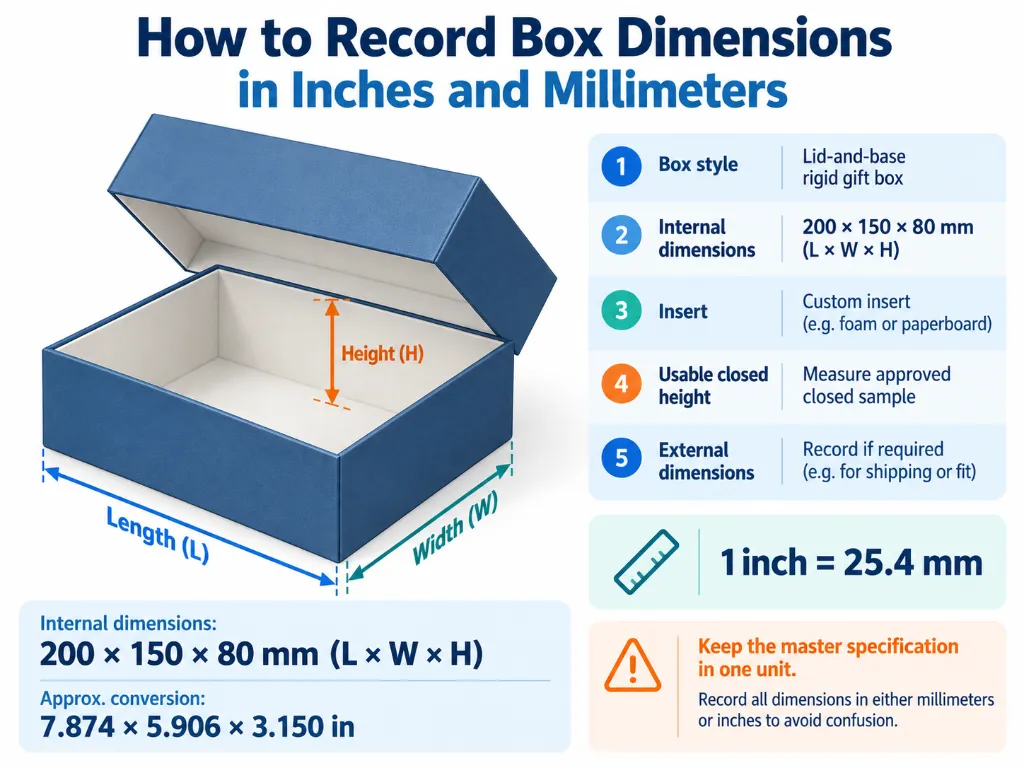
Inches and millimeters
Keep one master unit on the approved drawing. Add an inch conversion beside it when the U.S. team needs it.
1 inch = 25.4 mm.
A record can look like this:
| Item | Recorded detail |
|---|---|
| Box style | Lid-and-base rigid gift box |
| Internal dimensions | 200 × 150 × 80 mm (L × W × H) |
| Inch reference | 7.874 × 5.906 × 3.150 in |
| Insert | Paperboard tray; cavity approved on sample |
| Usable closed height | Checked with the real product and the lid shut |
| External dimensions | Taken from the approved closed sample |
| Shipping parcel | Measured again after final packing |
Tooling uses the unrounded metric figures. A labeled photo stops a sideways opening being read as a vertical one.
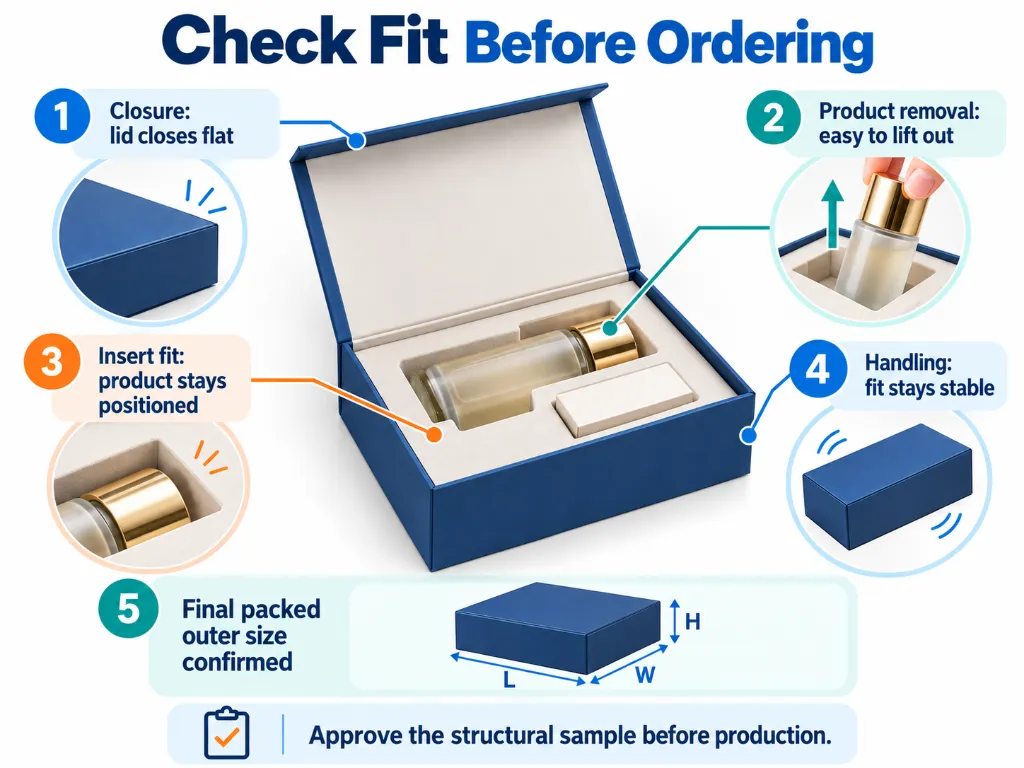
Check the fit before you order
Load a structural sample with the real products, the insert, and the printed pieces. Check it the way a packer loads it and the way a customer opens it.
- Closure. The lid shuts without touching the product or lifting at a corner.
- Removal. Each item comes out without force and without damage.
- Insert. The product stays put when the box is tilted.
- Drawer. A loaded tray slides, with play you intended.
- Consistency. The fit holds across several product samples.
- Parcel. The packed outside size matches the freight plan.
On a display pack, approve the rigid box, the fitted insert, and the accessory compartment as separate points. A pass on the empty box does not approve the loaded one.
Write the final internal, external, and cavity dimensions on the structural drawing once the fit is signed.
Guangzhou Tendlyn Trading Co., Ltd. cuts folding cartons, mailers, rigid boxes, paper bags, and paper tubes in its Foshan and Zhanjiang plants. The company was founded in Guangzhou in 2009. Minimum order is 100. Send internal dimensions, box style, and a product sample to info@axwp.com, +86 158 1238 1273, or WeChat trimgem, and the quote follows once structure, board, print, and quantity are set.
