A mailer can arrive in one piece and still fail. The bottles have walked, the accessory is under the tissue, and the first thing the customer sees is empty board.
The insert is what stops that. A custom mailer with an insert is a corrugated outer plus an internal structure cut around the real product. The mailer takes the route and carries the print. The insert controls position, separation, and how the product comes out.
Cosmetics, candles, devices, wellness kits, subscriptions, and gift sets need both parts drawn together.
The best insert is the one that holds the product, lets it come out, packs in a repeatable sequence, and uses only the material that job requires. The tightest cavity and the most expensive tray are different goals.

What you are specifying
Two components:
- A mailer cut to the loaded insert, not to a guess
- A tray, divider, or support inside it
Unlike shredded paper or air pillows, an insert gives each item a place.
A serum, a jar, and a facial oil can look easy on a layout. They have different weights, cap diameters, heights, and finishes. In one open cavity the heavy bottle migrates. A fitted insert limits that travel before it becomes a chip or a scuff.
Common structures:
- Die-cut cavities
- Bottle and jar collars
- Folded paperboard platforms
- Corrugated locks and bridges
- Dividers
- Multi-level trays
- Molded fiber nests
- Honeycomb pads where the load is high
Why an insert instead of loose fill
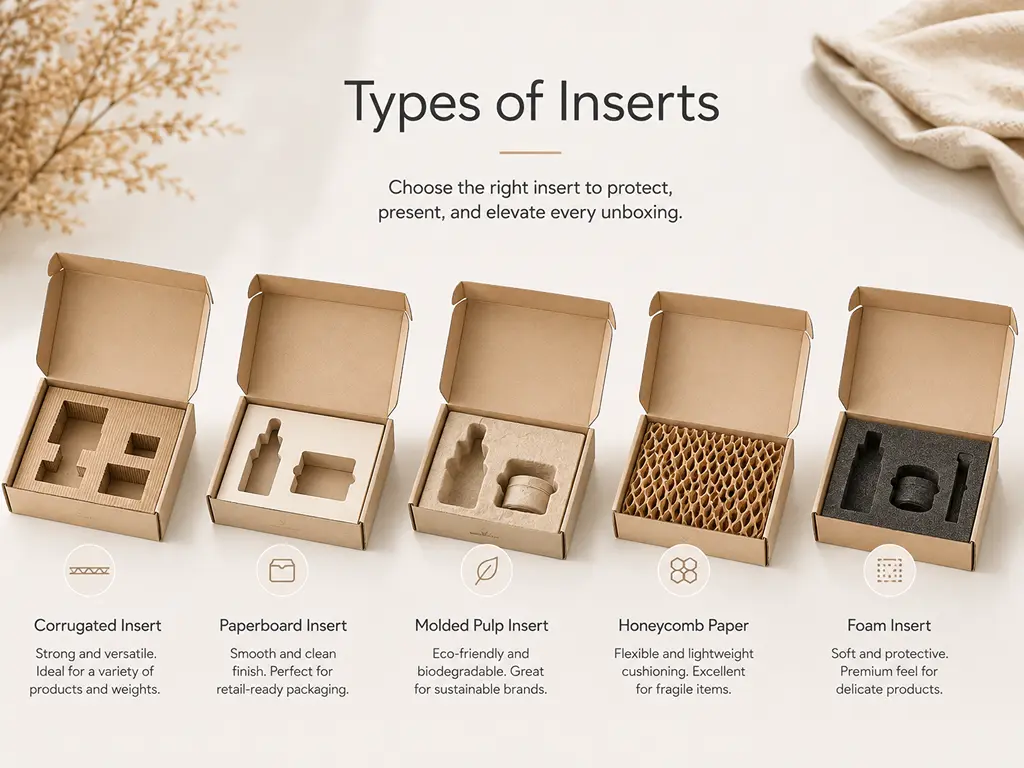
The gain is control after the parcel leaves the table.
Movement. Parcels are lifted, tilted, stacked, vibrated, and dropped. A fitted structure limits how far an item can travel before it hits another item or the wall. That matters for glass, cosmetic jars, candles, electronics, and any kit with parts that can collide.
A repeatable open. Without a structure, ten customers open ten different arrangements. A PR kit, an influencer mailer, a subscription, a launch, or a gift set is judged on the first view. The insert is the layout.
Less loose fill. A right-sized mailer and a fitted insert can retire tissue, shred, and pillows that were only there because the product could move. The U.S. EPA's packaging guidance makes the same point: efficiency is less material for the same function. Pulling cushion out and raising the damage rate is not efficiency. Read the principle on the EPA sustainable packaging page.
Which material
There is no universal insert. Start from weight, what can be damaged, the surface finish, how the box is packed, and the route.
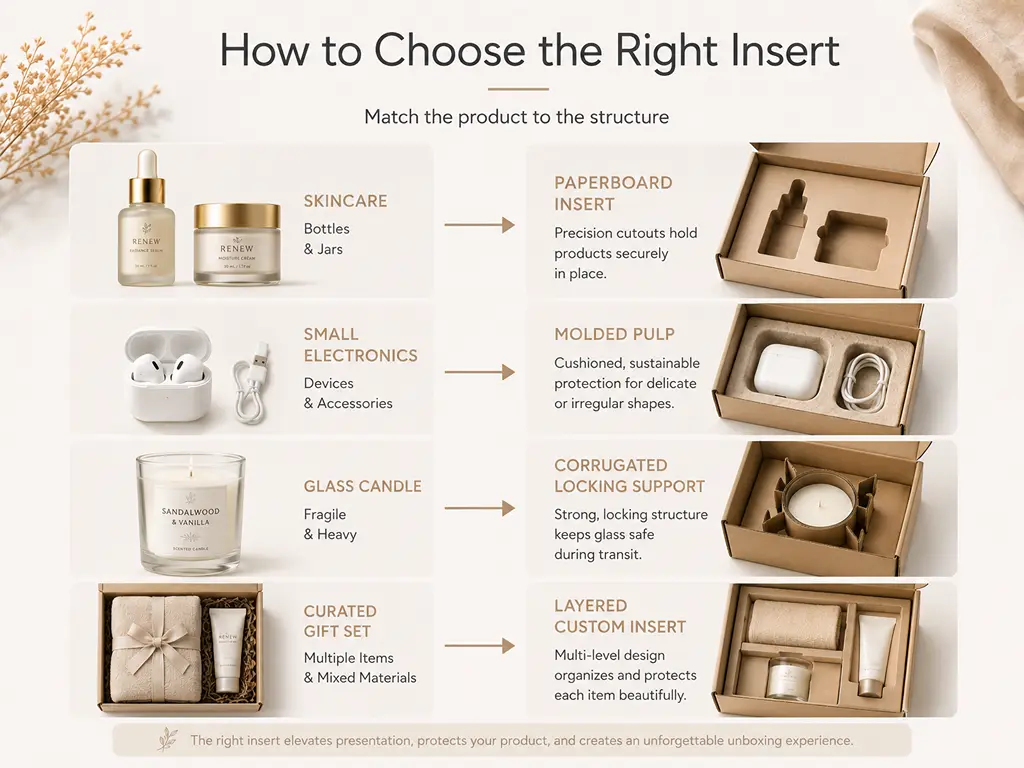
| Insert | Suits | Strength | Watch |
|---|---|---|---|
| Corrugated | Bottles, candles, electronics, heavier kits | Structure, locks, bridges | Raw flute edges look industrial |
| Paperboard | Cosmetics, accessories, light kits | Clean face, can be printed | Little cushion for a heavy piece |
| Molded fiber | Beauty, electronics, personal care | A deep, shaped nest | Tooling, and a texture some luxury lines reject |
| Honeycomb paper | Heavy or high-value pieces | Compression | More structure than a light product needs |
| Foam | Fragile equipment, complex shapes | Cushion and a precise nest | Leaves the paper stream |
Foam is a comparison, not a default. If the brand's goal is a fiber pack, design the corrugated or paperboard geometry to do the holding. If it cannot, say so before the art is drawn around a tray that will be swapped later.
Corrugated

Use corrugated when the insert does mechanical work: supports, bridges, partitions, locks, multi-level platforms, without adding a lot of weight. Several heavy glass containers that must stay upright, or a product that needs support from more than one direction, usually outgrow a thin paperboard tray.
The trade-off is the edge. Exposed flute reads technical. If the brand face has to be smooth, wrap the insert or move to paperboard where the load allows it. E flute and B flute are the usual choices: E for a cleaner edge and a lighter kit, B when the piece is heavier.
Paperboard
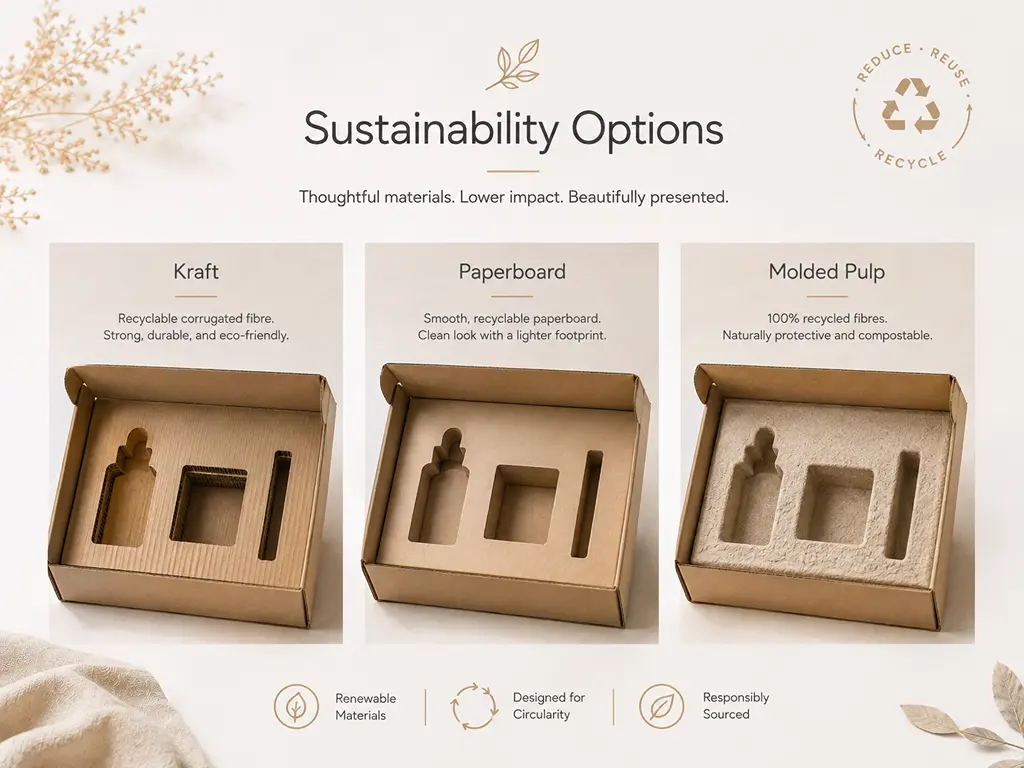
Paperboard fits when the product is light and the interior is part of the presentation: skincare sets, fragrance samples, small accessories, promotional kits. It can be printed, so a name or a one-line instruction lives on the tray and you may drop a separate card.
Buyers often ask for the cavity as tight as possible. A bottle gripped too hard is difficult to remove. Labels scuff on the cut edge. The next batch of bottles, a fraction larger, will not go in. Controlled clearance beats maximum tightness.
Molded fiber
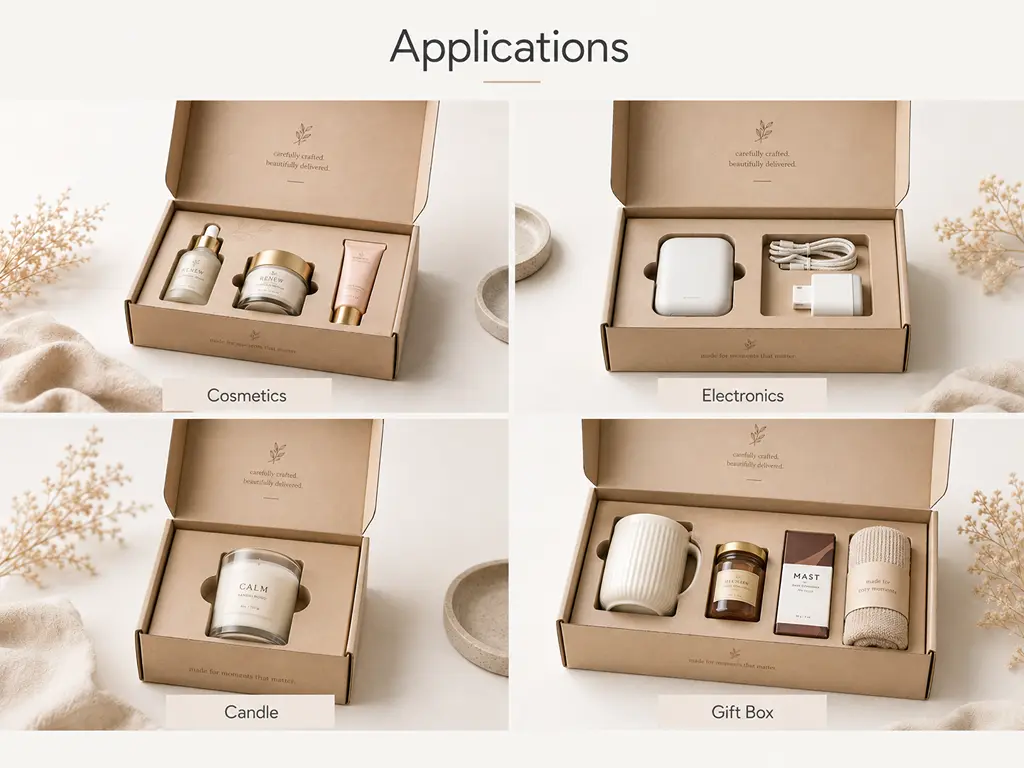
Molded pulp is the right conversation when you need a deep three-dimensional nest rather than a folded platform: cosmetics, personal care, small electronics, wellness products. The texture is part of the design. It suits a plain, material-led brand. A polished luxury interior may need a different surface or a different material.
Five questions before you pick a material
How heavy is it? A tube and a filled glass candle are different loads. Heavier pieces need support and a path for the load into the mailer wall, not a tray that folds the first time the parcel is tipped.
What can actually be damaged? Breakage is only one failure. A scratched label, a bent pump, a rubbed coating, a loose cap, two parts colliding, or a pressure mark on a decorative finish can make the unit unsellable. On a premium product, cosmetic damage is a real defect.
How much does the product vary? Nominal dimensions are a start. Bottles, jars, caps, and assemblies move from lot to lot. The cavity needs enough tolerance to accept that variation without becoming loose. Fit-critical work uses physical samples from more than one lot.
How will it be packed? A structure that looks right in a render can still be a bad commercial design. If the table needs several minutes to fold tabs and force products into openings, labor is part of the packaging cost. On a sample, count the folds, whether glue is required, the loading order, how easy it is to assemble wrong, how the product comes out, and whether the insert can arrive pre-assembled. Awkward at 100 units is a nuisance. Awkward at 10,000 units is the process.
How will it travel? A local PR drop and a parcel that crosses several hubs are different hazards. Know parcel versus pallet, weight, distance, the carrier, stacking, and the damage you already see. Treat product + insert + mailer as one system.
Tighter is not automatically safer
Eliminating every visible gap by shrinking the cavity solves one problem and opens another. On a coated glass bottle in a paperboard tray, a smaller opening can cut lateral travel and increase friction on the label.
Support the bottle lower on the body, add a folded lock, or control a different direction of movement. Design to paths and contact points. The smallest hole is not the safest hole.
A thin paperboard tray is the wrong default when the product is heavy, tall, or top-heavy. It can look correct in a photograph and collapse after repeated tilts. Corrugated locks, a multi-layer corrugated structure, molded fiber, honeycomb, or a mix of those can use less total material than an underbuilt tray plus the pads you add later to rescue it.
Draw the product first
The sequence that keeps the mailer small:
- Product dimensions
- Orientation
- Surfaces that cannot be touched
- Clearance
- Insert geometry
- Outer mailer dimensions
Choosing the mailer first and then filling the leftover space is how oversized parcels get designed.
Removal is part of the fit. Finger notches, thumb cuts, pull tabs, side openings, flexible locks, and clearance at the cap and shoulder mean the customer does not have to shake the hero product out.
A kit does not have to give every item the same area. Put the main product where the eye lands. Accessories and the card take the secondary cells. That is layout, and it is also protection.
Time it on the packing table
Judge the insert where it will be paid for. Have the people who pack the order build several samples. Revise if two tabs are easy to confuse, the tray springs open before loading, bottles have to be forced, the insert works in only one sequence, print is damaged during assembly, or accessories fall out as the lid closes.
Those fixes are cheap on a sample. They are expensive after the die is in production.
Right-size, then stop
A smaller mailer can cut board, cut loose fill, improve the pallet, and reduce dimensional weight. Clearance still has to protect the contents. A compact parcel with a higher damage rate is not a better pack.
Replacing foam with paper does not by itself make the system responsible. Count total material, protection, fiber source, recyclability, coatings, laminations, adhesives, the collection system at the destination, and the cost of a damaged reship.
Where the mailer and the insert can both be compatible fiber without giving up protection, the disposal line gets simpler. Say that. Do not say the pack is recyclable everywhere.
FSC chain-of-custody board is available on request, and an FSC claim belongs on the pack only when the order is placed and invoiced under that claim. FSC does not mean recyclable everywhere, plastic-free, compostable, or carbon neutral.
If you also sell into Australia, the APCO Sustainable Packaging Guidelines are a useful checklist: function, material efficiency, and end of life together. For the EU, the same logic shows up in PPWR minimisation: less material only when the function still holds.
Prototype, and name the test
A dieline proves geometry. It does not prove the route. On the prototype, check insertion, removal, assembly time, internal movement, contact points, closure, compression, a drop, and what the customer sees when the lid opens.
An internal factory drop or shake is useful in development. It is not an ISTA test unless you ran an ISTA procedure. ISTA's 1-Series procedures are integrity screens. The 3-Series procedures are general simulations of particular distribution hazards. Pick the procedure from the product and the route before you freeze the tooling. The catalog is at ISTA.
Four design rules show up again and again on mailers that work:
- Fix the structure, then the graphics. Art drawn around a cavity that later moves is scrap.
- One insert that locates the product can remove both loose fill and a confusing pack sequence.
- Print the insert when it replaces a card. Do not print every surface because it is there.
- Take material out only after the structure is doing the protection.
Where an insert earns its place
| Category | Why the insert is there | Typical build |
|---|---|---|
| Cosmetics and skin care | Separates bottles and jars | Paperboard or corrugated tray |
| Electronics | Holds the device and the accessories | Corrugated or molded fiber |
| Candles | Limits glass movement | Corrugated lock |
| Subscription kits | Repeats the layout | Modular paperboard |
| Jewelry and small accessories | Keeps pieces visible | Light fitted tray |
| Wellness | Mixed containers | Multi-cavity |
| PR and launch kits | Controls the first view | Printed paperboard or corrugated |
| Premium sets | Hierarchy without a full rigid box | Layered insert |
A soft apparel item in a compact mailer often gains nothing from a tray. Adding one because a "premium" pack is expected to have an insert spends material without solving a problem.
What to send for a quote
- Actual product dimensions and weight
- Photos from more than one angle
- How many pieces per mailer
- Preferred orientation
- Fragile or scratch-sensitive areas
- Shipping method and destination
- Quantity
- Any sustainability claim you intend to make
- What fails in the current pack
Physical samples matter when fit and surface protection are the issue.
Short answers
What is the best insert material? Paperboard for light products and a clean interior. Corrugated when the insert has to be strong. Molded fiber when you need a deep nest. Weight, fragility, finish, route, and the packing process decide it.
How tight should it be? Tight enough to limit travel, loose enough to load and remove, and tolerant of normal product variation. A cavity cut to one perfect sample will reject the next lot.
Can paper replace foam? Often, when the structure does the cushioning and the positioning the foam was doing. A flat swap of material names is not that design.
Are mailers with inserts recyclable? Easier when both parts are compatible fiber. Coatings, laminations, labels, and adhesives still count, and so does the local mill. Keep the claim specific.
Should one supplier draw both? Yes, in most cases. The insert sets internal size, clearance, assembly, board, and how the finished parcel performs. Two separately drawn parts rarely meet without a compromise you did not plan.
Guangzhou Tendlyn Trading Co., Ltd. was founded in Guangzhou in 2009 and converts mailer boxes, folding cartons, rigid boxes, paper bags, and paper tubes in its own Foshan and Zhanjiang plants. Minimum order is 100. Send product dimensions, quantity, and the destination market to info@axwp.com, +86 158 1238 1273, or WeChat trimgem. The quote follows once structure, board, print, and quantity are set.
