A corrugated box is liner, fluted medium, and starch. Everything after that is converting: cut, print, fold, and a test that tells you the bond held.
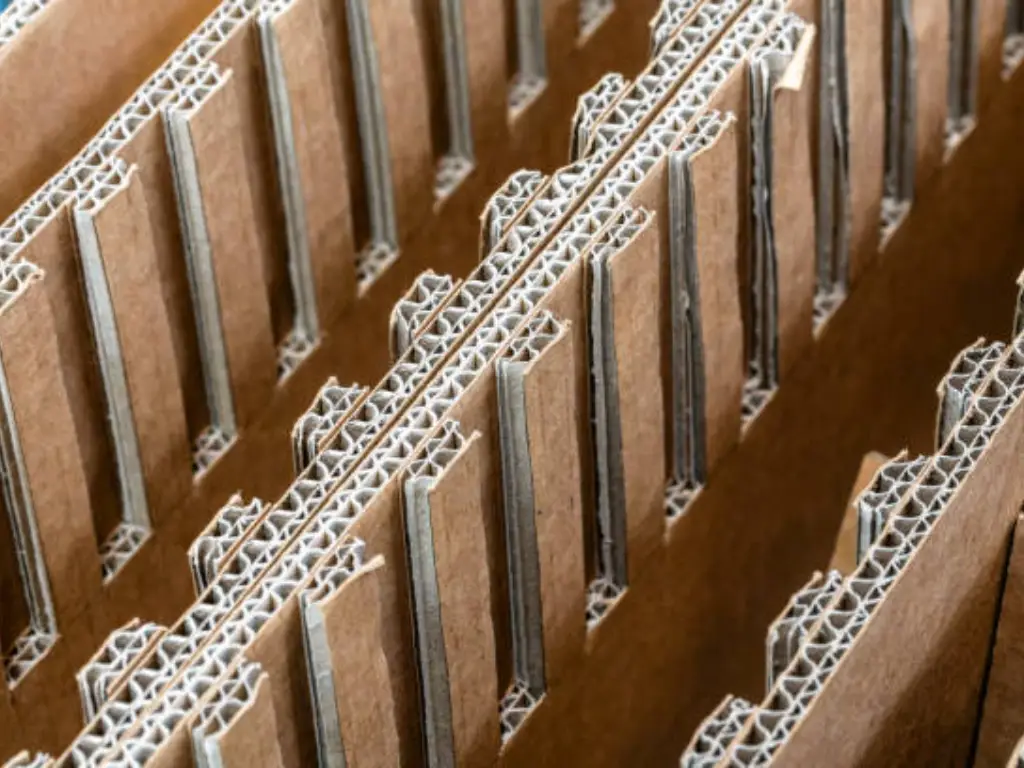
The two papers
Linerboard is the flat face. Virgin kraft liner is specified when you need tear and a cleaner surface. Recycled liner is specified for cost and for recycled content. Many boards are a mix. Say which face is which if the outside has to be white and the inside can be brown.
Corrugating medium is the paper that becomes the wave. It is usually a semi-chemical or recycled sheet chosen because it will flute and then hold the flute under load.
Not every kraft sheet will run. The mill weight has to match the flute profile, and the moisture has to sit in a narrow band or the board warps. Grammage is checked by methods such as ISO 536 and TAPPI T410. If you write “kraft” and nothing else, you have not specified a board.
Poly-coated or wax-treated liners exist for wet or greasy foods. They also change how the box recycles. Call them out. Do not let them arrive as a surprise on a standard mailer.
On the corrugator
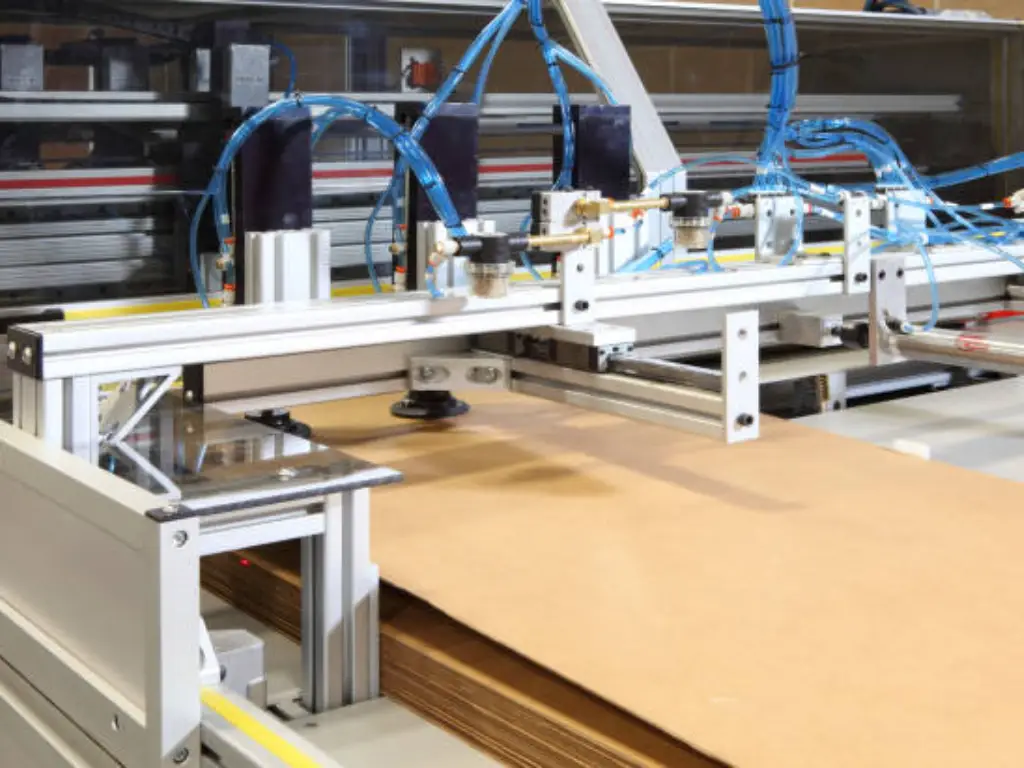
The medium is fluted
Rolls of medium are heated and steamed so the fibers will take a shape. Corrugating rolls press the sheet into the wave. The roll profile is the flute. A, B, C, E, and F are different rolls, not a setting you twist on one machine between jobs without a change.
Starch goes on the tips
The adhesive is starch, often corn. It is applied to the flute tips, then the first liner is bonded with heat and pressure. That pair is single-face board: one liner, one flute. It is flexible. Plants ship it in rolls for wrapping and for layer pads.
The second liner makes a wall
Single-face meets the second liner at the double backer. That is single-wall board: two liners, one flute. Double wall adds another single-face bond (three liners, two flutes). Triple wall adds one more (four liners, three flutes). Each extra wall adds caliper, stacking strength, weight, and board cost.
Heat sets the bond
The web runs over hot plates. The starch gels and dries. The operator is watching temperature, warp, and the glue line. A board that leaves the corrugator wet will curl overnight in your warehouse.
Slit and score
The web is slit to blank width and scored where the box will fold. Score depth is a setup, not a default. Too deep and the liner cracks on the folder. Too shallow and the box fights the person packing it.
After the corrugator
Print and die-cut

Flexo can run inline: rubber or photopolymer plates, water-based ink, shipping marks or a simple brand color in one pass with the die-cut.
Litho-laminating is the other path. The graphic is offset-printed on a coated sheet, then glued to single-face or single-wall board. Mailers and retail shippers with photographs go this way. Registration is tighter. You pick up a lamination glue line and a risk of curl.
Digital and preprint exist for other run lengths. Digital skips plates and fits short runs. Preprint prints the liner before it is fluted, which suits long runs of a repeated graphic. Screen is a specialty hit, not the production method for a shipping box.
Coatings are a separate instruction. Aqueous varnish and UV protect ink and change the sheen. UV on corrugated is usually on the litho sheet, not flooded onto raw kraft. Wax and polyethylene resist water and grease and hurt recycling. A die-cut window with film is a plastic insert. A perforation is a cut in the die. Both belong on the dieline, with bleed marked, before steel is made.
Fold and glue
The folder-gluer folds the blank and closes the manufacturer’s joint with glue, or with stitches on heavy export boxes. Sensors can kick out a misfold. They do not invent a square box if the score was wrong. Bundles ship flat. The customer erects them.
Flute, wall, and the styles plants actually cut
Caliper below is approximate. Liner weight moves it. Flute count is per foot.
| Board | Approx. caliper | Flutes per foot | Where it fits |
|---|---|---|---|
| A flute, single wall | 4.7–5.0 mm | ~33 | Cushion. Fragile goods. Coarse print face. Often an RSC or a pad. |
| B flute, single wall | 2.5–3.2 mm | ~47 | Flat-crush resistance, cleaner print. Trays, die-cuts, canned goods. |
| C flute, single wall | 3.5–4.0 mm | ~39 | General shipping. RSC and HSC. Better stacking than B on the same liners. |
| E flute | 1.0–1.8 mm | ~90 | Mailers, retail die-cuts, a flat print face. |
| F flute | 0.8–1.2 mm | 120+ | Small retail and cosmetics. Finer than E. Not a heavy RSC flute. |
| BC double wall | B+C | — | Export, heavier RSC and FOL, trays. |
| EB double wall | E+B | — | Printed retail and shelf-ready packs that still need a stronger flute behind the face. |
| Triple wall | three flutes | — | Bulk bins and freight that used to move in wood. AAA, ABC, ACC, and ACA are all real builds. |
FEFCO publishes the style codes buyers and plants share. The ones you will order most often:
- RSC (regular slotted container). Four flaps meet in the middle. The default shipping box. Common in C or B, and in BC when the load is heavy.
- FOL (full overlap). Outer flaps overlap fully, so the top and bottom are double thickness. Heavy or dense goods.
- HSC (half slotted). No flaps on one face. You add a lid, or you use it as a tray.
- Die-cut. A steel rule cuts a mailer, a shelf-ready tray, or a fitted shape. E and F are common when the face is printed. The die is part of the tooling.
- Telescope. Two pieces. The cover slides over the base. Tall or fragile goods, often double wall.
There is no standard D flute in this set. Profiles that fall between the named flutes get sold as the nearest standard, or as a mill’s own microflute. Do not write “D” on a spec and expect a shared meaning.
Tests that belong on the spec

- ECT crushes the edge of the board. It is the number that tracks how a box stacks. Specify it on the flute you are buying.
- BCT compresses a finished, empty box. Use it when the pallet pattern matters.
- Burst (Mullen) punctures the face. Older specs still use it. It does not replace ECT for stacking.
- Flat crush loads the flute from the face. It tells you whether print pressure or a strapped bundle will collapse the wave.
- Cobb measures water take-up. It matters for cold rooms and humid DCs. It does not make a box waterproof.
Glue skips, warped sheets, and type off the score should be caught before the bundle is strapped. Put the acceptance numbers in the order if you care about them. “Good quality” is not a method.
Fiber claims and coatings

FSC paper is available on request. If the claim matters, it has to be on the order and on the invoice. Water-based ink and starch adhesive are already the normal corrugated system. A plant does not become a different process because a job ticket says “eco.”
Wax, poly, and film windows are the exceptions you should see in the spec. So is any declaration of conformity. That document follows your market and your substance list. It is not a standing certificate that covers every box on the floor.
