A jewelry box fails on the piece, not in the presentation deck. A loose ring well scratches a polished band. A necklace that can slide will knot. The supplier is the plant that either holds those fits or does not.
Unit price comes last. First you need a factory that can build the structure, match the cloth, and repeat the print.
What the choice changes
The box is the first object the customer handles. Color drift, a scuffed wrap, or glue on the turn-in reads as the brand.
Protection is mechanical. The insert has to stop the piece moving. Studs that can flip will dent each other. A chain without a hook or a slot will tangle in transit. Those returns cost more than the gap between two board quotes.
A late box also moves the launch. Put sample sign-off, production start, and the ship date in writing before you book a campaign around them.
Factory or trading desk
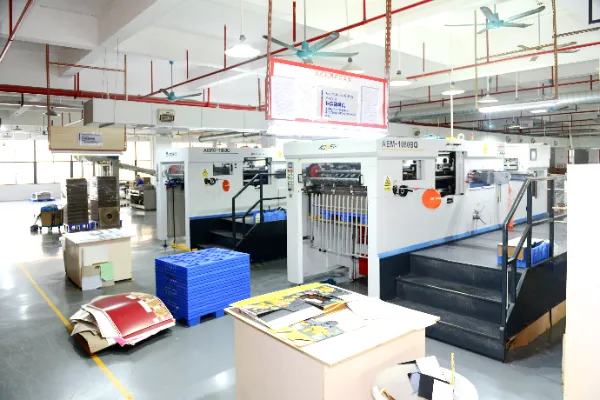
Guangzhou Tendlyn Trading Co., Ltd. was founded in 2009 in Guangzhou. The converting plants are in Foshan and Zhanjiang. The work on those floors is folding cartons, mailer boxes, rigid boxes, paper bags, and paper tubes. It is not a trading desk that forwards your dieline and your deposit.
Use a factory when the box is specific: a set caliper, a velvet or faux-suede wrap, a magnet, a foil stamp, or an insert cut to one ring or one chain. You want the people who set the die and the wrap grain in the same building as the sample.
A trader is a reasonable layer when you are collecting unrelated items and you have no one to coordinate them. You give up a direct look at board, adhesive, and make-ready. For a jewelry rigid box, that is usually the wrong trade.
What to check before a bulk order
Walk the spec in this order.
Fit. Internal size includes the insert, not only the jewel. Put the real piece in. Shake the closed box. A tick means the cavity is large. The lid should seat without a fight and without a rattle. Chains need a hook or a long slot. Earrings need separate wells. A bangle needs a wall that will not let it roll into the hinge.
Board, wrap, and lining. Name the greyboard caliper, the wrap paper, and the lining cloth. A jewelry rigid box is greyboard, a wrap, and a turn-in on the inside edge. The insert top is often velvet, faux suede, or microfiber over paperboard or EVA. Recycled content and FSC are separate lines on the spec. FSC paper is available when you ask for it. It is not the default on every job. A declaration of conformity follows the spec you wrote.
Print. Approve a physical proof for color, foil, emboss, or deboss before the run. A PDF is not a foil sample. Gold foil on black soft-touch does not look like gold foil on uncoated kraft. Sign the placement: lid center, a corner, or the inside lid.
The master sample. One signed pre-production box is the reference. Later cartons are compared with that box.
Inspection. Ask where incoming board is checked, where wrap and corners are checked on the line, and who looks at finished goods. Write down what you will reject: open corners, a magnet off its mark, foil shift, glue marks, an insert that lets the piece move.
The plant is real. Ask for business registration and export papers, then look at the floor. Photos of a die-cutter are a start. A visit, or a live view of your job on the wrapping line, is better. Tendlyn's carton and rigid-box work is in Foshan and Zhanjiang.
Who supplies the sheet. Ask whether greyboard, wrap paper, and cloth are bought in, and whether magnet setting or hand wrap leaves the building. Those two steps are where jewelry boxes drift.
How to read a sample
Open and close every sample. Look at corners, the turn-in, and the magnet or the lid fit. A single handsome box shows what the plant can do on a bench. Pieces from a second setup show whether the line repeats it.
For silver and other metals that tarnish, write the paper and the cloth into the spec. A practical target is a near-neutral sheet, about pH 4.5–7.5, and chloride under 10 ppm. Leave a silver chain in the closed box for a few days and look for new darkening. That check catches a dirty adhesive or a sulfur-heavy cloth. If a retailer wants a lab report, ask for it against this spec. Do not treat a verbal "tarnish resistant" as the report.
Print has to match the signed proof. A soft logo, foil that misses the deboss, or a stamp sitting off center is a defect unless you asked for that look.
Quantity, time, and what drives the price
Ask whether your quantity fits the line that will run it, and whether a peak month puts you behind other jobs. Get that answer against your structure.
Tendlyn's minimum order is 100. That is the floor. A plain folding carton and a wrapped rigid box with cloth and a magnet do not cost the same per unit at 100. Make-ready, the cutting die, foil plates, and cloth yield are fixed work. They sit on every unit until quantity spreads them out.
The price is written after four things are known: structure, board, print, and quantity. A number offered before that is a guess. A new die or a new foil stamp is its own line. Freight and duty sit outside the unit price.
The schedule moves with those same four items, plus how fast you sign the white sample and the printed sample. Use the written schedule for this job.
Claims you can actually support
If you sell into the EU, retailers will ask whether the pack can be recycled, what it is made of, and how much it weighs. That file is for EPR as much as for the customer. A paper box with a plastic window, a heavy film laminate, and an EVA insert is a mixed object. Say what it is. Do not print "fully recyclable" across it.
FSC applies when you specify FSC paper and the chain-of-custody paperwork is part of the order. Ask at quoting.
In the US, keep environmental lines specific. "Recycled greyboard core" can sit on a spec. A broad eco slogan cannot.
Questions that get a straight answer
- What greyboard caliper and wrap are you putting on this lid-and-base, and can you show a swatch?
- Will you cut the insert from the CAD of our piece, or from a photo?
- Where can the foil sit, and is the inside lid a separate plate?
- What is included at 100 units, and what changes if we add a magnet or a drawer?
- Can we approve a white sample for fit, then a printed sample for color?
- What happens to a batch with open corners or shifted foil?
- Is the wrap done in Foshan or Zhanjiang, or is it sent out?
Vague answers on fit, and on who does the wrap, are the ones that turn into marked metal.
Short answers
How do you find a plant? Write the structure, the piece it must hold, and the quantity. Shortlist factories that build rigid boxes. Ask for a sample with your jewel in it.
Factory or stock wholesaler? Direct factory work fits when the box is custom and you can approve a sample. A wholesaler fits when you need a few stock pouches and you accept their size.
What minimum is reasonable? Tendlyn's MOQ is 100. The quote shows how a simple carton and a cloth-lined rigid box differ once the spec is set.
How do you judge a sample? Use your jewelry. Open and close the box. Check corners, turn-in, magnet seating, and logo position. If the piece moves, the insert is wrong.
How do you avoid a weak supplier? Registration, a view of the line, a signed sample, and a written defect rule. Inspect a quantity you can actually open, then repeat the order.

When the structure, the board, the print, and the quantity are known, send them. The quote is written from those four. info@axwp.com, +86 158 1238 1273, WeChat trimgem.
