Start with the product. Artwork comes after the box has a job: fit, survive the route, carry the information that market requires, and be makeable at the quantity you will actually order.
For paper packaging, use this order:
Product brief → structure and material → size → dieline → artwork → prototype and test → production specification.
The formats below are folding cartons, rigid boxes, and corrugated mailers.

1. Write the brief from the route
Before you open a board book or Illustrator, lock:
- Product dimensions and weight
- How many units in the pack
- What breaks, leaks, or scuffs
- Retail, e-commerce, subscription, or wholesale
- Storage and shipping conditions
- The cost band and the quantity
- Insert or cushion
- Barcode, warnings, and the legal lines
- Food contact, if the board or the adhesive touches food
- The country where it will be sold
A skincare bottle, a glass candle, a device, and a ceramic do not start from the same blank.
Walk the pack through packing, warehousing, shipping, the shelf or the doorstep, opening, and disposal. That sequence catches slow assembly, wasted cube, a weak lock, a product that will not come out, and a box that renders well and ships badly.
2. Pick structure and material together
A heavier board will not rescue the wrong style.
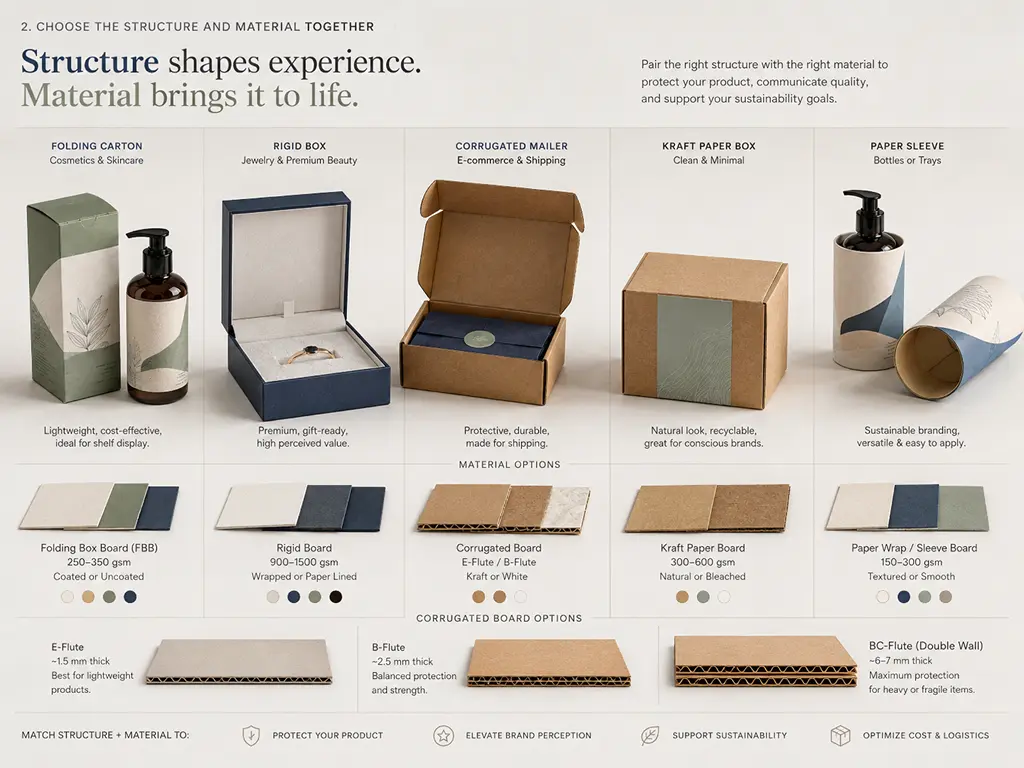
| Type | Fits | Strength | Watch |
|---|---|---|---|
| Folding carton | Cosmetics, supplements, food, light retail | Low material use, ships flat | Limited protection for heavy or fragile goods |
| Rigid box | Jewelry, beauty, electronics, premium gifts | Presentation and a stiff shell | More material, more assembly, more freight cube |
| Corrugated mailer | E-commerce and subscriptions | Transit protection | Waste if it is oversized |
| Kraft bag or sleeve | Retail, secondary branding, natural-positioned goods | Low material, a paper face | Not a shipper by itself |
Do not specify the sheet by grammage alone. Two boards at the same gsm can differ in stiffness, bulk, print surface, cracking, and how they fold. Ask for grade, gsm, caliper, grain, virgin or recycled content, coating, and food-contact status when it applies.
In the U.S., food-contact suitability starts from FDA rules for that use, including coatings and adhesives. See the FDA note on food-contact substances. In the EU, Regulation (EC) No 1935/2004 is the framework, and paper is still heavily shaped by member-state recommendations. Name the food, the temperature, and the contact time in the brief.
Use the least material that still delivers strength, print, handling, and the opening you promised. FSC board is available on request when the claim needs chain of custody. It is not the default, and it is not a recyclability claim.
3. Size it around the product
Measure the product. Do not design from a guess.
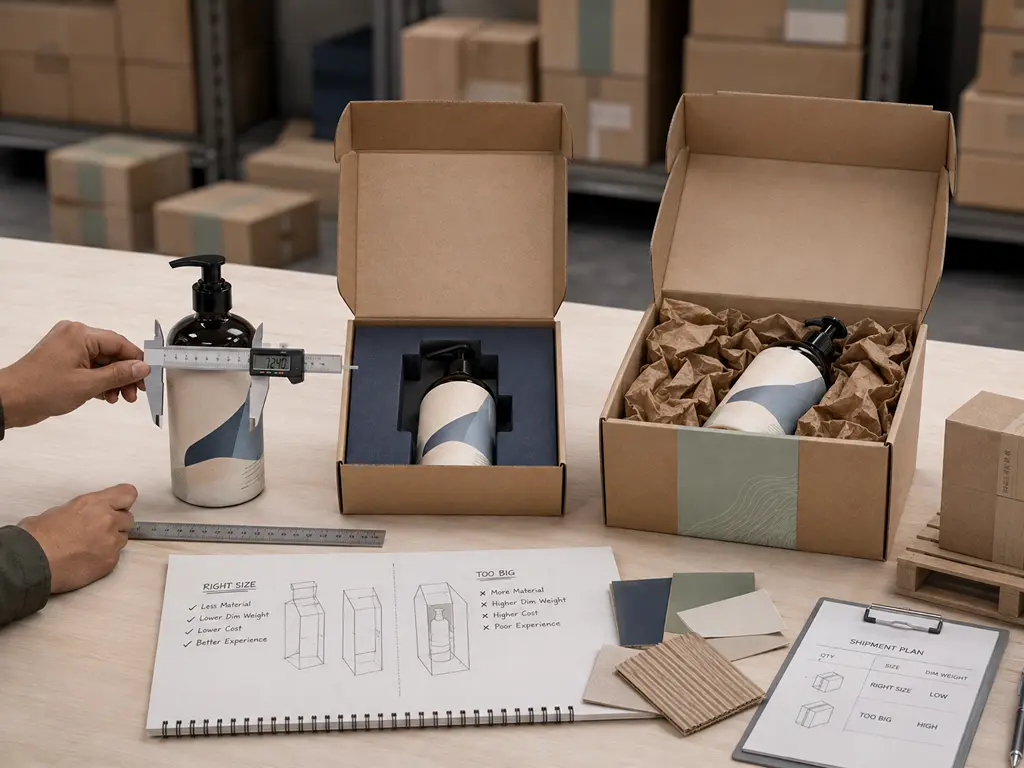
Internal size = product + clearance + the space the insert occupies.
Extra clearance is more paper, more movement, more warehouse cube, and often more freight. Clearance still has to let a packer load the product and a customer remove it.
Dimensional weight makes the empty space a cost. FedEx publishes this formula for inches and pounds:
DIM weight = length × width × height ÷ 139
A 12 × 10 × 8 in carton is 960 cubic inches, about 6.9 lb of dimensional weight before that carrier's rounding and other rules. Check the current FedEx dimensional-weight notes. EU parcel carriers use their own divisors on the greatest outside edges. The lesson is the same: cube is a freight input.
A U.S. EPA shipping case makes the point at scale. Changing package geometry cut packaging weight and transport demand on a private-label product. The material in that case was not paperboard. The geometry lesson still applies to cartons. See the EPA packaging write-up.
4. Approve the dieline before the art is finished
The dieline is the production map.
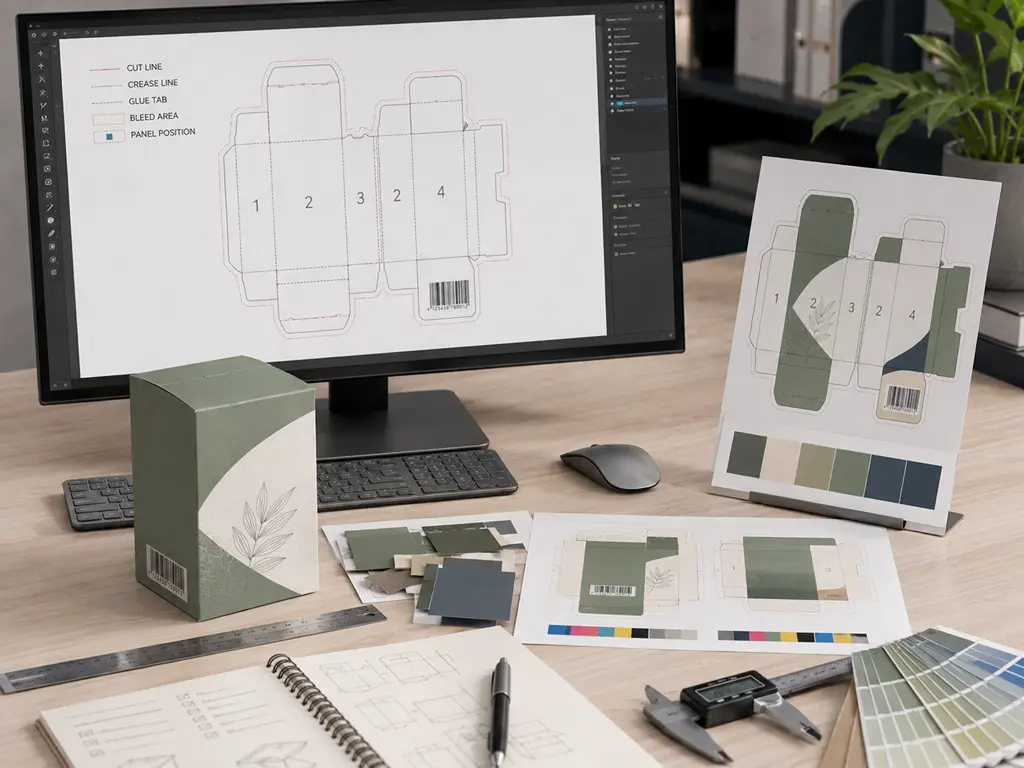
It should show cut and crease, glue areas, bleed and safety, panel positions, and insert positions when there is an insert.
A bleed of about 3 mm / 0.125 in is common on printed paper packs. Take the number from the plant that will print the job.
Before you release art, check CMYK and Pantone, image resolution, fonts, bleed, safe margins, folds, claims, recycling text, and the barcode. GS1 US tells you to keep proportions and quiet zones. EU barcodes fail for the same reasons: quiet zone, contrast, and a crease through the bars.
One foil, one emboss, or one coating, used with a reason, usually does more than a stack of effects on the same panel. Keep glue areas free of foil, film, and heavy varnish.
5. Adapt the art for the U.S. and the EU
One structure can often serve both markets. The art usually cannot.
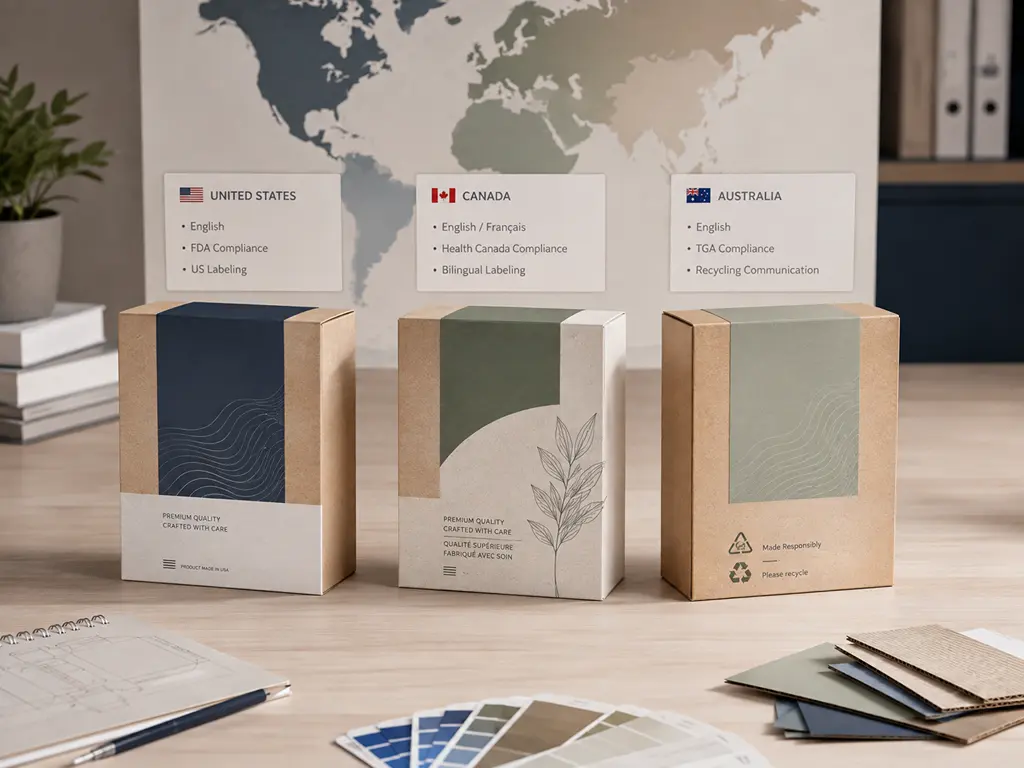
| Market | What to check | Where to start |
|---|---|---|
| United States | Food contact, environmental claims, parcel size, barcode | FDA, FTC Green Guides, carrier rules, GS1 US |
| European Union | PPWR minimisation and recyclability, food contact, claims, labelling | Regulation (EU) 2025/40, Regulation (EC) 1935/2004, national labelling |
| Canada, if you sell there | Identity, net quantity, dealer, bilingual copy, Québec | Competition Bureau, OQLF |
| Australia, if you sell there | Food-contact fitness, environmental claims, disposal marks | FSANZ, ACCC, APCO |
United States. Do not print "green" or "eco-friendly" without a qualified claim. The FTC Green Guides want the benefit named and supportable. "Carton made with 80% recycled paperboard" is a claim you can document. "Eco-friendly packaging" is not. Read the FTC Green Guides summary before the line is locked.
European Union. PPWR has applied since 12 August 2026. Weight, volume, and recyclability of the whole construction belong in the design, not in a footnote after the dieline is cut. Food-contact status is separate from PPWR. Environmental claims have to be specific here as well. A recycling icon that does not match the coatings and the collection system is a claim.
Canada. Many prepackaged non-food products need product identity, net quantity, and dealer information. If Québec is in the plan, French copy is a layout problem, not a last-week translation. OQLF rules affecting product information have applied since 1 June 2025. See the OQLF product guidance and the Competition Bureau labelling page.
Australia. FSANZ expects food packaging to be fit for the food and not likely to contaminate it. Acid, oil, heat, freezing, humidity, and recycled fiber can all change that. The ACCC expects environmental claims to be clear and supportable. The Australasian Recycling Label is a component-level disposal mark, not a decoration. Packaging regulation there is also under reform; check the current DCCEEW packaging page before a new run.
6. Prototype, then test
A render will not tell you fit, closing force, board feel, how the insert comes out, real color, or shipping.
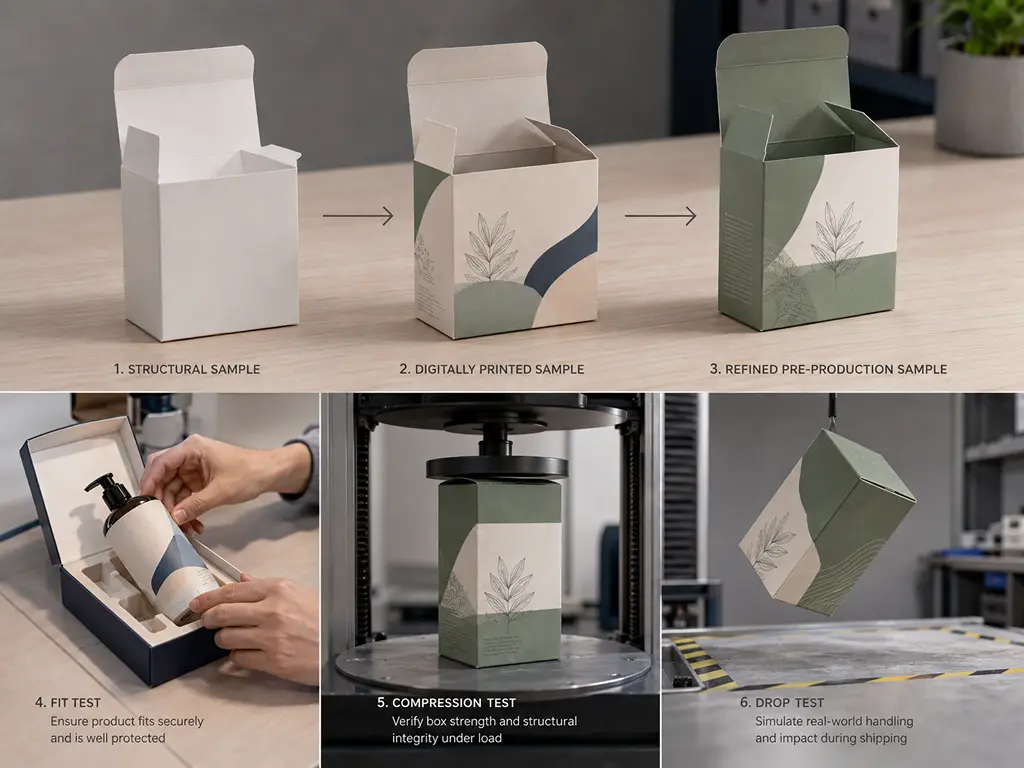
| Sample | What it is for | When |
|---|---|---|
| Structural | Fit, size, fold, closure, assembly | Before art is final |
| Digital print | Graphics and an approximate look | During art approval |
| Pre-production | Production material, print, finish, and structure | Before a run you cannot easily reprint |
On a pack with a rigid box, a fitted insert, and an accessory cell, approve those as separate points. A passed empty box does not approve the loaded one. Speed the meetings up if you must. Do not let mass production be the first time the structure is real.
Tests follow the route: drop, compression, vibration, rub, adhesive, humidity, or a shipping trial. ISTA Procedure 3A is a general simulation for individual parcel shipments up to 150 lb / 70 kg. Other channels use other procedures. Confirm the current list at ISTA. An internal drop is a screen. Call it that.
7. Freeze the specification
| Item | Lock it as |
|---|---|
| Dimensions | Internal and external |
| Material | Grade, gsm, caliper, flute if any |
| CMYK, Pantone, ink, process | |
| Finishing | Lamination, foil, emboss, coating |
| Artwork | Final file and version |
| Inserts | Material, cavity, removal space, orientation |
| Quantity | Count and the tolerance you will accept |
| Packing | Units per master carton and the method |
| Quality | Color, dimensions, appearance, function |
| Reference | The approved physical sample |
The approved sample is the reference for the run. A later substitution of board, adhesive, or coating needs a recorded change, not a quiet swap.
Short answers
What is the first step? Dimensions, weight, fragility, channel, market, and cost. Graphics follow the structural brief.
Should the box be skin-tight? Leave clearance for packing, tolerance, the insert, and removal. Empty space still needs a protective or functional reason.
What file do printers expect? Vector art, commonly Illustrator, with the approved dieline on its own technical layer. Confirm PDF/X settings with the plant.
What makes a paper pack the more responsible choice? Right-sizing, a structure that does the work, material you can justify, a recycling route that exists, and claims that match the file. A brown kraft face or a recycling symbol does not do that by itself.
Five questions before the run
- Will it protect the product on the real route?
- Can it be made and packed the same way every time?
- Can the customer read the product and the required information quickly?
- Does the art match the rules of the market where it will be sold?
- Has a physical sample confirmed the structure?
If one answer is open, the job is not ready for mass production.
Guangzhou Tendlyn Trading Co., Ltd. was founded in Guangzhou in 2009 and converts folding cartons, mailer boxes, rigid boxes, paper bags, and paper tubes in Foshan and Zhanjiang. Minimum order is 100. Send the brief and the dieline to info@axwp.com, +86 158 1238 1273, or WeChat trimgem. The quote is written after structure, board, print, and quantity are known.
