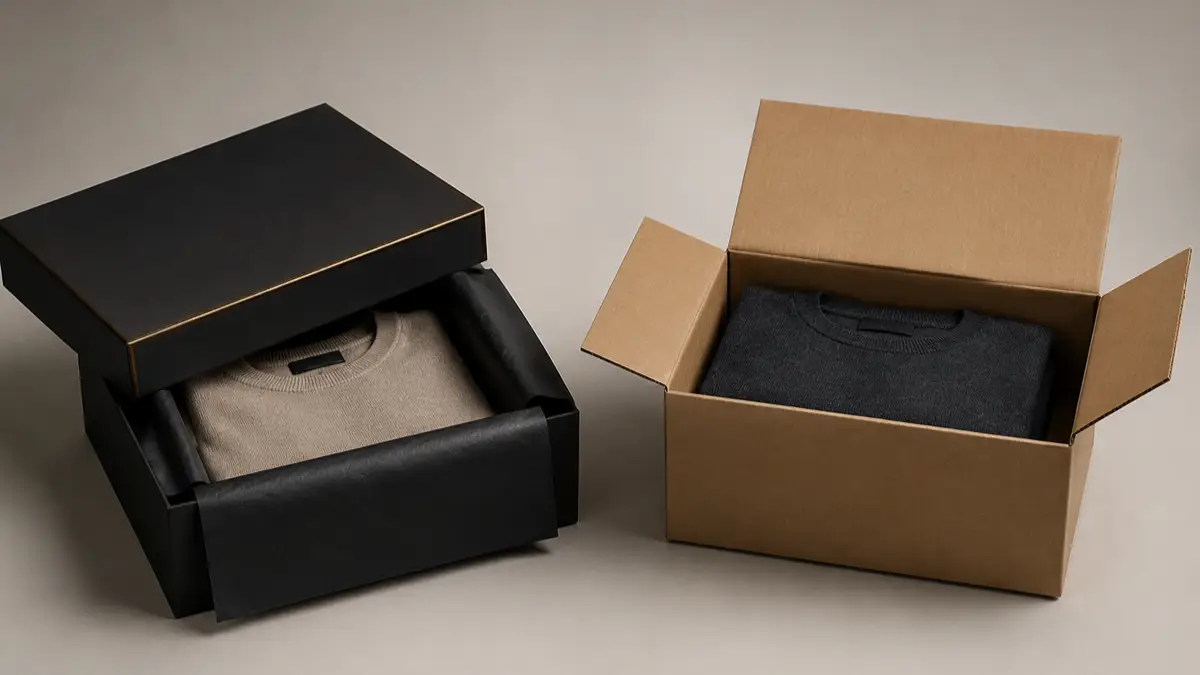
A luxury apparel box and a folding carton are different constructions, not two finishes on the same blank. One is wrapped chipboard that is built in the plant. The other is a single paperboard sheet that the packer erects. Pick the one that matches the garment and the warehouse, then spend the finish budget on that structure.
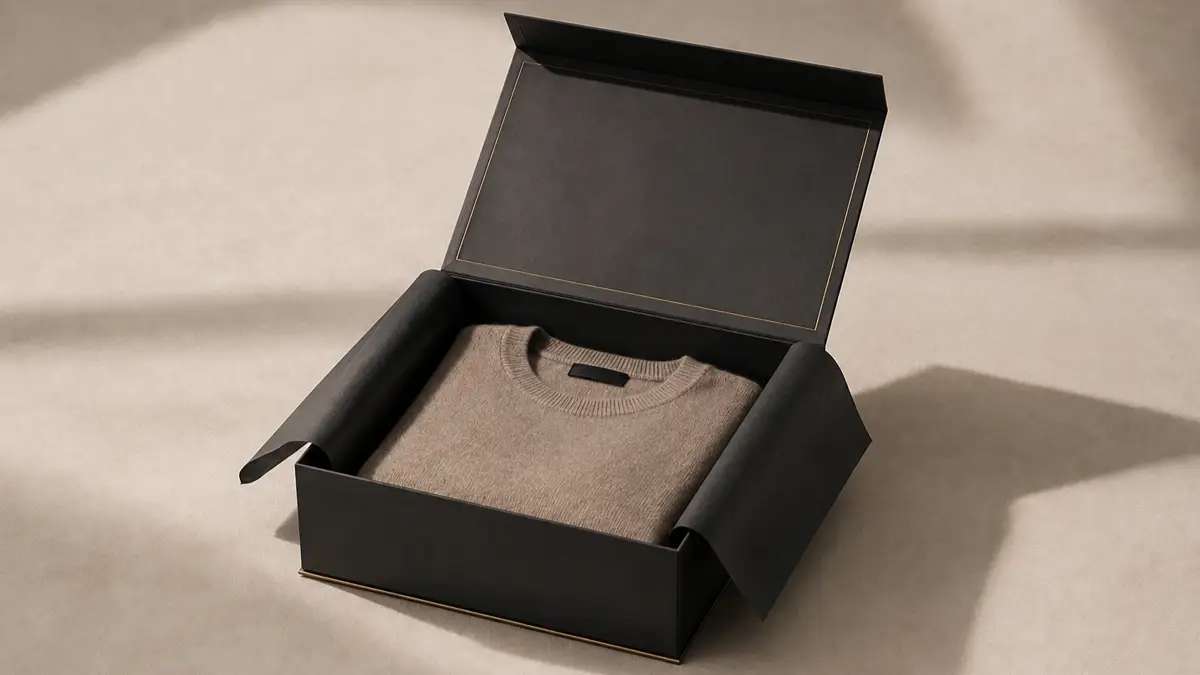
Rigid setup box
The board is greyboard or chipboard, commonly 1.2 mm to 2.5 mm, sometimes up to 3 mm on a large lid. A printed wrap, often 128 gsm to 200 gsm coated paper, is glued over it and turned in at the edges. The weight the customer feels is the chipboard, not the ink.
That build is what lets you hide a magnet, run a ribbon pull, or hold a deep lid without the wall bowing. It also means the box is wrapped, glued, and formed before it reaches you, unless you specifically order a collapsible rigid. Formed boxes ship as cubes. You pay for air on the inbound truck and again on the shelf.
Opening styles that belong on this board:
- Lid and base, the plain two-piece
- Magnetic book-style or hinged lid
- Drawer: a wrapped sleeve and a sliding tray
- Book-style with a ribbon or tab
Velvet, silk, or a paperboard insert is a second spec. The textile is not the structure. If the scarf or knit needs to stay put, draw the cavity. Do not assume the lid will do that job.
Folding carton
A folding carton is one sheet: SBS, FBB, or kraft, typically about 250 gsm to 450 gsm, caliper roughly 0.3 mm to 0.8 mm. It is die-cut, creased, printed, and often side-glued, then packed flat. The packer pops the crash-lock or tucks the ends at the bench.
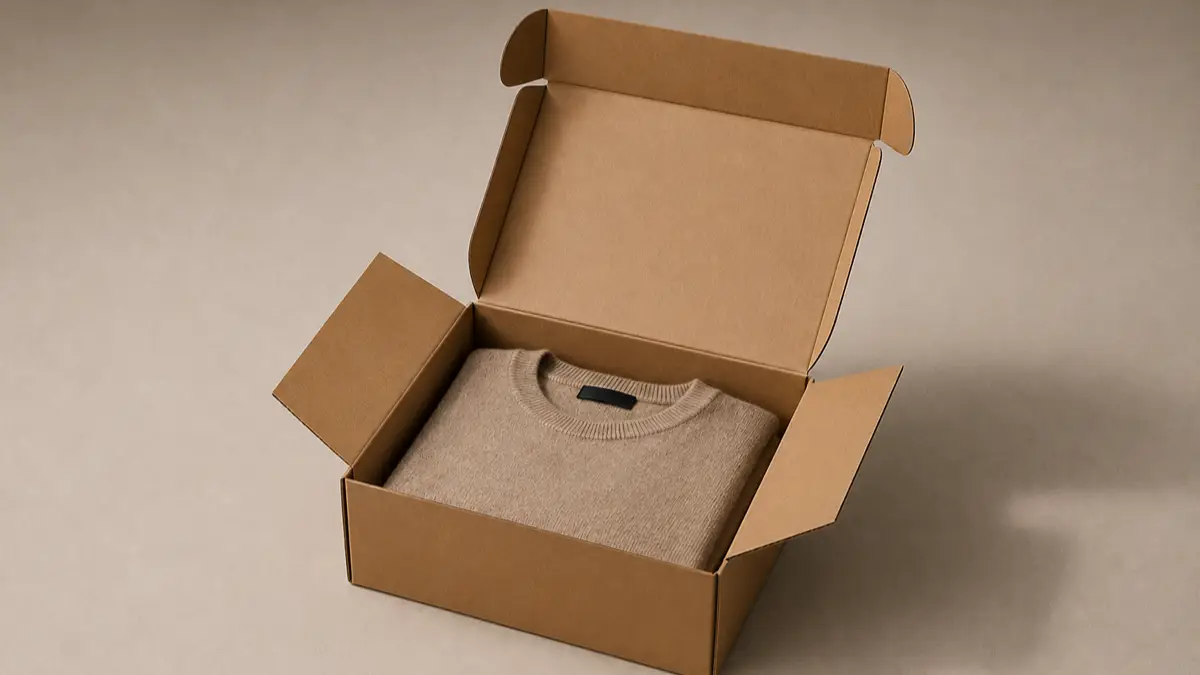
The sheet takes offset, foil, emboss, and soft-touch. A well-printed SBS carton does not look like a shipping box. It will not feel like 2 mm chipboard, and it should not be asked to. Thin board springs. A heavy embellishment or a tall tuck on a light caliper shows that spring as a gap.
Use it for folded garments, a sleeve over tissue, a gift sleeve around a mailer, and any line where you would rather store blanks than empty boxes. Retail programs with many sizes fit this format because one pallet of flats replaces several pallets of set-up boxes.
What changes in the plant and on the truck
Rigid assembly is hand work or a slow wrap line: board grooving, corner staying, wrap gluing, turn-in, magnet placement. Folding cartons run on a die-cutter and a folder-gluer. The same artwork hour does not buy the same number of boxes. That is why a rigid unit stays expensive after the quantity rises. You are still paying board mass and assembly, not only make-ready.
Freight follows the pack pattern:
- Folding cartons ship flat. Inbound volume collapses.
- Set-up rigid ships assembled. Inbound volume is the box.
- A collapsible rigid folds after it is wrapped. You keep the wrapped edge and cut the cube. The hinge and the fold line have to be engineered. A cheap score on thick greyboard cracks the wrap.
Right-size either format to the folded garment. Empty height is what triggers dimensional weight on the way to the customer. Shaving a few millimeters off a lid does nothing if the insert still needs that height.
When the rigid box is the right spend
Use it when the garment is the kind of thing people keep the box for, and when the construction has a job:
- A scarf, fine knit, or small leather item that needs a located insert
- A limited set with a magnetic close or a drawer
- A shop presentation where the box sits on a table, not in a mail slot
- Any pack that must carry hardware the folding carton cannot hide in a flap
The board thickness is the product signal. Foil on a flimsy tuck does not replace it. If the retail price cannot carry a formed box plus the inbound cube, do not force the format and then strip the caliper until the corner splits.
When the folding carton is the right spend
Use it when you need print, a clean open, and a flat inbound:
- Folded tees and basics in a branded carton rather than a shipper
- High-SKU lines where storage is the constraint
- Sleeves and trays over a wrapped garment
- A gift presentation that is still packed at your bench
If the tier is premium and you stay on folding board, spend the money on caliper, an insert, and one finish. Soft-touch or a small foil on 400 gsm SBS reads as a decision. Four finishes on 250 gsm board read as a struggle.
Finishes, reuse, and the paper stream
Both formats take foil, emboss, deboss, and film lamination. On a rigid box those finishes sit on the wrap, not on the greyboard. On a folding carton they sit on the sheet that also has to crack cleanly on the crease. Test the crease after lamination. Soft-touch and heavy film crack on a tight fold if the score is wrong.
Recycling is simpler on an unlaminated folding carton. A rigid box is greyboard plus wrap plus glue, and often a magnet. The customer can reuse it. The material recovery is harder. If you need an FSC claim, specify chain-of-custody on the paper you want labeled. FSC does not make a magnet or a film laminate disappear.
What to send for a quote
A price without the build is a guess. Send:
- Garment folded size, and whether an insert locates it
- Format: two-piece, magnetic, drawer, or folding style (straight tuck, reverse tuck, crash-lock)
- Board: greyboard caliper for rigid, or gsm and grade for the carton
- Wrap or print substrate, and the one or two finishes you will actually run
- Flat shipment or set-up, and the quantity per size

Guangzhou Tendlyn Trading Co., Ltd., founded in 2009, converts these packs in its own Foshan and Zhanjiang factories: rigid boxes, folding cartons, mailers, paper bags, and paper tubes. The paper-pack minimum is 100. Write the quote only after structure, board, print, and quantity are set. For that, use info@axwp.com, +86 158 1238 1273, or WeChat trimgem.
