On a rigid box the greyboard is the structure, usually 1.5–3.0 mm. The finish lives on the wrap. That sheet is printed and decorated flat, then glued over the V-grooved board and turned in. Anything that has to fold — the corner, the hinge of a magnetic lid, the turn-in — will crack a brittle coating.
Seven finishes cover nearly every luxury brief. Stacking all seven on one lid is how make-ready and scrap take over the job. One hero finish and one support is enough for a buyer to recognize the brand.
Guangzhou Tendlyn Trading Co., Ltd. has wrapped rigid boxes since 2009, in its own Foshan and Zhanjiang factories. Minimum order is 100. FSC board is available on request. A quote waits on structure, board, print, and quantity, because each finish below is an extra station.
Foil stamping
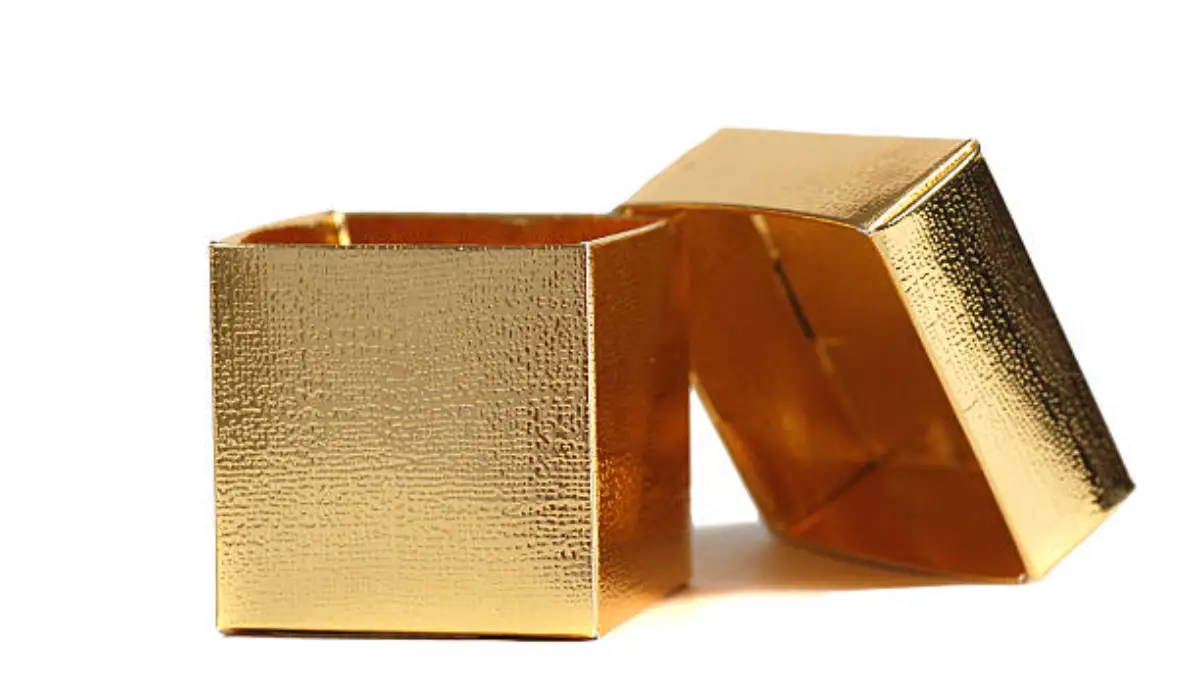
A heated brass die presses foil onto the sheet. The foil can be metal (gold, silver, copper, rose) or a pigment color. Holographic foil shifts as the box moves. Unlike a metallic ink, foil sits on top of the sheet and stays opaque, which is why it still reads on a dark navy wrap.
Stamp the wrap while it is flat. A large mark on the lid panel stays intact because that panel is never folded on a gluer. Run the same foil across a corner or into the turn-in and it splits. Keep the die at least a few millimetres inside the panel edge.
Foil over soft-touch needs a foil made for that film. A standard foil will skip or scuff off. Fine type needs a clean die and a make-ready that does not over-pressure the board. Too much heat dishes a thin art paper. Too little leaves a broken edge you will see under a shop light.
The die is tooling. A repeat order reuses it if the artwork does not move. A 0.5 mm shift between foil and a printed outline is scrap. Put the registration target on the drawing.
Use foil for the logo, a limited line, or a thin border. A full-panel foil is a different job: more foil, more heat, and a surface that scratches against the next box in the pack. Slip-sheet those.
Spot UV
Spot UV lays a clear varnish on part of the sheet and cures it under UV lamps. Against matte aqueous or matte film it reads as gloss on a quiet ground. A heavier coat gives a raised, glass-like spot. The color of the print underneath does not change.
Registration is the whole quality argument. The varnish has to sit on the logo, not in a halo beside it. Build a trap in the file only if your prepress agrees. Keep the varnish off scores, lid hinges, and anywhere the wrap turns a corner. High-build UV cracks there and shows white.
Spot UV is one varnish pass. It is a poor place to hide a weak print. If the artwork is soft, the gloss will make the soft edge louder.
Embossing and debossing
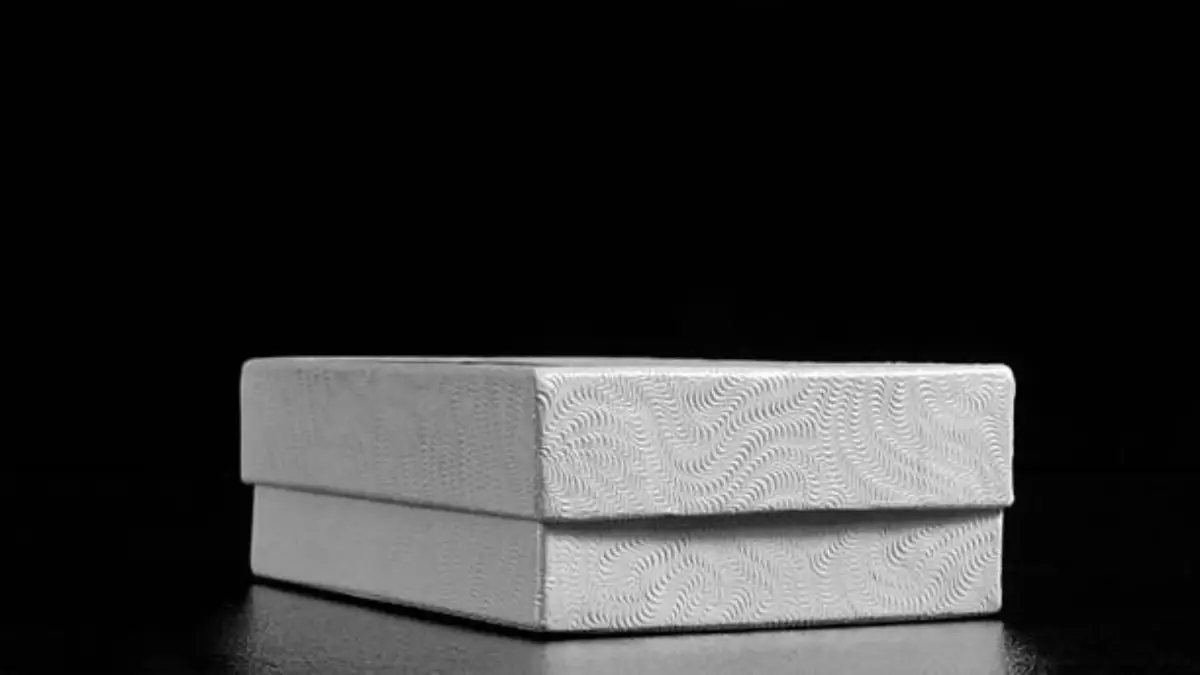
Matched metal dies push the wrap up (emboss) or down (deboss). Shadow does the work. There is no extra ink.
On a rigid job the hit is usually on the flat wrap, before it goes over the greyboard. Deep emboss on a light art paper splits the coating. A shallower hit, with the greyboard behind it only after wrapping, is a different setup and has to be sampled. Do not assume the two methods match.
| Emboss | Deboss | |
|---|---|---|
| Direction | Raised | Recessed |
| Reads as | Louder, more traditional | Quieter |
| Risk | Cracked coating on the high point | A shallow hit that disappears under soft-touch |
Foil plus emboss — a raised metallic logo — needs the foil and the emboss in register. That is either a combination die or two stations. Budget the make-ready. On a minimalist lid, a 0.3 mm walk between foil and emboss is the only thing the eye finds.
Deboss on a linen sheet flattens the texture inside the mark. That contrast is usually what you wanted. Say so on the spec, or the press will ease off and you will lose it.
Soft-touch lamination
Soft-touch is a film. The hand is velvety, the gloss is gone, and the box feels slightly warmer than a hard gloss laminate. It is the usual base under foil or spot UV, because the contrast is strong.
It scuffs. Black and deep navy show fingerprints and white pressure marks from the next box, from a mailer, and from a retail tester. If the file is dark, specify an anti-fingerprint or anti-scratch treatment, or switch to the matte film in the next section. “Soft-touch, and it must stay perfect in a subscription mailer” is two specs fighting.
Film gauge changes lid fit. Approve the lid after lamination, not on a bare greyboard sample.

Textured varnish
Textured varnish is screen-printed and UV-cured. It builds a grit or a pattern: fine sand, a linen suggestion, a leather suggestion. The board itself is not deformed, which separates it from emboss.
It can sit on one graphic only — a leaf, a monogram — and leave the rest of the panel smooth. It takes handling better than soft-touch. A coarse grit on a fragrance lid feels like sandpaper next to a glass bottle. Approve a swatch, not the word “linen.” Two suppliers’ linen varnishes are not the same plate.
Use it when the brand wants touch without a plastic-film hand, and when the art has a zone that should feel different from the ground. Keep it off the turn-in. Thick varnish at the fold cracks and flakes into the cavity.
Anti-scratch matte
Anti-scratch matte is a tougher matte film. The surface is flat, low glare, and slower to show the white scuffs that ruin black electronics and jewelry boxes. It does not feel like soft-touch. It feels smooth and hard.
This is the practical film when the box will be rubbed: PR kits, sets that are picked up all day on a counter, anything packed without an individual poly bag. It still is a film. If the recycling claim is “paper only,” it does not qualify. If the claim is a durable luxury carton, it is often the right one.
The gain shows up in yields. Fewer lids get wiped out between wrapping and packing. That scrap never appears as its own line, but it is in the unit cost.
Specialty textured paper
Here the texture is made in the paper machine: linen, felt, laid, pearl, some leatherette sheets. You can skip an overall laminate. The hand is the sheet.
Through-dyed papers matter at the edge. V-grooving and turn-in expose the edge of the wrap. A sheet that is color on the surface and white in the middle shows a white line at every corner. A through-dyed sheet does not. Specify it when the corner is visible, which on a rigid box it is.
Uncoated texture marks with finger oil and can refuse foil unless the foil and the sheet have been sampled together. Some pearl and heavy embossed sheets need a primer. FSC is available when that mill lot is on the chain of custody. Ask on the order. A textured look is not automatically an FSC claim.
These sheets also simplify the process when you drop the laminate. You give up the scuff shield. For a keepsake box that is opened and shelved, that is often acceptable. For a box that rides loose in a master case, it is not.
How to choose without burying the lid
- Jewelry and fragrance. Foil or deboss on soft-touch or on a through-dyed linen. One metallic color.
- Devices and dark boxes. Anti-scratch matte, sharp type, foil only if it is small.
- Natural or apothecary lines. Textured sheet or zonal textured varnish, aqueous if you are still on a folding carton beside the rigid.
- A lid people will handle hard. Prefer anti-scratch or a tougher varnish over bare soft-touch.
Restraint is a production fact. Every added station has its own make-ready and its own reject mode: foil shift, UV halo, emboss depth, film bubble, varnish grit that does not match the swatch. Two finishes you can hold in register will look more expensive than four that wander.
Name the finish, the swatch or foil code, the keep-off areas (scores, corners, turn-in), and whether a slip sheet is required in the pack. The sample you approve should already wear the film. A plain printed sheet will not tell you how the lid fits or how black soft-touch scuffs.
