An oversized mailer sells air to the carrier. An undersized mailer arrives with a crushed lid or an insert that would not go in. Size is an inside dimension plus the flute you chose, not a guess from the product photo.
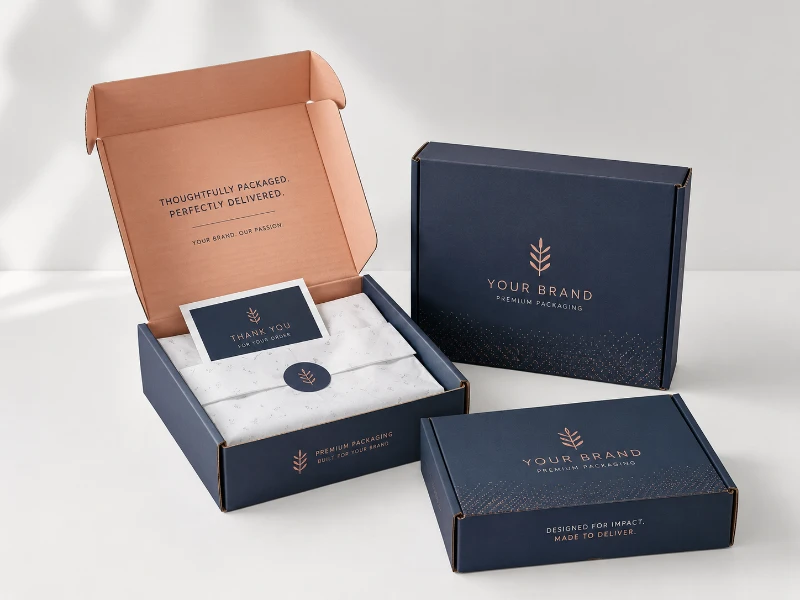
Inside size is the order
The inside length, width, and height are the cavity you pack. That is the number on the purchase order.
Outside size is larger by the board caliper, the folds, and any lock. Carriers rate the outside. Warehouse slots care about the outside. If you only send an outside target, the plant will still cut an inside, and the product may not fit.
E flute is about 1.0–1.8 mm. B flute is about 2.5–3.2 mm. The same 12 × 9 × 4 inch inside size is a different outside box on those two boards, and a different blank. Fix the flute before you freeze freight calculations.
Clearance
Measure the product in the orientation it ships. Include the lid, the cord, the pump, and any retail carton that stays on.
Add clearance per side for what you actually put in the box:
- 3–6 mm (about 1/8–1/4 inch) when the fit is snug and the item is not fragile.
- About 6 mm (1/4 inch) for a light tissue wrap.
- About 12 mm (1/2 inch) for a normal pad or a die-cut insert.
- Up to 25 mm (1 inch) when the item needs real cushion, not just a slide fit.
Do not add a full inch “to be safe” and also add a thick insert. That is how you buy a larger dim-weight bracket. Empty space is not protection. A die-cut insert or a pulp tray locates the product. Loose paper stuffed into a big cavity does not.
Sizes buyers keep in the library
These are common inside dimensions, not a catalog. Custom sizes are cut to the dieline. The sheet and the flute set the limit, and the plant confirms it on the drawing.
| Inside size | Millimeters | Typical pack |
|---|---|---|
| 4 × 4 × 2 in | 102 × 102 × 51 | Small jewelry, a sample, one cosmetic |
| 6 × 4 × 2 in | 152 × 102 × 51 | Slim accessories |
| 6 × 6 × 2 in | 152 × 152 × 51 | A candle, a folded scarf, a flat gift |
| 8 × 6 × 3 in | 203 × 152 × 76 | Cables, a small skincare set |
| 9 × 6 × 3 in | 229 × 152 × 76 | A book, a mid-size kit |
| 10 × 8 × 4 in | 254 × 203 × 102 | Folded apparel, a beauty kit |
| 12 × 9 × 4 in | 305 × 229 × 102 | The size many apparel and subscription orders actually use |
| 12 × 10 × 6 in | 305 × 254 × 152 | Deeper bundles |
| 14 × 10 × 5 in | 356 × 254 × 127 | Bulkier apparel, a multi-item gift |
| 16 × 12 × 6 in | 406 × 305 × 152 | Outerwear, a large set |
| 10 × 8 × 1 in | 254 × 203 × 25 | A flat tee or a print. Check it. One inch inside disappears once the board and a card are in. |
| 14 × 10 × 2 in | 356 × 254 × 51 | One folded shirt |
Clothing is the pack that gets sized wrong most often. A single light tee can live in 10 × 8 × 2 in (254 × 203 × 51 mm) or a flat 14 × 10 × 2 in. A hoodie wants depth: 12 × 9 × 3 in (305 × 229 × 76 mm) or 16 × 12 × 4 in (406 × 305 × 102 mm), depending on the fold. Two to four garments are why 12 × 9 × 4 in shows up so often. Measure your fold, not a generic apparel box.
Freight, storage, and how many sizes to own
Dimensional weight charges the volume when the parcel is light and large. The fix is a smaller inside size and a located product, not a lighter ink.
Most brands can run on three or four inside sizes. One for the small SKU, one for the hero, one for the bundle, and a flat if you ship shirts. A unique mailer for every SKU multiplies dies, board positions, and pick errors. Build the library around the orders you ship most, then let the rare SKU use the next size up with an insert.
Pallet and shelf math uses the outside size. Ask for it in the quote once the flute is chosen. A mailer that does not stack because the lid crown is high will cost more in the DC than it saved in board.
Write the packed weight on the brief. The plant matches liner and flute to that weight. ECT or BCT is the check. A kilogram guess on a slide is not a board grade.
Custom size
You can order the inside size the product needs. MOQ at Tendlyn is 100. The die, the print method, and the blank size still decide whether that dimension is practical. Send the product size, the clearance you added, and the flute. You will get a dieline back with inside and outside figures. Approve that, not the round number you started with.
Crash-lock and tuck lids change the blank more than they change the inside cavity. Name the lid if your filler is automatic. A lid a person can close on a bench may not close on your line.
Questions that come up
Are mailers quoted inside or outside?
Inside. Outside is a result of flute and style. Use outside for the carrier and the pallet.
How do I pick from the list above?
Add your clearance to the packed product. Choose the smallest inside size that clears it. If none do, the size is custom.
How much air is too much?
If you are pouring filler into a void, the box is large or the insert is missing. Snug goods stay near 3–6 mm a side. Fragile goods get cushion by design, up to about 25 mm, not a second empty box around the first.
What about a very flat or very large pack?
A 1 inch inside height has to be checked with the real fold. Large packs need the flute and the ECT named. The drawing will show if the blank exceeds the sheet.
What to send for a sample
Packed product dimensions, clearance, flute, print method, and quantity. A white sample in the production board is the one you fill. A sample in a different flute can feel fine and still be the wrong freight size.
The price is written after structure, board, print, and quantity are known.
