A mailer box and a poly mailer are not two prices for the same shipper. One is a corrugated structure. The other is a film bag. The garment, the carrier rule, and what you want the customer to do with the empty pack decide which one you buy.
What each format actually is
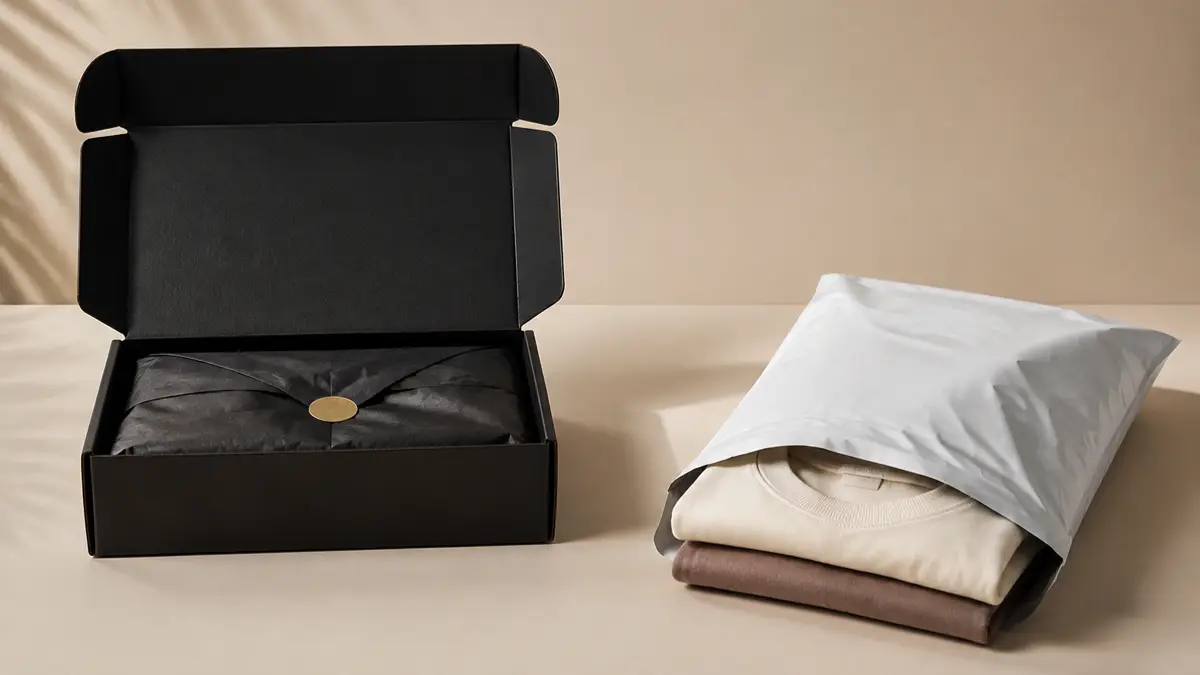
A mailer box is corrugated board, usually E flute or B flute, cut as a one-piece mailer with a crash-lock or tuck closure. The flute is the cushion. The liner is the print surface. You can print the outside, the inside, or both. The box holds a fixed cube after it is folded.
A poly mailer is polyethylene film, often in the 2 to 3 mil range, with a self-seal strip. It has almost no crush strength. It sheds water. It collapses around a folded shirt, so the parcel cube follows the garment instead of a dieline.
Tendlyn builds the paper side of this choice: custom mailer boxes, folding cartons, and related paper packs. Film mailers come from a bag converter. Do not ask one plant to pretend it runs both processes well.
Where the money actually moves
Do not shop this decision off a unit-price screenshot. A quote is written after board, print, quantity, and the shipper cube are known.
The mailer box costs more per piece because you are buying liner, flute, medium, a cutting die, and print make-ready. A printed film bag uses less material and a simpler setup. That gap is real. It is not the whole landed cost.
Carriers bill many apparel parcels on dimensional weight. A rigid mailer keeps its length, width, and height. A light tee in a tall box can rate as if it weighed more than the garment. A poly mailer that hugs the fold often stays on actual weight. If you ship thousands of single tees, that rating difference usually beats the gap in pack cost.
Storage follows the same logic. Film mailers stack as flat sleeves. Knocked-down mailer boxes still take more shelf per hundred units, and set-up boxes take far more. If the warehouse is the constraint, price the shelf, not only the piece.
Protection
Flute resists stacking and takes the hit on a drop. A hoodie, a denim stack, or a blazer with buttons survives better when the wall does not collapse onto the fold. A poly mailer does not stop a carton above it from pressing a crease into structured cloth.
Film wins on water. Rain on a doorstep beads off polyethylene. Uncoated kraft liner wicks. If the lane is wet and the product is a tee, the mailer is the simpler barrier. If you need both crush strength and a water barrier, put the garment in a bag and the bag in the mailer box. That is two components. Spec them that way.
Sharp hardware is the failure mode people miss. Zipper pulls, buckles, and metal buttons puncture film. They do not puncture E flute as easily. If the trim can cut the bag, the bag is the wrong shipper.
What belongs in each
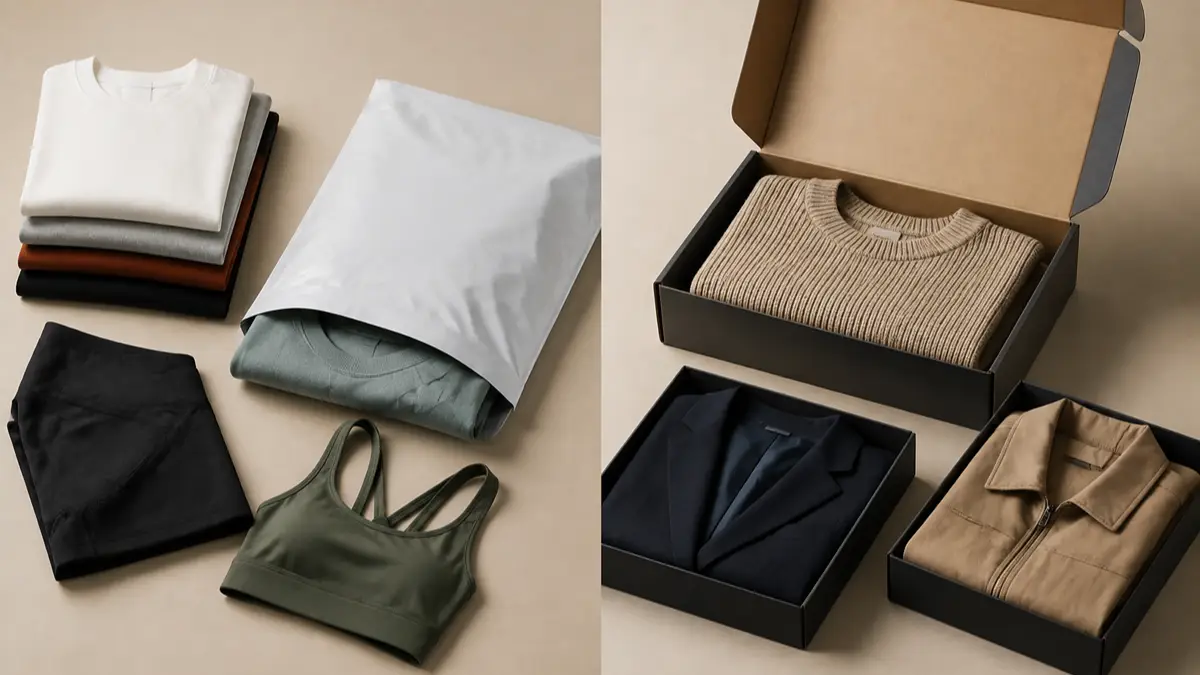
Poly mailers fit flat, compressible goods:
- Tees, tanks, and leggings
- Underwear, socks, scarves, and swim
- Soft dresses with no hard trim
- Single light garments that already survive a fold
Mailer boxes fit goods that have to keep a shape, or that ship as a set:
- Hoodies, sweaters, and outerwear
- Blazers, dress shirts, and anything you pressed
- Jeans and other heavy cloth that slumps in a bag
- Multi-piece orders and subscription sets
- Garments with hardware or beading
A silk blouse can ship in either, but not bare. Tissue or a paper wrap inside the chosen shipper is what stops scuff. The outer format does not replace that layer.
Unboxing and returns
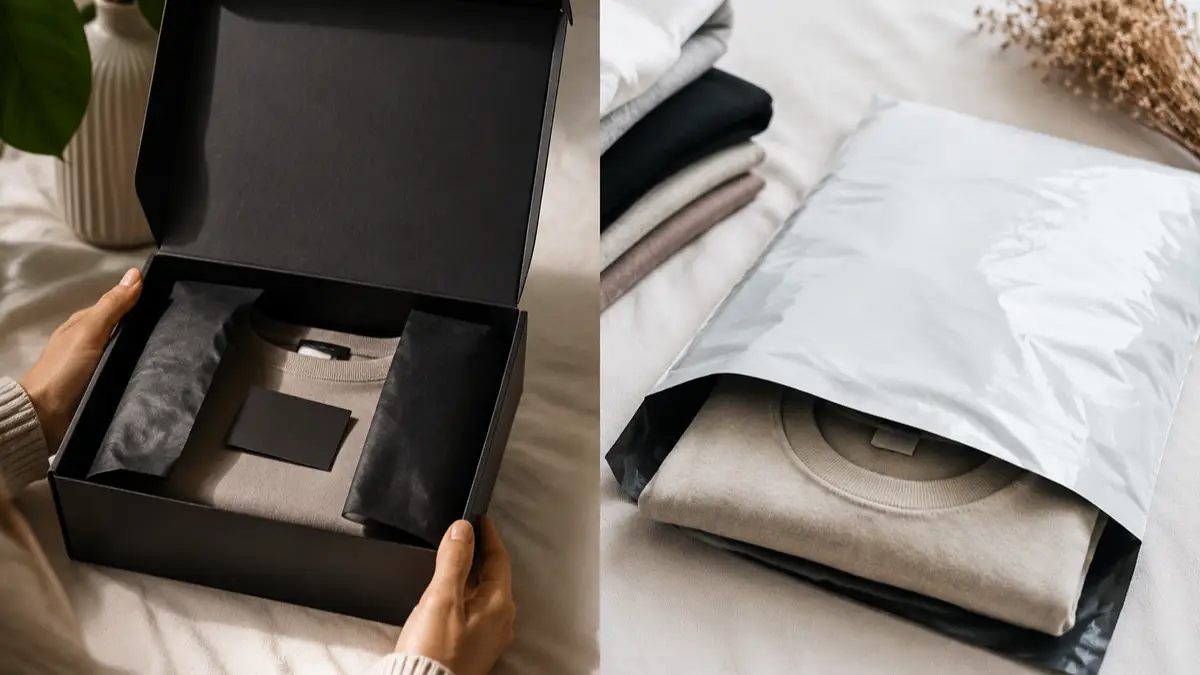
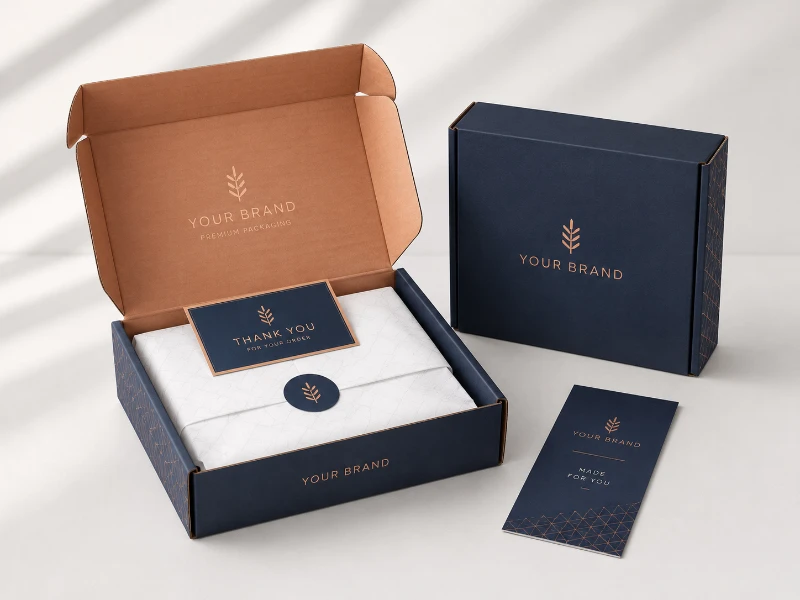
A mailer box gives you panels. Interior print, a tissue wrap, and a simple insert are enough for a first order or a high-price line. You do not need a rigid gift box to get a clean open. You need a square that opens in one motion and a garment that has not been crushed.
A poly mailer can still look deliberate. One logo, one color, a straight label, and a seal that does not wrinkle across the mark. Dual-seal strips matter more than a second ink color. The customer opens once and reseals for a return without hunting for a new bag.
Use both on purpose. Single basics go in film. Structured garments, bundles, and the first order from a new customer go in a printed mailer. One format for every SKU is how brands either crush a blazer or pay dimensional weight on a tee.
Material and disposal
A poly mailer uses less fiber and less freight mass. That is a real production and transport difference. It does not make the bag curbside recyclable. Most household programs do not take thin polyethylene. Store drop-off for film is the actual path, and many customers will not use it.
An uncoated or lightly printed paper mailer usually goes in the paper stream if it is clean. Film lamination, heavy foil, and a plastic window change that. Say what the pack is. "Recyclable" with no instruction is how a kraft-looking laminate ends up as a contaminant.
Recycled-content film and recycled-content liner both exist. Ask for the claim on the lot you are buying, not on a mood board. FSC chain-of-custody on the paper mailer is available when you specify it. It is not automatic, and it says nothing about the film bag.
Short comparison
| Poly mailer | Corrugated mailer box | |
|---|---|---|
| Structure | Film, collapses to the garment | E or B flute, fixed cube |
| Best apparel | Flat tees, leggings, soft accessories | Outerwear, tailoring, bundles, hardware |
| Main hazard | Puncture, crush, crease | Water on uncoated liner, dimensional weight |
| Warehouse | Very flat | Knocked down, still bulkier |
| Returns | Dual-seal strip on the same bag | Box can be reused if it is still square |
| Disposal | Film drop-off, rarely the curbside bin | Paper stream if the board is clean and not laminated |
Specifying the mailer box
If the paper mailer is the one you are buying, send the garment folded, not a guess at the SKU name. The dieline follows the folded size plus a little ease so the crash-lock does not bulge.
Decide these before artwork:
- Flute and liner: E flute for a lighter mailer, B flute when the stack or the hardware needs more wall
- Closure: crash-lock for speed at the bench, tuck when you want a cleaner reopen
- Print: outside only, or outside and inside. Interior print is a second pass. Price it as such
- Insert or tissue: only if the garment needs location or scuff control
- Quantity, and whether several sizes share one print form
Guangzhou Tendlyn Trading Co., Ltd. has made paper packaging since 2009, with its own converting in Foshan and Zhanjiang. Mailer boxes are a normal run, and the paper-pack minimum is 100. The quote comes after structure, board, print, and quantity are fixed.
If you want that quote against a real folded garment, write info@axwp.com, call +86 158 1238 1273, or WeChat trimgem.
