A factory audit asks whether this plant can repeat your carton. A pre-shipment inspection asks whether one lot matches the spec. You want the audit before the deposit, and the inspection before the balance. Walking a showroom, or trusting a PDF certificate, is neither.
This is written for paper packaging: folding cartons, rigid boxes, mailer boxes, paper bags, paper tubes. A plant that extrudes film or moulds bottles is a different audit.
What you are there to see
You are checking four things.
The legal entity on the invoice is the entity that runs the machines. The machines on the floor can cut, print, and finish the structure you are buying. Quality records are filled when the work happens, not reconstructed for your visit. A finished lot can be traced back to board, ink, and adhesive.
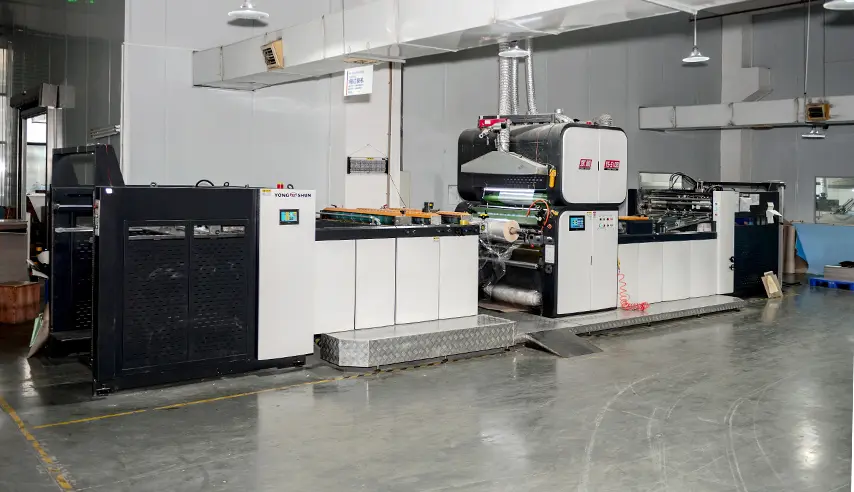
An audit qualifies the plant. An inspection samples a lot, usually against an AQL you wrote into the order, and looks at dimensions, registration, color, and glue. Passing an inspection does not mean the plant can do the next structure. Passing an audit does not mean you skip the inspection.
Licenses and certificates
Start with the business registration. In mainland China that is the unified social credit code and the business scope. The scope should include manufacturing or printing, not only trading, consulting, or "technology services." Match the name to the bank account and the invoice. Match the registered address to a building you are standing in, not to a serviced office photographed once.
Then check any certificate you intend to rely on. ISO 9001, ISO 14001, FSC, PEFC: look up the registration number with the issuer or in the scheme's database. Read the scope and the address. A valid certificate for "metal parts" does not cover a folding-carton line. An expired certificate, a missing number, or a scan whose address is not this site is a stop.
FSC on your pack is chain-of-custody for the board you specified. Confirm the plant's code covers the process that will convert your job, and that they will buy certified board for it. The logo in the lobby is not the claim.
Food-contact paperwork, if you need it, is a declaration or a migration report for the paper, ink, coating, and adhesive in the conditions you stated. A hygiene license on the wall does not replace that stack.
Equipment and whether it is actually running
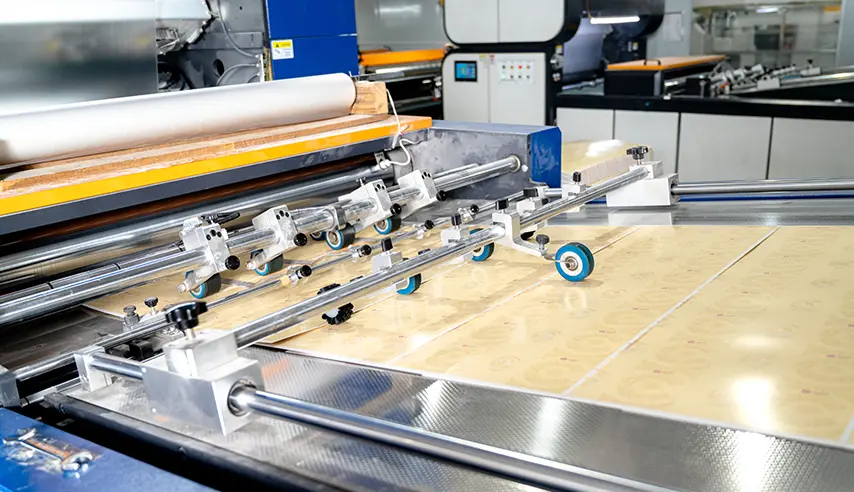
Walk the floor with the job in mind. For paper packaging, look for a printing press that matches the process you were quoted (offset, flexo, or digital), a die-cutter, a folder-gluer if the carton is side-glued, and a rigid line — grooving, corner staying, wrapping — if you are buying setup boxes. Foil, lamination, and window patching are easy to subcontract. Ask, in front of the machine, which of those stay here.
Write down what you see: press size, number of colors, whether a spectrophotometer is on the press, how old and how clean the gluer is. A sales list of "five Heidelberg" that you cannot find is a capacity claim without machines.
Stated output is a theoretical number. Ask what ran yesterday, on which shift, and what the changeover between two carton sizes looks like. A plant already full, with no second shift and no room to stage board, will miss your date when a job overruns. You do not need their internal OEE slide. You need to see whether the constraint — often the gluer, the foil pull, or the hand-wrap table — can clear your quantity.

Quality system, on the bench not in the binder
ISO on the wall is the start. On the bench you want:
- Incoming board checked against the spec before it is issued, with the mill ticket still attached
- In-process checks for color, registration, and glue at a stated interval, in the operator's hand, not in one handwriting at the end of the shift
- A quarantine area that has something in it, labeled, not a clean corner that has never been used
- A quality lead who can stop a press without asking the production supervisor for permission
- Training or work instructions at the gluer and the wrap table that match the job travelers
Pick a finished carton and ask them to walk it backward to the board lot, the ink batch, and the die. A plant that can do this does it in the time it takes to pull the records, not after a lunch break of searching. Then pick a board lot and ask where it went. If inputs, finished goods, and scrap do not roughly reconcile, either the scrap is hiding a defect or part of the job left the building.
Line clearance is the boring check that prevents the wrong art on your lid. Before a new job, previous sheets, old plates, and leftover labels should be off the press and out of the staging area. If yesterday's carton is still on the feed table, believe that over the SOP.
Print and finishing
Compare a live sheet to the signed proof under a consistent light. Do not accept a hallway glance. Registration, type on a small panel, and the position of a foil relative to a score are the failures that scrap lipstick cartons and small cosmetic packs.
If color is critical, the plant should be able to measure it. A spectrophotometer with a calibration sticker, a target you agreed (often stated as a Delta E), and retained sheets from the approval, beat a pressmind saying it looks close. Agree the Delta E and the light in the spec. Do not let the audit invent one.
On finishing, look for foil that cracks on the score, lamination bubbles, wrap that lifts at a corner, glue that strings, and a crash-lock that will not erect without a fist. Rub, tape, and a fold test on the laminated sheet tell you whether the finish survives the crease and the shipper. Do these on the sample you approve, not only on a kept showpiece.
Sampling
Do not let the host hand you the five best cartons from the top of a stack. If you are checking a lot, pull across the pallet under the sampling plan in your order. Compare to a signed master, not to memory. Photograph defects and write the measurement. A re-check after a plate change or a new board skid is part of the same discipline.
Red flags
- Registration scope is trading only, or the address is not this building
- Certificates that do not verify, or that belong to another site
- You are steered away from the print hall, the glue line, or the warehouse
- Board stored on the floor, edges wavy, no wrap. That board will not hold caliper or color
- Color judged by eye on an uncalibrated press, for a job you specified with a measurement
- Scrap that does not match the process they claim to run. Window film in the scrap of a "no outside process" plant means a subcontractor
- Capacity numbers that do not match the machines and the people in the room
- Records filled in after the fact, or a trace that cannot leave the office computer

A practical checklist
| Look at | You want to see | Walk away if |
|---|---|---|
| Entity | Manufacturing scope, name matches invoice and account | Trading company, address does not exist |
| Certificates | Live registration, scope is this site and this process | Expired, borrowed, or for another product |
| Machines | Press, die-cutter, gluer or wrap line that matches the quote | The quoted process is not on site and nobody said so |
| Color | Proof, instrument, retained sheet | Visual only, on a job with a Delta E spec |
| Trace | One carton back to board and ink | No lot numbers, or a story instead of a record |
| Materials | Board off the floor, identified | Wavy board, mixed lots, unlabeled ink |
| Clearance | Previous art off the machine | Old sheets still in the feed |
A conditional pass is a list of fixes with dates, checked on a return visit or with evidence, before the bulk order. It is not a paragraph in the meeting notes.
Guangzhou Tendlyn Trading Co., Ltd. has run its own converting in Foshan and Zhanjiang since 2009, for folding cartons, rigid boxes, mailer boxes, paper bags, and paper tubes. If you want to audit that floor rather than a trading desk, write info@axwp.com, call +86 158 1238 1273, or WeChat trimgem. Bring the spec. The visit is the check.
