A cream jar insert has two jobs: stop the jar moving, and present it when the box opens. Paperboard and EVA foam do those jobs at different weights, different end-of-life routes, and different setup costs.
Why the jar needs a seat
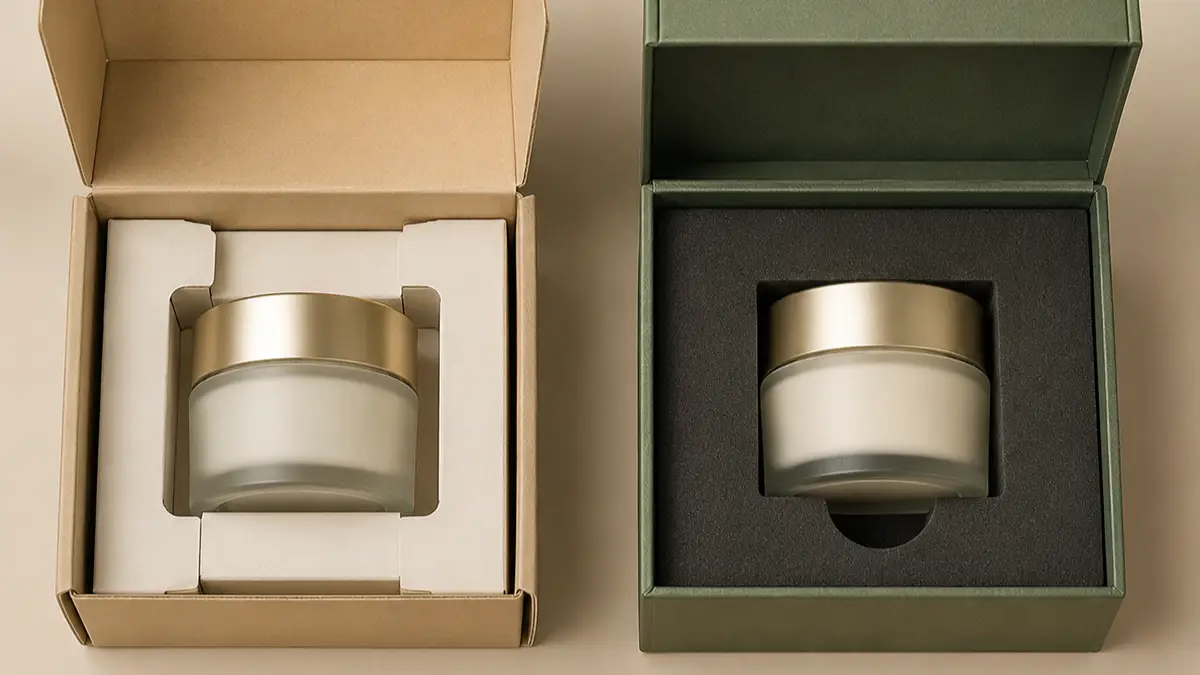
A heavy glass jar or a pump cracks or scuffs when the carton has room to let it travel. The leak and the return follow. A cavity that fills that room stops the rub on the label and keeps the dispenser head off the panel.
On a shelf or in a rigid box, the same cavity holds the label square to the opening. In a kit, it separates the jar, the pump, and the tool so the set does not arrive as a pile.
Paper
A paper insert is board, cut or folded, that holds, organizes, and sometimes carries a line of type. Mills and plants make it from paperboard, kraft, chipboard, or SBS, chosen for stiffness and for print.
It fixes the jar so the surface does not rub. It can carry instructions on the insert itself. Formats run from a die-cut platform matched to the jar, to a folded card, to a thicker divider in a set. For a light retail jar, a card divider is often the whole protection, and it adds little mass to the parcel.
EVA
EVA, ethylene-vinyl acetate, is a closed-cell foam. It compresses and comes back. The cells resist water, oils, and a lot of what leaks in a rough lane. It damps vibration and takes a vertical drop better than an open foam such as polyurethane, which matters with a heavy or sharp jar.
Cavities are die-cut or routed to the jar, so the piece does not walk. In a rigid box the foam is also the presentation layer. Separate slots keep a spatula off the glass. Packing is repeatable because every cavity is the same.
Protection
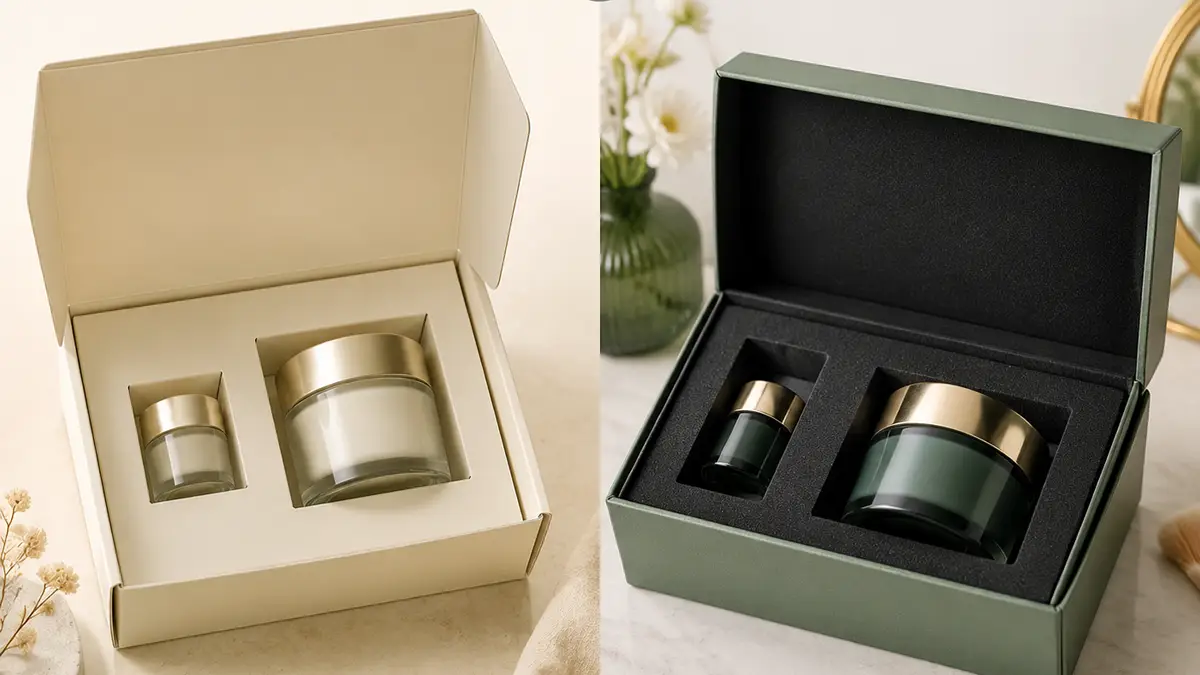
EVA absorbs drop energy. How much depends on density, thickness, jar weight, and the carton around it. It recovers after compression better than a crushed fiber, again depending on those same variables. Molded pulp cushions an edge or a base well, and it gives up earlier than a dense EVA under a sharp point load. Closed-cell EVA keeps its cushion in humidity. Paperboard wants a coating or a treatment if the lane is damp.
Light jars, palettes, and samples are a paper or pulp job. Fragile, heavy, high-value glass is the EVA job. A hidden divider with a moderate load can stay paper and stay recyclable. A complex shape that must not shift wants the die-cut foam cavity.
Recycling and the claim
Paper uses renewable or recycled fiber. EVA is a synthetic. Clean paperboard, with little coating, is what municipal paper systems already take. EVA has a thin recycling path in most markets. A film, a foil, or a stubborn adhesive on the paper insert can knock that insert out of the paper stream too.
The unboxing has to hold the glass and still match what you say about plastic. Molded pulp or an engineered corrugated divider is the construction behind a plastic-reduction claim you can show. A heavy, bulky insert also raises freight mass and cube, which is its own footprint. Check the insert against the waste rules and the retailer rules in the market you ship to.
What it costs to make
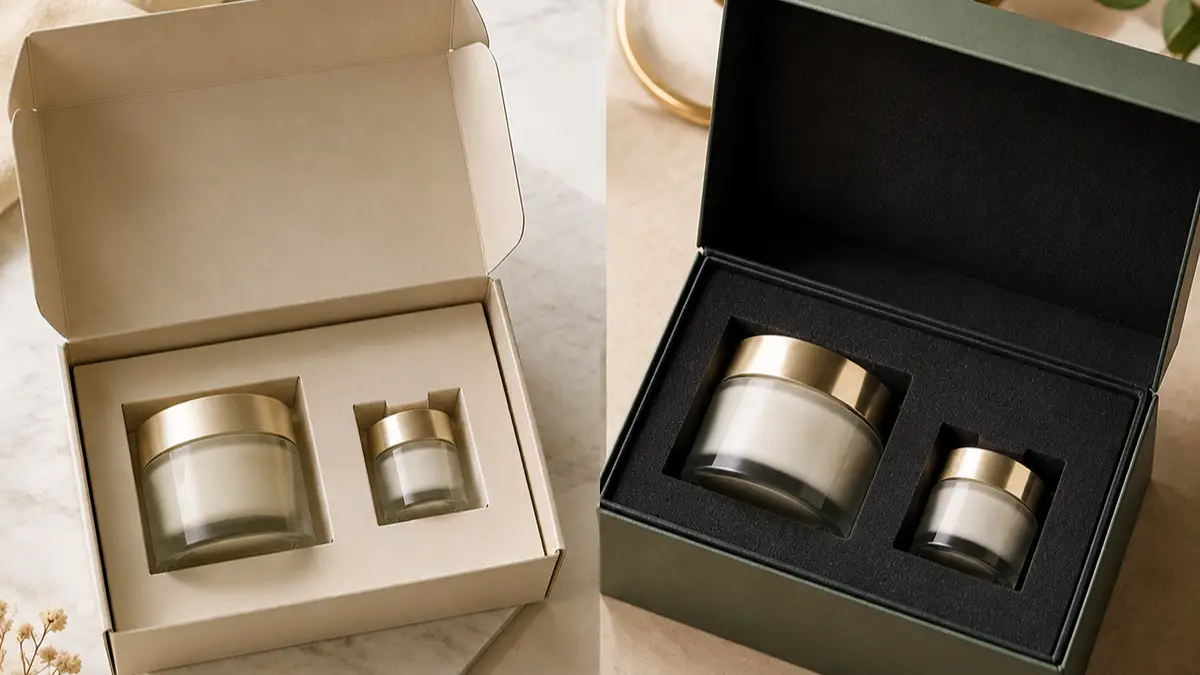
Paperboard is die-cut, scored, folded, and sometimes glued on fast equipment. Setup is small. EVA is also die-cut, and the tool for a simple cavity is modest next to a molded-pulp tool. The piece is higher because the foam is denser and, when you wrap it in velvet or paper, someone does that by hand. On a premium carton, the insert is a real share of the unit. The exact share is on your quote, after material, size, quantity, and finish are known. Nothing on this page is a price.
Use paper when the insert is hidden and the jar is light. Use EVA when the cavity is on view and the jar is glass that has to arrive whole. EPE is the lighter, less expensive foam cousin when you need cushion and you do not need EVA's face.
Which brand it fits
A mass or natural line keeps tooling small, ships the insert flat, and stays in a paper recovery stream. Kraft or molded fiber matches that. Palettes, cards, and sample sets get order without much added weight.
Glass cream jars, serum bottles, and anything with a return history on a parcel lane get EVA's drop performance. The edge of a dense foam reads as a finished gift inside a rigid box. The cavity can follow a shoulder, a lid, or a pump neck. The higher piece belongs on a product whose price already assumes that open.
Guangzhou Tendlyn Trading Co., Ltd., founded in 2009 in Guangzhou, cuts paper inserts and the cartons around them in Foshan and Zhanjiang: folding cartons, rigid boxes, mailers, paper bags, and paper tubes. MOQ is 100. FSC paper is available on request. EVA is specified with the carton when the jar needs it, so the cavity is not an afterthought.
A selection table
| Paperboard | EVA | |
|---|---|---|
| Protection | Light to moderate. Stops basic scuff | High. Takes a drop when density and thickness match the jar |
| Recyclability | Strong, when uncoated and printed with a recoverable ink | Weak in curbside systems |
| How it ships | Flat | As a formed piece. It does not flat-pack |
| Typical board | Often 300–400 g/m² white card or kraft for light jars | Density and thickness set with the jar weight |
Eco-led retail goes to paperboard or molded pulp. Heavy glass, and a direct-to-consumer lane with a breakage history, goes to EVA.
For a presentation foam cavity, a working clearance is about ±0.5 mm per side. Measure the jar you will ship: diameter, height, lid, pump neck, label. Dense EVA for a long, multi-leg route. Paperboard for organization on a short one. Confirm the paper version still flat-packs before you book freight. Drop the prototype and look for scuffs.
Short answers
Which one protects a cream jar? EVA, for glass or a heavy jar. It takes the shock and holds position. Paper is enough for a light plastic jar. It does not have the impact performance for fragile glass in a rough lane.
Does paper recycle? Plain paper and board, yes, in a normal paper stream. A plastic laminate, a heavy varnish, or an adhesive that will not let go of the fiber will stop that. Uncoated board and water-based ink keep the route open.
Does EVA cost more? Yes. Foam, the cut, and any wrap sit above a folded paper insert. How far above is a quote, not a published range. Budget the difference once you know density, thickness, and quantity.
Which looks more dressed? EVA, because the edge is clean and the cavity is exact. Velvet or flock can go over it. A paper insert can still look considered, through the board, the fold, and the print.
Is molded pulp the middle? It protects, it is fiber, and it nests, so the warehouse cube drops. It will not feel like foam. It suits a skincare line that wants both.
Send the jar drawing and the lane to info@axwp.com, +86 158 1238 1273, or WeChat trimgem.
