The bottle is glass, filled with alcohol and oils, and it will ship on its side. The paper pack has two jobs: keep that glass from hitting the wall of the carton, and tell the price tier before the cap comes off. Tendlyn makes the paper pack. Folding cartons, rigid boxes, paper tubes, and the paper insert. The bottle, the pump, and the cap come from the primary supplier. The carton is built around their dimensions.
What the carton is protecting
Light changes a fragrance. An opaque carton, or a board with a coating that blocks UV, is the paper part of that barrier. The bottle glass may already be tinted. Do not assume the carton can be a clear window "so people see the juice" unless you have accepted the light.
Shock is the insert's job. A folding carton alone will crush before it saves a heavy, narrow bottle. Air at the neck and a loose collar are how atomizers leak and how collars chip. Temperature swings are mostly a shipping problem. A thick rigid wall buffers them a little. It does not replace a sane freight plan.
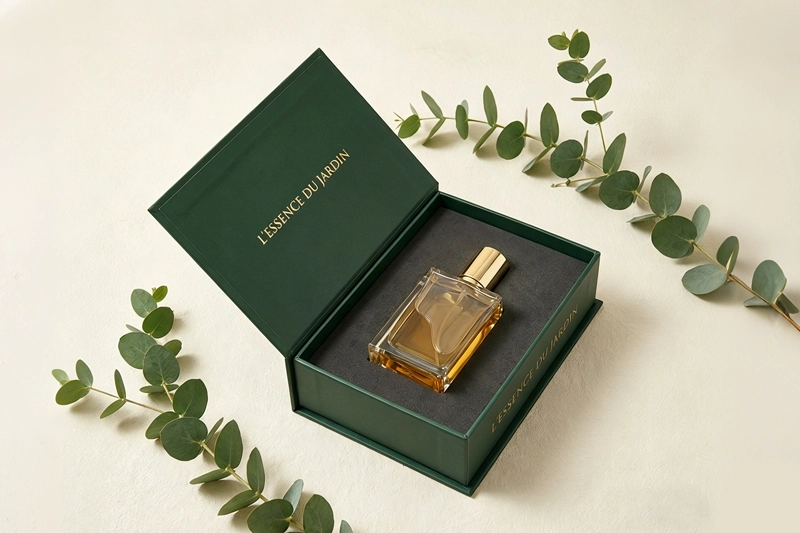
Folding carton or rigid box
Folding carton. Paperboard, commonly about 300–400 gsm for a perfume tuck or crash-lock carton, sometimes a bit lighter on a small vial sleeve and heavier when the bottle is tall. It ships flat and is erected at packing. Print area is large. Crush resistance is modest, so the insert has to carry the bottle. This is the normal build for a wide retail line.
Rigid box. Wrapped greyboard, often about 1.5–2.5 mm, already set up. It does not fold flat. The wall is what people mean when they say the box feels expensive, and it is also what stops a pallet edge from kissing the glass. Use it for a heavy bottle, a gift set, or a line whose price depends on the object in the hand.
Rigid structures that show up on fragrance:
- Magnetic book-style. Magnets in the flap, one close, no tuck tab. The magnet must clear the bottle collar when the lid swings.
- Drawer. Tray and sleeve, ribbon pull. Good when you want the bottle to appear in one motion. The tray floor needs the insert, or the bottle rides the ribbon.
- Shoulder and lid. The base has a neck, the lid fits over it, and the outside seam is a clean line. The shoulder height has to match the lid depth or the box looks stepped.
- Hinged chest. A flip lid on a rigid base. Useful for a set of minis. The hinge board and the stay need a sample you can open fifty times.
Name the style on the dieline. "Luxury box" is not a structure.
Inserts
Measure the bottle: height with cap, shoulder width, base, and any raised medallion that can scratch. A tall bottle with a high center of gravity wants a wider base and a collar that holds the neck, not only a pad under the foot.
- Die-cut paperboard. The usual mid-line fitment: a platform, a collar, or a crash-folded cradle. It recycles with the carton if it is the same fiber family and not glued to a film. Tolerance is tight. Too loose and the bottle ticks. Too tight and the coating on the glass scuffs.
- EVA foam, skived to the contour, sometimes wrapped in paper or cloth. It takes a drop better than board. It is a different material from the carton. If you claim a paper pack, say the insert is foam.
- Molded pulp. A fiber shape for brands that do not want foam. It can look raw on purpose. Seal or tissue the face if the pulp dusts onto a lacquered bottle.
- Fabric-wrapped board. Paper or foam core, velvet or suede on the show face, for a collector set. The cloth is the presentation. The core is still what locates the glass.
On the white sample, seat the real bottle. A working target is about 0.5–1.0 mm of clearance around the glass, adjusted for how much the insert compresses, and for the bottle maker's own variation. Check a few bottles, not one hero sample. Shake the closed carton. Then stand it, lay it, and look at the collar and the base for witness marks.
Print and surface
Offset is the normal route for a carton run with process art and a PMS logo. Digital fits a short edition or a change of scent name without a new plate. Foil, emboss, and spot UV are tools, not a set you have to use all of.
- Matte or soft-touch film sets the hand-feel and protects the ink. Full-film lamination is also a recycling question. Put it on the spec if the retailer will ask.
- Foil stamp for the house mark or a thin rule. One plate, one position.
- Spot UV against matte, on a word or a crest, not on every edge.
- Emboss or deboss on the logo. On rigid wraps, the stamp hits the wrap paper before or after lamination. Ask which, because the order changes the bite.
A matte carton with one foil mark is easier to keep consistent than a carton with foil, spot UV, emboss, and a soft-touch film all fighting for the same 10 mm logo. Gloss and metal read as louder fragrance. Matte and a shallow deboss read as quieter. Match the juice, not a finish menu.
Retail unit versus a set
A single bottle on a shelf wants a compact folding carton or a small rigid box, an insert that holds one glass, and a front panel you can read at arm's length: brand, scent name, size.
A set wants a larger rigid box, a tray that fixes each bottle and miniature, and finishes you can live with on a gift table. Inside print, a ribbon, and a platform are normal. They add make-ready and assembly. They do not fix a bottle that does not fit the cavity.
Sampling, then the run
Write the bottle drawing, the board, the insert material, the artwork, and the quantity before anyone cuts a sample. Send the physical bottle if you can.
- White sample: structure, opening, insert, real bottle.
- Printed sample: color, foil, film, emboss.
- Sign that pair. The plant runs to the signed box.
Sequence on a folding carton is print, surface, die-cut, then glue. A rigid box is cut greyboard, wrap, turn-in, magnet or shoulder fit, then the insert. Pack-out matters. Say how many finished boxes go in a master carton, and whether a glass set needs dividers. Perfume cartons scar in transit when they are packed loose.
Who should build it
You want a plant that runs rigid wrap and folding cartons, and that will talk about greyboard caliper and flute if the shipper is a mailer. Tendlyn's factories are in Foshan and Zhanjiang. The company was founded in 2009 in Guangzhou. It is not a trading desk.
Ask who cuts the insert, and whether foam or pulp is made in-house or bought. Ask for the quote split into unit, die, foil plate, and insert tool. FSC paper is available on request, not as a standing claim. A declaration of conformity follows your spec.
Tendlyn's MOQ is 100. A four-color carton with a paper insert and a wrapped rigid set with a magnet are not the same job at that floor. The price is written after structure, board, print, and quantity are known.

Send the bottle dimensions, the carton style, the insert material, the finishes, and the quantity. info@axwp.com, +86 158 1238 1273, WeChat trimgem.
