A corrugated order fails in a few places you can already name. Wrong flute. Soft glue line. Print that walks. A dieline nobody filled with the real product.
A directory ranking does not catch any of that. A short audit does. Use this as a plant checklist, not as a list of factories.
Confirm you are talking to the converting site

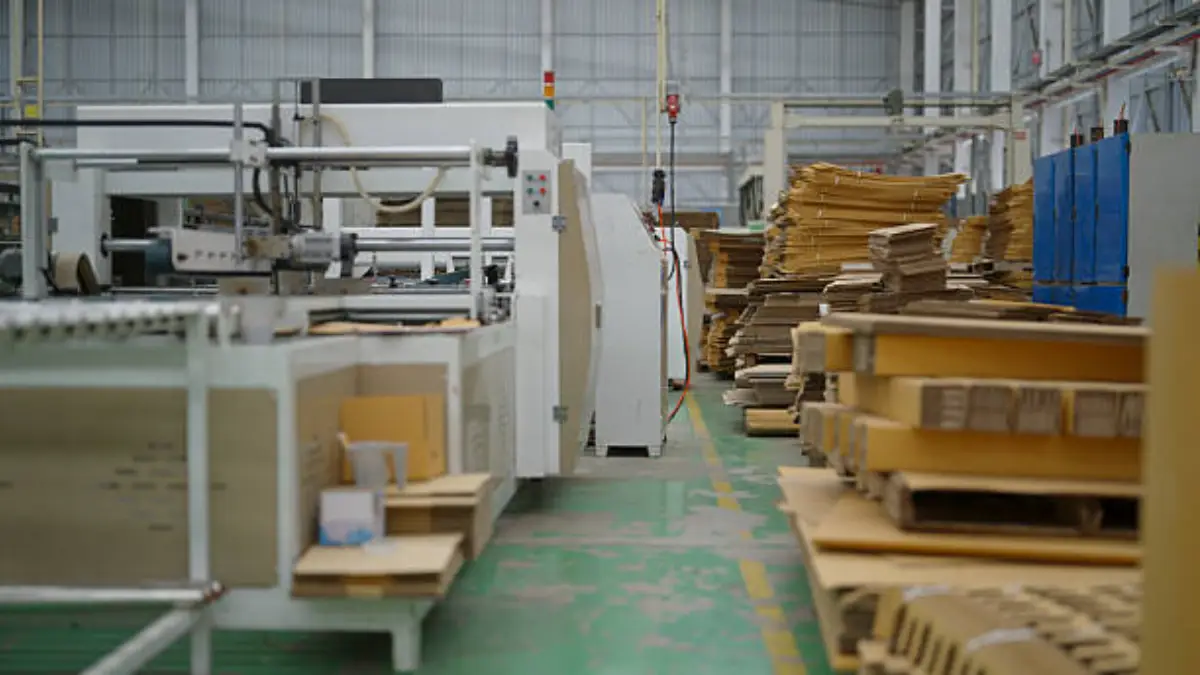
Ask who owns the equipment and which address runs your structure. A trading desk can forward a PDF. It cannot show you the corrugator, the die-cutter, or the folder-gluer.
Shipping RSCs and litho-laminated mailers are different lines. On a visit or a live video, ask for the line that matches the quote. A sample room is not production.
Guangzhou Tendlyn Trading Co., Ltd. (广州庭琳贸易有限公司) was founded in 2009 in Guangzhou and converts in its own factories in Foshan and Zhanjiang. The scope is custom paper packaging: folding cartons, mailer boxes, rigid boxes, paper bags, and paper tubes. MOQ is 100. You want that kind of plain answer from any plant you shortlist: site, process, and a real minimum.
Board before graphics

Corrugated board is liner plus fluted medium. Strength sits in the paper and the flute. Ink does not add stacking strength.
For most branded work the flute set is A, B, C, E, and F. Thickness below is approximate board caliper. It moves with liner weight.
- A flute is about 4.7–5.0 mm, near 33 flutes per foot. It is the thickest common flute and the one you pick for cushion. The face is ribbed, so fine print looks coarse.
- B flute is about 2.5–3.2 mm, near 47 flutes per foot. Quotes differ because some mills state flute height and some state caliper. B resists flat crush and holds a cleaner print than A or C.
- C flute is about 3.5–4.0 mm, near 39 flutes per foot. Cushion and compression sit in the middle. It is the usual shipping flute. On the same liners, C generally stacks better than B because the caliper is taller. B wins on flat crush, not on column strength.
- E flute is about 1.0–1.8 mm, near 90 flutes per foot. Mailers and retail cartons use it when the print face matters.
- F flute is about 0.8–1.2 mm, with more than 120 flutes per foot. Cosmetics and small electronics use it when the pack has to print like a carton and still have a flute.
Single wall is one flute and two liners. Double wall adds a flute and a liner. BC is the common export pair. EB puts the finer E face out for print and B behind it for crush. Triple wall is three flutes and four liners. It is for heavy freight, not for a mailer.
Write the test, not the word “strong.” Edge crush (ECT) tracks stacking better than a hand flex. Burst (Mullen) still shows up on old specs. Box compression (BCT) is the finished box under load. Flat crush (FCT) tells you whether the flute will collapse under a print plate or a stack of sheets. Ask for a recent result on the grade you are buying.
Print, then the die
Flexo puts water-based ink on the board with plates. It fits shipping marks, one or two brand colors, and long runs of RSC or FOL. Registration is looser than offset. Small type and photographs suffer.
Litho-laminating prints the sheet on an offset press, then glues it to the flute. E and B mailers usually go this way. Type is sharper. You also add a glue line, so curl after lamination is a reject.
Ask how color is proved. A drawdown or a printed sheet on the real paper beats a PDF. Name the coating before anyone assumes it. Aqueous, spot UV, and film lamination do not behave the same in rub or in a recycling mill. If the pack has to stay in the paper stream, say that before a film is specified.
Die-cutting follows. Flatbed dies hold tighter scores on thick board and shorter runs. Rotary dies are the fast path on long corrugated runs. Ask who owns the die. The cutting rule, the score, and the glue tab should already be on the dieline you signed. A deep score cracks the liner. A shallow score fights the folder-gluer.
The sample is the approval

Approve in layers.
- Structure first: plain board, correct flute, correct inside dimensions. Fill it with the product, the insert, and the tissue you actually ship.
- Print second: color, type, foil, and spot UV on the paper that will run.
- Transit if the goods are heavy or fragile. ISTA is a test protocol. It is not a logo a plant can add after the fact.
Inside dimensions are what you order. Outside dimensions grow by the board caliper and decide freight. Get both numbers after the flute is fixed. An E-flute mailer and a B-flute mailer with the same inside size do not share an outside size.
A low minimum only helps when the sample and the bulk use the same board and the same die. MOQ at Tendlyn is 100. A white sample cut on a different line is a different box.
Records that match this job
You need documents tied to the order, not a wall of frames.
- Incoming paper: grammage and moisture. ISO 536 and TAPPI T410 are grammage methods. Wet board warps, and the print moves with it.
- In process: glue-line width, score depth, registration.
- Finished goods: dimensions, the ECT or BCT you specified, rub on the ink, count per bundle.
- FSC on request. If you did not order FSC, the logo does not belong on the pack. If you did, the claim belongs on the invoice and the job ticket, with the license code.
- Declarations of conformity follow your spec. Name the market and the substance list. A sentence that says “fully compliant” is not a declaration.
Export and the person on the file
The packing list has to match the cartons on the pallet. Marks have to be readable at the receiver. FOB and EXW put different work on you and on the plant. Write the Incoterm in the order, not in a chat message.

One person should own the dieline. Revisions go in writing, with the date and the dimension that changed. If color questions come back as “no problem” and no delta, you do not have a standard yet.
What has to be known before a price exists
A quote is written after structure, board, print, and quantity are known. Flute, paper grade, color count, coatings, inserts, and hand work all move the number. A flexo RSC and a litho-lam mailer are not the same unit.
Send these with the dieline and keep the replies:
- Which site runs this structure, and can we see that line?
- Flute, liners, and the ECT or BCT you will hold.
- Inside size, outside size, and the caliper you used.
- Print method, color count, and the proof.
- Who owns the die, and what the sample is made from.
- Whether FSC is on this order, and which declaration you will sign against our spec.
- Incoterm and carton pack.
Tendlyn takes that brief at info@axwp.com, +86 158 1238 1273, or WeChat trimgem.
