A cosmetic carton quote is a stack of choices. Board, inks, each finish, how the box is formed, how many you run, and whether it ships flat or set up. Change one and the number moves. There is no rate card that survives first contact with a dieline.
Guangzhou Tendlyn Trading Co., Ltd. has quoted this way since 2009. The company is in Guangzhou. Orders are converted in its own factories in Foshan and Zhanjiang. Minimum order is 100. One hundred pieces is enough to run a short order. It does not spread make-ready the way a long folding-carton run does. FSC board is available on request and is a different sheet price from the stock board. Declarations of conformity follow the brand’s spec.
Board and the sheet you actually buy

Fiber is the first driver. Solid bleached board prints cleaner and costs more than coated recycled board of the same gsm. Higher gsm, and thicker greyboard, use more fiber and weigh more in the freight bill. A folding carton at 250 gsm and one at 400 gsm are different quotes before anyone talks about foil.
The blank has to nest. A tall window, a hang tab, or a lid that does not interlock with its neighbor buys waste around the die. Ask the plant to nest the dieline before the shape is frozen. A small move of a glue flap can put another row on the sheet. That saving is specific to the blank. It is not a flat percentage you can take to finance.
Greyboard for rigid boxes is specified in millimetres, commonly 1.0–3.0 mm. The wrap is a second sheet, often a coated art paper, sometimes a textured mill sheet that prices by the ream and may have a mill minimum of its own.
Each spot color is a plate or a press unit, plus a washup. A full-bleed photograph uses more ink and more drying than a one-color logo. White ink on kraft is its own station.
Offset suits long runs and image-heavy art. The plates and make-ready are the fixed part. Digital skips plates and carries a higher cost per sheet as quantity climbs. The crossover depends on colors, coverage, and sheet size. Ask for both routes on the same spec if the quantity is still in play. Do not publish a crossover as if it were universal.
Pantone on a logo, CMYK on the photograph. That split is usually cheaper and more repeatable than forcing the logo through four colors and then arguing about the batch.
Finishes and scrap
Soft-touch, matte or gloss film, foil, emboss, and spot UV each add a pass. Make-ready on that pass is scrap: sheets used to get pressure, heat, and register. A foil stamp that walks 0.5 mm off a printed keyline is a rejected box. The quote includes a yield assumption whether or not the line item says “spoilage.”
Tooling sits beside the pass. A cutting die, a brass foil die, an embossing die. Repeat orders reuse them if the art and the structure do not move. A “small” logo nudge is a new die.
Dark soft-touch fails in handling more often than anti-scratch matte. Those rejects are part of the rigid-box price. Spec the film you can pack, not the film that looks best as a swatch on a desk.
Structure and labor
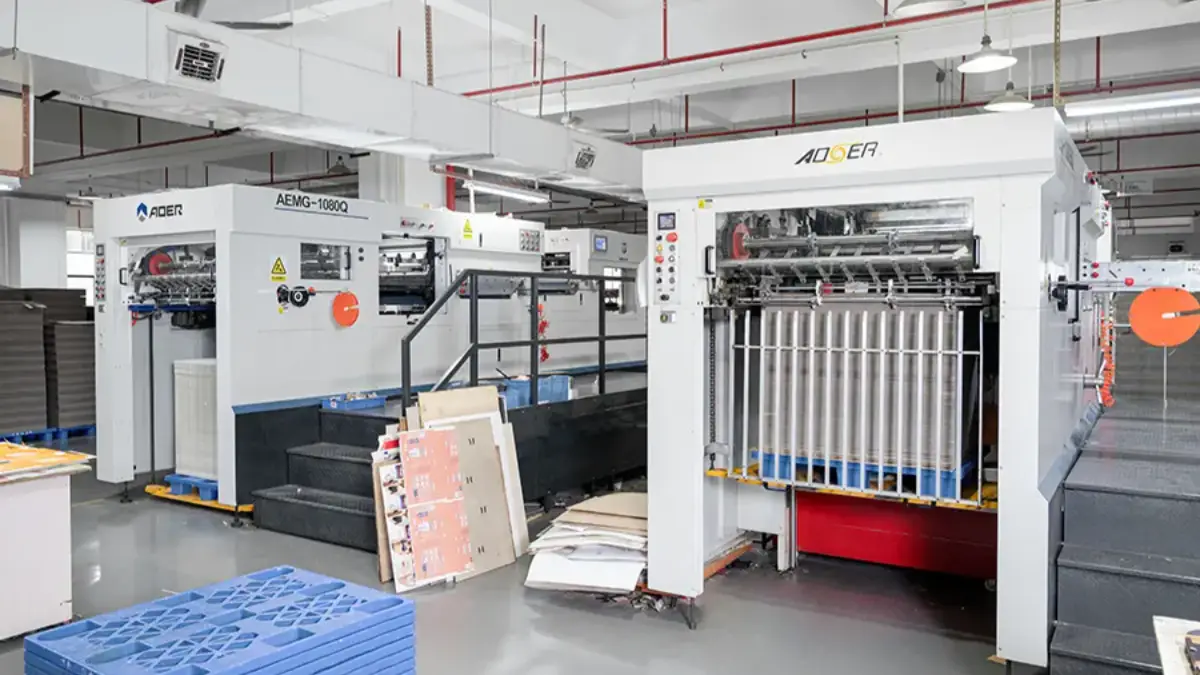
A standard folding carton is printed, die-cut, and folder-glued. On a long run that is a fast line. A rigid box is V-grooved, glued, wrapped, and turned in. Magnets, ribbons, and layered inserts are slower stations. The same artwork on those two structures is two prices.
Short folding runs still pay the die and the press make-ready, and they may not fill an automatic gluer the way a long run does. Short rigid runs stay hands-on. That is why a 100-piece magnetic box and a 100-piece tuck carton do not scale the same way. Quantity brings the unit down by spreading setup. The shape of that curve depends on the job.
Foshan sits in the Pearl River Delta supply cluster: paper, foil, and cutting dies are close. Zhanjiang is the other plant. Proximity shortens the errand for a die or a foil re-order. It does not zero out material cost when pulp moves.
Freight is part of the pack
Folding cartons ship flat. A pallet holds a lot of blanks, and the landed cost per unit stays closer to the ex-works number.
Rigid boxes ship set up unless you ordered a collapsible rigid and sampled the lock. You pay cube. Warehousing pays cube again. Compare the two formats only after freight and your packing labor are in the sheet. A collapsible rigid saves space and adds a lock you must prove on a sample.
Duty is calculated by the importer from the HS code, the origin, and the destination’s schedule. Those schedules move. A broker can price your code. An article cannot fix a single China-wide rate. Consolidating POs so one shipment carries several SKUs spreads the freight and the clearance. It does not change the duty rate.
Air freight for a missed holiday date is a different product from a planned ocean booking. The packaging quote will not absorb it unless you ask, and then the quote is for the emergency, not for the carton.
Testing and paperwork
REACH-minded ink and glue, TPCH metals, and the EU packaging metals ceiling (94/62/EC, 100 ppm sum of lead, cadmium, mercury, and hexavalent chromium) are spec items. Compliant chemistry can cost more than an unnamed ink. A third-party report is often billed per submission, not per box. Failing a heavy-metal screen at the border puts the shipment at risk, which is the expensive version of a cheap board.
FSC adds chain-of-custody board and the mark only when you request it. Burst, edge-crush, or Cobb tests, if your retailer asks for them, are extra reports and sometimes a heavier sheet. Name the test. “Stronger board” is not a method.
PPWR design-for-recycling work — dropping a film, changing an insert from EVA to pulp — can raise one line and lower another. Price the stack you will actually claim.
What buyers add, and what they can take off

The adds are familiar: magnetic closure, a custom cavity, deep emboss, foil, soft-touch, a textured sheet. Each is a station. They are justified when the set is the gift and the lid is the product.
The reductions are equally concrete.
- Fewer inks. A spot logo instead of a fifth color.
- Aqueous instead of film, when the claim and the channel allow it.
- One board across SKUs, so a short lip carton and a short cream carton can share a sheet order.
- A standard reverse-tuck or straight-tuck instead of a shape that nests badly.
- A folding refill next to one rigid launch box, so you are not shipping air on every repeat purchase.
- Art locked before tooling. Rework on a die is a second setup.
What to ask for on the quote
List it so two suppliers can be compared.
- Board grade, gsm or caliper, FSC or not
- Print method, colors, coverage, one side or two
- Each finish, named
- Tooling: new or existing
- Structure and ship condition, flat or set up
- Insert material
- Test reports, if any
- Quantity breaks you actually might run
- Incoterms, so freight is either in or out on purpose
Then the quote means something. Send the dieline and the spec to info@axwp.com, or call +86 158 1238 1273, WeChat trimgem.
