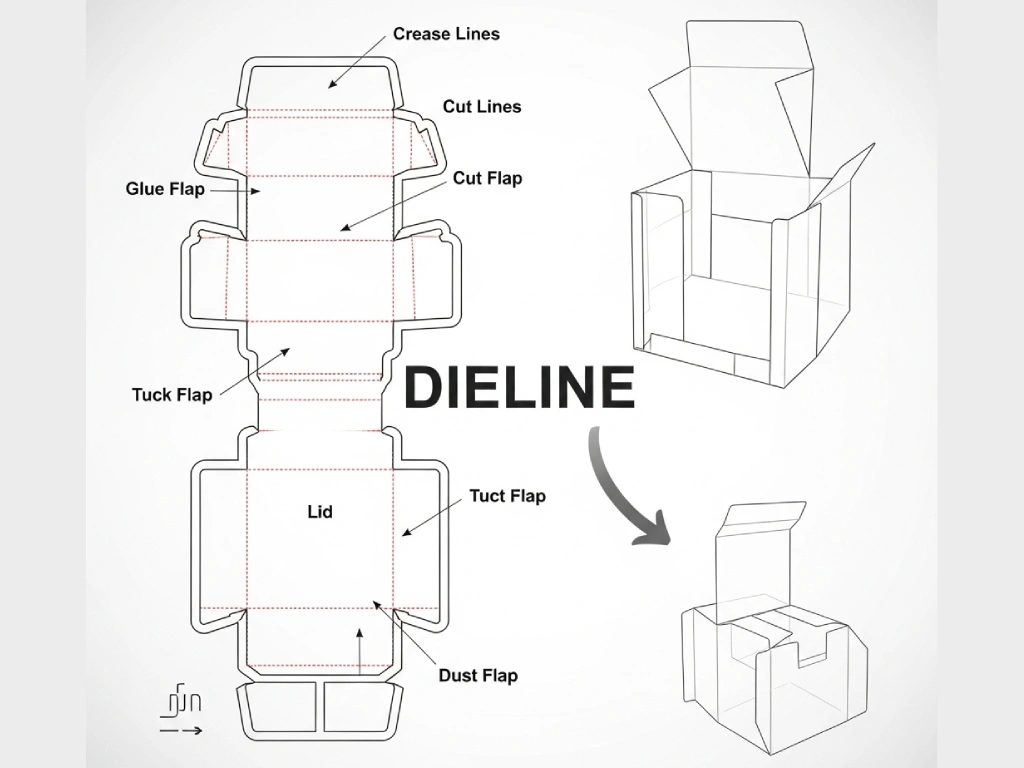
A dieline is the flat drawing of the box before it is folded. It tells the die where to cut and where to crease, and it tells the designer which part of that flat sheet will be a visible panel. Art placed without it is a picture of a box, not a file a plant can run.
What is on the sheet
A folding-carton dieline shows the blank in one plane.
- Cut lines. Where the knife goes. The edge of every flap, the window, the nick that keeps the blank in the sheet until it is stripped.
- Crease lines. Where the board will fold. A crease is not a cut. If the rule is too deep, the board cracks. If it is too light, the carton will not erect square.
- Bleed. Art that runs past the cut, usually 3 mm, so a small move of the sheet does not leave a white line at the knife.
- A quiet area inside the cut for type and logos. How far inside depends on the panel and on how close the crease is. Type on the crease breaks.
- Glue areas. The flap and the panel it lands on, kept free of heavy ink, film, and spot UV. Glue on a coating peels clean. Glue into fiber tears.
A rigid box is not this blank. The greyboard has its own cut sizes for the lid and the base. The wrap has a separate layout, with turn-in drawn on every edge. Treat that wrap layout as the dieline for print. A folding-carton template will not describe it.
Line colors are a legend you agree with the plant. One common file uses a solid line for cut and a dashed or second color for crease. Another plant's CAD system uses its own layers. A red crease in your file that the plant reads as a cut will be knifed. Send the legend with the file, and ask them to confirm it before the die is ordered.
The file is vector. Illustrator, a PDF that still has the vectors, or a CAD format from a structural program such as ArtiosCAD. A JPG or PNG of a dieline cannot drive a knife.
Why the file is the record
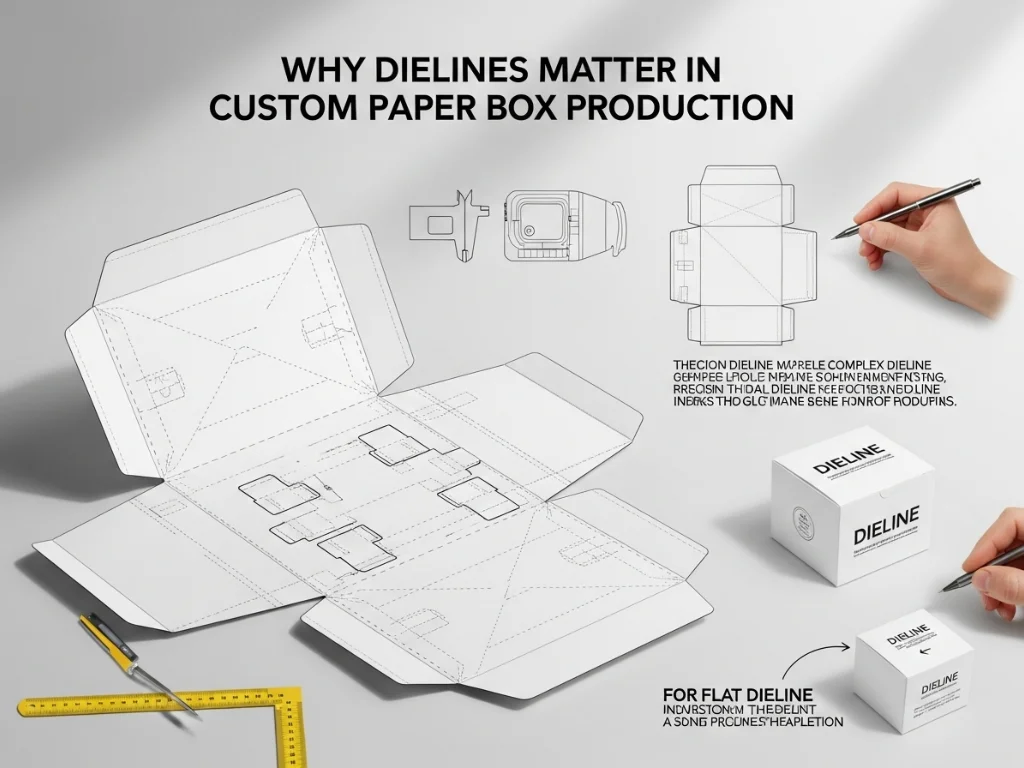
The dieline is what design, print, and the die shop share. A change to a tuck length has to land in the same file the artist is painting. A second PDF "for reference" is how the printed sheet and the die stop matching.
Fixing a 2 mm error here is a file edit. Fixing it after the die is cut is a new die, and often a reprint. Measure the product, including the cap and any part that sticks out, before the blank is drawn. Board caliper changes the blank. A crease planned for 0.45 mm board will not behave the same on 0.7 mm board. Write the caliper on the dieline.
The same file is the reorder. Name it, date it, and keep the die identification on it. A repeat that starts from someone's inbox copy of an old PDF is how a glue flap moves.
How the drawing is built
- Name the closure. Straight tuck, reverse tuck, crash-lock, a mailer, a sleeve, a two-piece wrap. The choice changes the blank more than the artwork does.
- Measure the product in millimetres. Add clearance for an insert wall if there is one. Write whether the dimensions are inside the finished box.
- Draw it in vector, with grain direction marked. The main crease should follow the grain the plant will run. Against the grain, the coating cracks.
- Mark cut, crease, bleed, perforation, and glue. A window and a zipper are cuts with a job to do. A perforation that is too strong will not tear. One that is too weak fails in the gluer.
- Place art only after the panels are labeled: front, back, top, glue flap, turn-in. Export a PDF the plant can check, and keep the native file.
A plain white sample folded from that file, in the real board, is the check before plates. A 3D view on a screen does not show a tight tuck or a crash-lock that crushes the corner.
Errors that survive until the knife
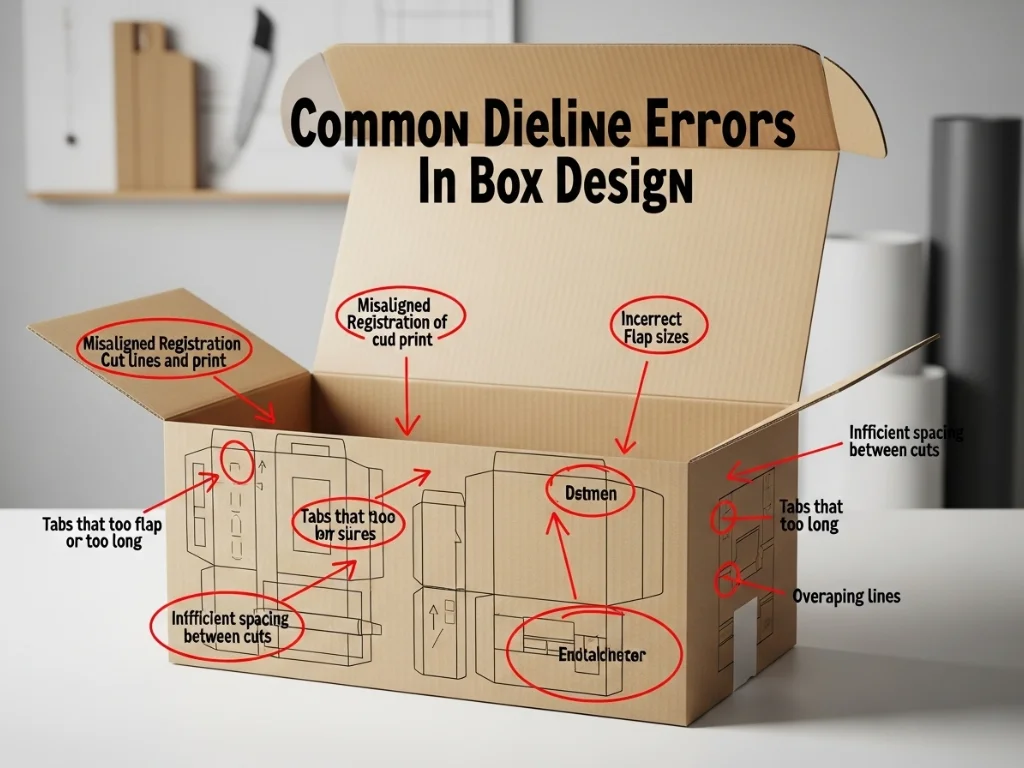
- No bleed. The knife moves half a millimetre and the panel has a white edge.
- Type or a barcode across a crease, or inside the glue flap. The barcode's quiet zone disappears into a fold.
- A raster dieline, or art in RGB. The plant needs vectors and a print color space, usually CMYK, with spot colors named for foil and for a Pantone.
- Glue flap covered in film or UV. The joint peels.
- A window with no patch allowance, or art under the patch that was meant to be hidden.
- Missing grain. The plant guesses, and the guess is wrong on a coated board.
- Inside size and outside size swapped. The product does not fit, or it rattles. Label the dimension "inside."
- On a wrap, no turn-in. The logo lands on the lip.
Guangzhou Tendlyn Trading Co., Ltd. will check a dieline against the board and the closure before a die is cut. The plants are in Foshan and Zhanjiang, and the company has converted paper packaging there since 2009.
Template or a blank drawn for the product
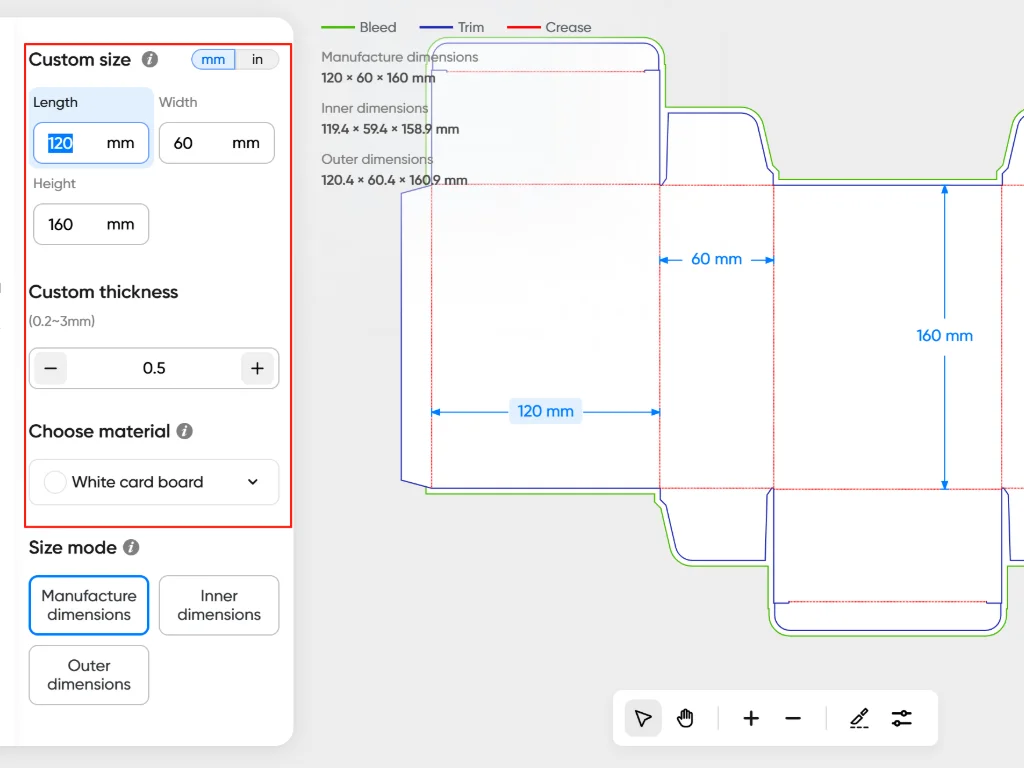
A template is a blank the plant, or a structural library, already has for a standard tuck, a mailer, or a pillow. Use it when the product fits that size and you can accept the void. It is the faster file, and the die may already exist.
Draw a new blank when the product has a neck, a shoulder, or a tray a standard tuck would hit; when the closure has to run on your cartoner; or when you need a window, a fifth panel, a crash-lock, or a wrap with a turn-in. A template stretched in a layout program, with the crease lines moved by hand, is not a new structural drawing. It is a broken one. Ask the plant to redraw it.
| Template | Drawn for the product | |
|---|---|---|
| Speed | The blank already exists | The structure has to be drawn and sampled |
| Fit | You accept that size | Inside size follows the product and the insert |
| Art | You place it in their panels | Panels are planned around the art and the folds |
| Extras | Only what that blank includes | Window, lock, magnet, zipper, as drawn |
| Risk | A loose pack | A file that was never folded in the real board |
Fold a paper plot of either file before you approve art. If the plot will not erect, the printed sheet will not erect.
Working the file with the plant
Send measurements in millimetres, the board and caliper, the closure, and a note of what must not be crushed (a cap, a bow, a spray). If you have a competitor carton or an old pack that is close, flatten it and send that too, as a reference, not as a die.
Label the layers in words: cut, crease, bleed, glue. Ask for a plotted sample or a cut-and-creased white blank in the board you will buy. Put the brand's color calls on the art file only after that blank fits the product.
MOQ is 100. The die and the plates are the same tools whether the first run is short or long. A reorder uses those tools again. The quote is written after the structure, the board, the print, and the quantity are known. Folding cartons, mailer boxes, rigid boxes, paper bags, and paper tubes are the range.
info@axwp.com, +86 158 1238 1273, WeChat trimgem.
